Ribeira Grande, Açores, Portugal — Southwestern Europe (Iberian Peninsula)
Igreja da Misericórdia
⎯⎯⎯
Church of Misericórdia
Photographed by Shaw Zavoshy, October 13, 2025
1. Igreja da Misericórdia / Church of Misericórdia Marker

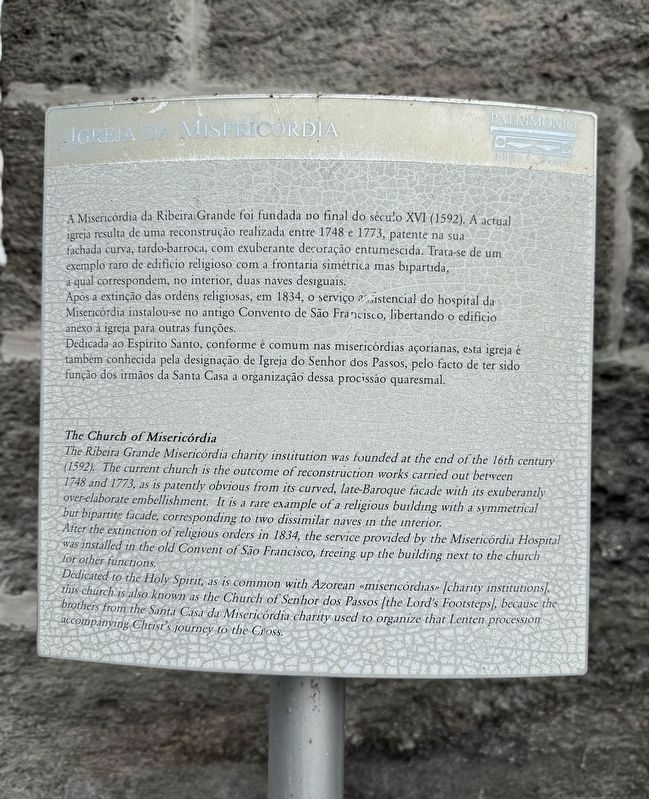
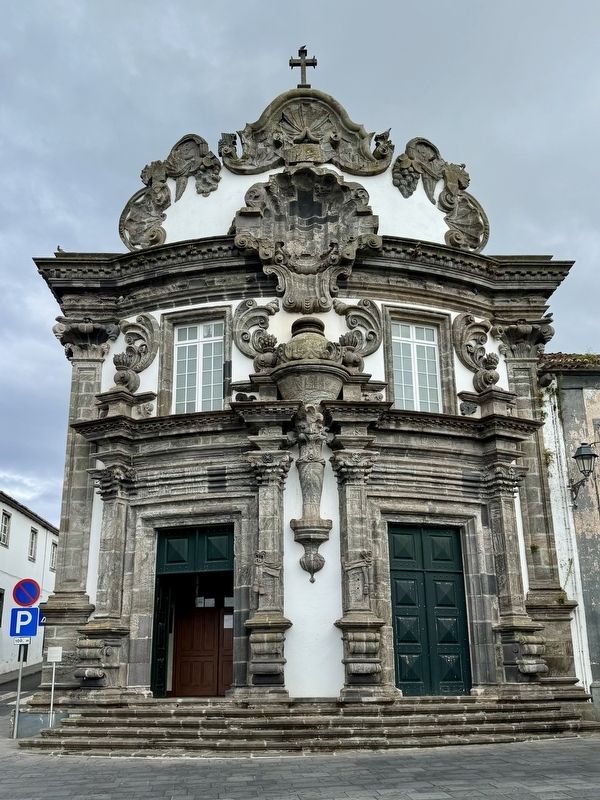
A Misericórdia da Ribeira Grande foi fundada no final do século XVI (1592). A actual, igreja resulta de uma reconstrução realizada entre 1748 e 1773, patente na sua curva, tardo-barroca, com exuberante decoração entumescida. Trata-se de um exemplo raro de edificio religioso com a frontaria simétrica mas bipartida, à qual correspondem, no interior, duas naves desiguais.
Após a extinção das ordens religiosas, em 1834, o serviço Pistencial do hospital da Misericórdia instalou-se no antigo Convento de São Francisco, libertando o edificio anexo à igreja para outras funções.
Dedicada ao Espirito Santo, conforme é comum nas misericórdias açorianas, esta igreja é também conhecida pela designação de Igreja do Senhor dos Passos, pelo facto de ter sido função dos irmãos da Santa Casa a organização dessa procissão quaresmal.
The Ribeira Grande Misericórdia charity institution was founded at the end of the 16th century (1592). The current church is the outcome of reconstruction works carried out between 1748 and 1773, as is patently obvious from its curved, late-Baroque
this page online
After the extinction of religious orders in 1834, the service provided by the Misericórdia Hospital was installed in the old Convent of São Francisco, freeing up the building next to the church for other functions.
Dedicated to the Holy Spirit, as is common with Azorean «misericórdias» [charity institutions], this church is also known as the Church of Senhor dos Passos (the Lord's Footsteps), because the brothers from the Santa Casa da Misericórdia charity used to organize that Lenten procession accompanying Christ's journey to the Cross.
Topics. This historical marker is listed in these topic lists: Architecture • Charity & Public Work • Religion & Religious Structures. A significant historical year for this entry is 1748.
Location. 37° 49.343′ N, 25° 31.167′ W. Marker is in Ribeira Grande, Açores. It is at the intersection of Rua do Passal and Rúa do Espirito Santo, on the right when traveling east on Rua do Passal. Touch for map.
Photographed by Shaw Zavoshy, October 13, 2025
2. Igreja da Misericórdia / Church of Misericórdia and Marker (left corner of the church)

Regionally, it is in the North Atlantic Region, in Europe, in the European Union, in Atlantic Europe, on the Iberian Peninsula, in the Schengen Area, and in the Western World. Historically, it finds itself in what was once Portuguese colonies and also the Roman Empire.
Also see . . . Igreja do Espírito Santo (Ribeira Grande) (Wikipedia, in Portuguese). Excerpt (in translation):
According to a deed of donation signed by Nuno Vaz and his wife Maria Gonçalves, it is believed that the Casa do Espírito Santo (House of the Holy Spirit) was built in 1522, next to which the Hospital da Santa Casa da Misericórdia da Ribeira Grande would later be established. The founders stated at the time that they were donating "for all time, a tiled house that they own, so that it may always be profitable and be theirs for the construction of the Chapel of the Holy Spirit, now built on this island."(Submitted on October 15, 2025.)
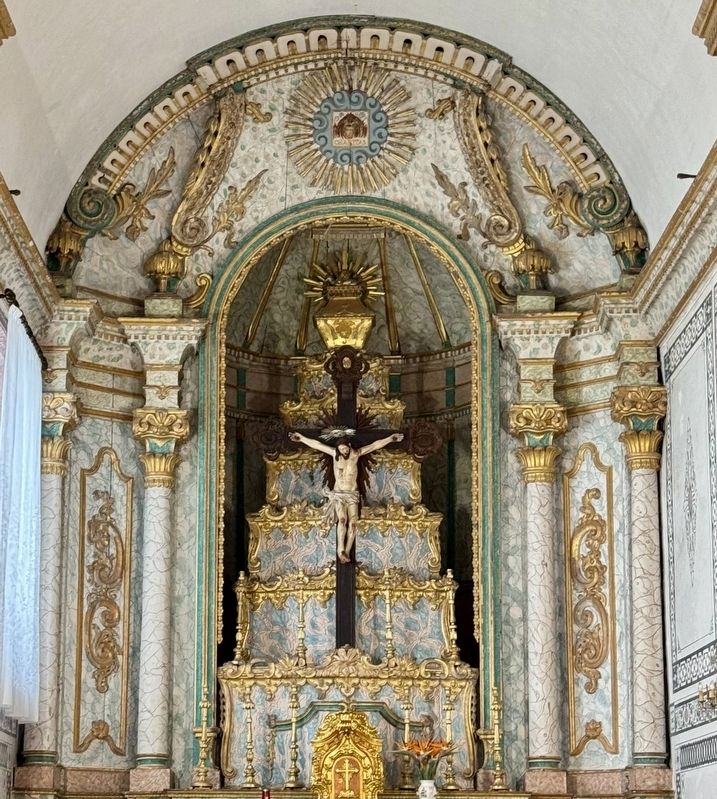
In 1591, Gaspar Frutuoso recorded that the Casa do Espírito Santo was located next to the square, at the top of alarge churchyard that sloped almost to sea level.Photographed by Shaw Zavoshy, October 13, 20253. Igreja da Misericórdia / Church of Misericórdia - altarpiece
The Misericórdia Church was founded in 1592, based in this chapel near the square, at the initiative of the City Council and the people, an institution that would be confirmed by the Bishop of Angra and by Royal Decree in February 1593. The Hospital da Santa Casa occupied the adjacent building, where the Finance Department currently stands, until 1834, when the Convent of São Francisco in that town became vacant with the abolition of male religious orders in the country.
In the mid-17th century, the original temple underwent reconstruction, resulting in the current Misericórdia Church (or Church of the Steps, as it is also known), which still stands today as a beautiful example of regional architecture from that period, particularly its façade, highly valued for the stonework executed by local stonemasons…
Photographed by Shaw Zavoshy, October 13, 2025
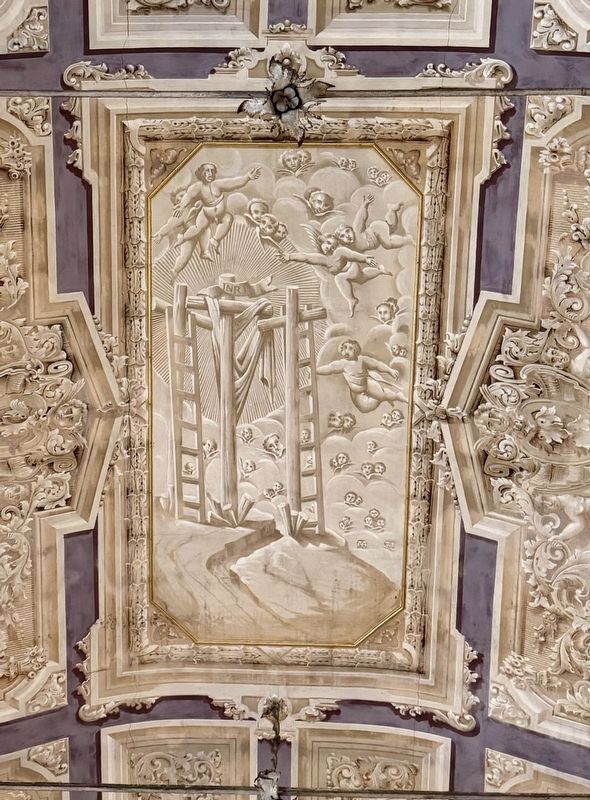
4. Igreja da Misericórdia / Church of Misericórdia - decorative ceiling panel
Credits. This page was last revised on October 15, 2025. It was originally submitted on October 15, 2025, by Andrew Ruppenstein of Lamorinda, California. This page has been viewed 73 times since then and 39 times this year. Photos: 1, 2, 3, 4. submitted on October 15, 2025, by Andrew Ruppenstein of Lamorinda, California.
