Itasca in DuPage County, Illinois — The American Midwest (Great Lakes)
The Itasca Depot
Photographed by Sean P. Flynn, October 16, 2025
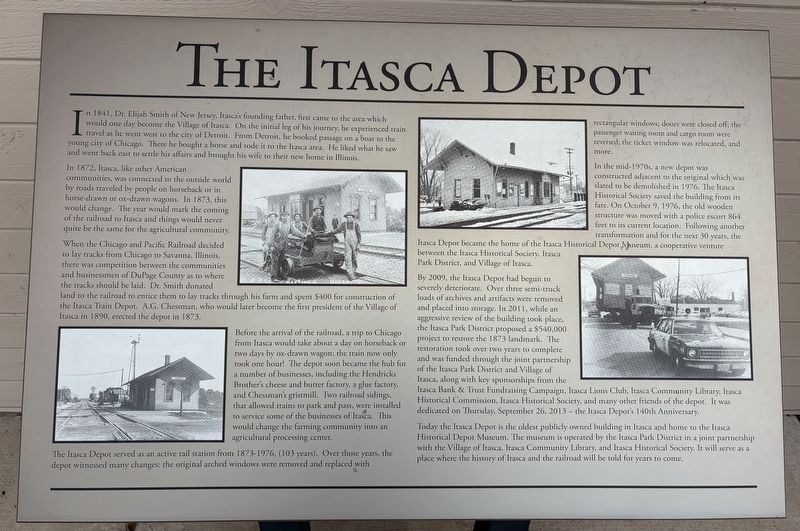
1. The Itasca Depot Marker
In 1872, Itasca, like other American communities, was connected to the outside world by roads traveled by people on horseback or in horse-drawn or ox-drawn wagons. In 1873, this would change. The year would mark the coming of the railroad to Itasca and things would never quite be the same for the agricultural community.
When the Chicago and Pacific Railroad decided to lay tracks from Chicago to Savanna, Illinois, there was competition between the communities and businessmen of DuPage County as to where the tracks should be laid. Dr. Smith donated land to the railroad to entice them to lay tracks through his farm and spent $400 for construction
this page online
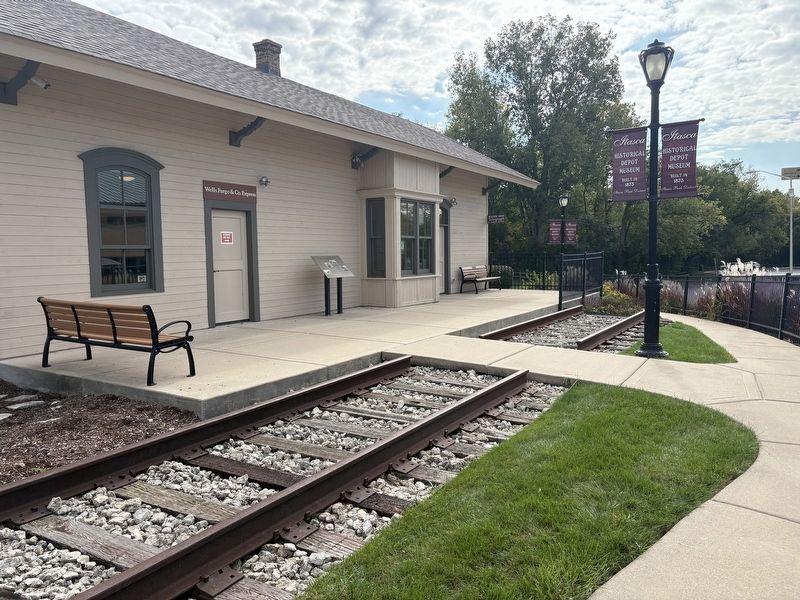
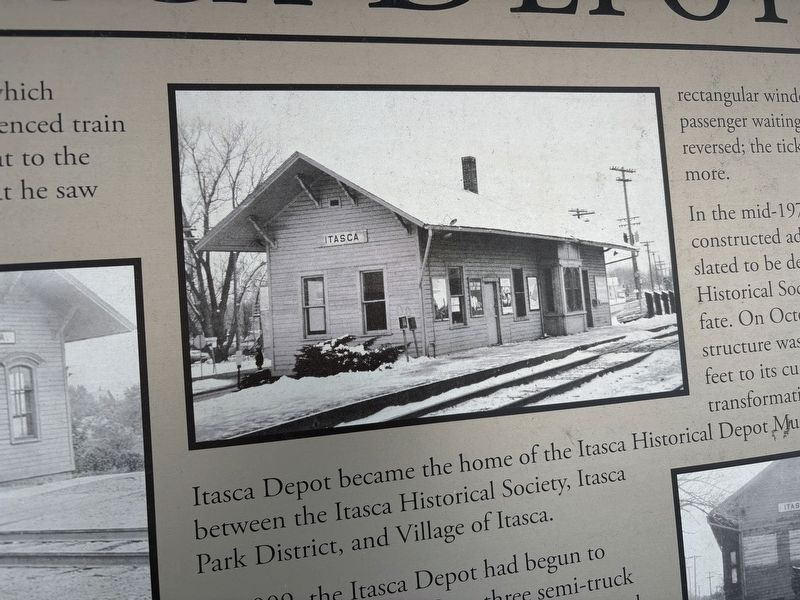
Before the arrival of the railroad, a trip to Chicago from Itasca would take about a day on horseback or two days by ox-drawn wagon: the train now only took one hour! The depot soon became the hub for a number of businesses, including the Hendricks Brother's cheese and butter factory, a glue factory, and Chessman's gristmill. Two railroad sidings. that allowed trains to park and pass, were installed to service some of the businesses of Itasca. This would change the farming community into an agricultural processing center. The Itasca Depot served as an active rail station from 1873-1976, (103 years). Over those years, the depot witnessed many changes: the original arched windows were removed and replaced with rectangular windows; doors were closed off; the passenger waiting room and cargo room were reversed; the ticket window was relocated, and more.
In the mid-1970s, a new depot was constructed adjacent to the original which was slated to be demolished in 1976. The Itasca Historical
Photographed by Sean P. Flynn, October 16, 2025
2. The Itasca Depot Marker
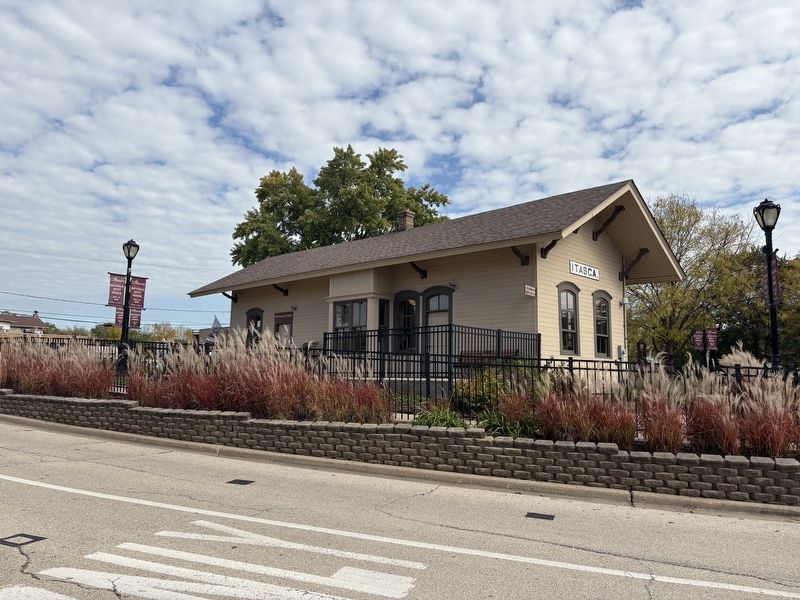
By 2009, the Itasca Depot had begun to severely deteriorate. Over three semi-truck loads of archives and artifacts were removed and placed into storage. In 2011, while an aggressive review of the building took place, the Itasca Park District proposed a $540,000 project to restore the 1873 landmark. The restoration took over two years to complete and was funded through the joint partnership of the Itasca Park District and Village of Itasca, along with key sponsorships from the Itasca Bank & Trust Fundraising Campaign, Itasca Lions Club, Itasca Community Library, Itasca Historical Commission, Itasca Historical Society, and many other friends of the depot. It was dedicated on Thursday, September 26, 2013 - the Itasca Depot's 140th Anniversary.
Today
Photographed by Sean P. Flynn, October 16, 2025
3. The Itasca Depot
Erected 2013.
Topics and series. This historical marker is listed in these topic lists: Architecture • Industry & Commerce • Railroads & Streetcars • Settlements & Settlers. In addition, it is included in the Chicago, Milwaukee, St. Paul and Pacific Railroad series list. A significant historical year for this entry is 1873.
Location. 41° 58.268′ N, 88° 1.174′ W. Marker is in Itasca, Illinois, in DuPage County. It is on Catalpa Avenue close to Irving Park Road (Illinois Route 19), on the right when traveling north. The marker is in front of the west side of the Itasca Historical Depot. Touch for map. Marker is at or near this postal address: 101 North Catalpa Avenue, Itasca IL 60143, United States of America. Touch for directions.

Regionally, this
Photographed by Sean P. Flynn, October 16, 2025
4. Historic photo of the Itasca Depot on the marker
Other nearby markers. At least 8 other markers are within 3 miles of this marker, measured as the crow flies: Itasca Historical Depot (a few steps from this marker); Milwaukee Road Locomotive Bell (a few steps from this marker); 01839 Milwaukee Road (within shouting distance of this marker); City of Wood Dale Veterans Memorial (approx. 1.8 miles away); Old Mill (approx. 2 miles away); Outbuildings (approx. 2.2 miles away); Four Square Garden (approx. 2.2 miles away); E.H. Dieke Barn (approx. 2.2 miles away). Touch for a list and map of all markers in Itasca.
Regarding The Itasca Depot. The Chicago and Pacific Railroad was constructed from Chicago to Elgin, and then went insolvent
in 1880. It then became part of the Chicago, Milwaukee, St. Paul and Pacific Railroad, best known as the Milwaukee Road. (It is different than the Chicago, Rock Island and Pacific, known popularly as the Rock Island, which started in Chicago but went southwest.)
Also see . . . Itasca - Yesterday & Today. From the Village of Itasca's official site
Excerpt: "In 1873, Smith plotted 80 acres of his land into lots. The Chicago and Pacific Railroad was completed from Chicago to Elgin, with stations at Bensenville, Wood Dale (called Lester), and Itasca. Smith gave the right-of-way to encourage location of the tracks through the settlement. He donated $400 to help build a station."(Submitted on October 17, 2025, by Sean P. Flynn of Oak Park, Illinois.)
Credits. This page was last revised on October 17, 2025. It was originally submitted on October 16, 2025, by Sean P. Flynn of Oak Park, Illinois. This page has been viewed 81 times since then and 34 times this year. Photos: 1. submitted on October 16, 2025, by Sean P. Flynn of Oak Park, Illinois. 2, 3, 4. submitted on October 17, 2025, by Sean P. Flynn of Oak Park, Illinois.
