St. Martinville in St. Martin Parish, Louisiana — The American South (West South Central)
Welcome to St. Martinville
Photographed by Cajun Scrambler, September 12, 2025
1. Welcome to St. Martinville Marker
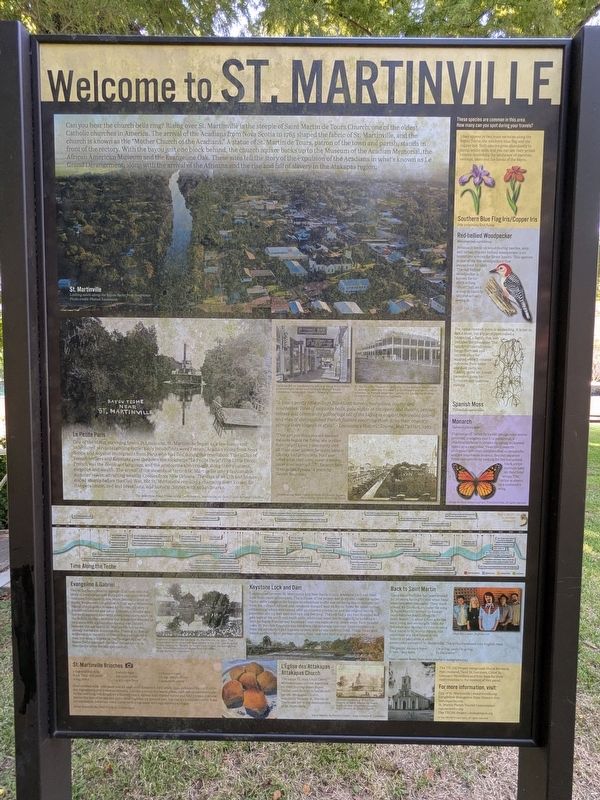
Can you hear the church bells ring? Rising over St. Martinville is the steeple of Saint Martin de Tours Church, one of the oldest Catholic churches in America. The arrival of the Acadians from Nova Scotia in 1765 shaped the fabric of St. Martinville, and the church is known as the "Mother Church of the Acadians." A statue of St. Martin de Tours, patron of the town and parish, stands in front of the rectory. With the bayou just one block behind, the church square backs up to the Museum of the Acadian Memorial, the African American Museum and the Evangeline Oak. These sites tell the story of the expulsion of the Acadians in what's known as Le Grand Dérangement, along with the arrival of the Africans and the rise and fall of slavery in the Atakapas region.
Le Petite Paris
One of the oldest surviving towns in Louisiana, St. Martinville began as a few slaves and indentured servants tending cattle. Early inhabitants were French, Acadian exiles from Nova Scotia and Royalist immigrants from Paris who had fled during the revolution. This influx of French settlers and Royalists gave the town the nickname "Le Petite Paris"
this page online
"It was a pretty little village filled with barons, marquises, counts and countesses. Tales of exquisite balls, gala nights at the opera and theatre, private soirees and community gatherings tell of the ladies in elegant bejewelled gowns and men of distinguished French fashion escorting them. Even their country picnics were elegant in style." - Louisiana's Historic Towns, Jess DeHart, 1983
"That girl you think you see beneath the oaks beside the Teche, she is other than the girl I was. I was surely with all those other women forced to leave a life they had grown into, but I was never what they were, never a mother, never even married.... -Excerpt from "Evangeline Speaks,"
Photographed by Cajun Scrambler, September 12, 2025
2. Welcome to St. Martinville Marker
Evangeline & Gabriel
One of the best romantic legends of all time tells the story of lovers separated during the expulsion of the Acadians from Nova Scotia. Made famous in print by Henry Wadsworth Longfellow in 1847, some believe the legend of Evangeline is based on the real-life story of Emmeline Labiche and Louis Arceneaux. Stories vary, but most versions start with young lovers torn apart by the British on their wedding day. Evangeline traveled to Louisiana with a group of exiles and met Gabriel beneath the oak tree in St. Martinville, but he was already married to someone else. There is no factual evidence that the story of Evangeline and Gabriel is true, but what is known as the "Evangeline Oak" on Bayou Teche has been the most visited spot in St. Martinville since the late 19th century.
St. Martinville Brioches
1 cup scalded milk
63/4 Tbsp. dry yeast
4 egg yolks
3 whole eggs
2/3 cups butter
4 2/3 cups flour
1 1/2 cups sugar
1/2 tsp. lemon flavor
Cardamom seeds
Cool scalded milk. Add yeast and let soak until dissolved. Add whole eggs, yolks and butter. Fold in dry ingredients and
Photographed by Cajun Scrambler, September 12, 2025
3. Welcome to St. Martinville Marker
Keystone Lock and Dam
Constructed between St. Martinville and New Iberia in 1910, Keystone Lock and Dam took three years to complete. The purpose of the project was to try and make the upper Teche more navigable for barges, as steamboat traffic was declining due to competition from the railroad. Several area residents donated land on Bayou Teche for construction of Keystone, which was named after an adjacent plantation, and the original facility consisted of a 175-foot dam and lock 229 feet long. The lock had a 160-foot chamber and gate bays at the north and south ends. Additional water was brought in by building a dam on Bayou Fuselier and Keystone Canal was expanded to divert water from Spanish Lake. By the time Keystone was complete, the waterway had even more competition from the automobile and highway system, and so was underutilized. Today, it's an area where paddlers must portage or carry their boat over land to go around the dam.
L'Église des Attakapas - Attakapas Church
The name Fr. Jean Louis Civrey, who accompanied the Acadians on their journey down Bayou Teche, used to refer to his church parish. Attakapas Church eventually became St. Martin de Tours and led to the development of St. Martinville.
Back to Saint Martin
Cajun band Feufollet has been around for 30 years, having formed when band members were teenagers. Their third album, En Couleurs, includes the song A Saint-Martin written by former band member Josh Caffery. "A Saint-Martin" is about a man who has been living and working in Texas for five years and decides it's time to come back home to St. Martin Parish. His mom lives in a little house in the country in Isle Labbé, a small Feufollet www.feufollet.net community outside of St. Martinville. The lyrics translated into English read: I'm going, yeah I'm going, "I'm gonna' die back home Where I was born, To Isle Labbé."
Find a complete Bayou Teche music playlist at techeproject.org!
The TECHE Project recognizes Shane Bernard, Patti Holland, Tami St. Germain, Chloé St. Germain-Vermillion and Erin Bass for their contributions to the content of this panel.
For more information, visit:
City of St. Martinville | stmartinville.org Longfellow-Evangeline State Historic Site lastateparks.com St. Martin Parish Tourist Commission cajuncountry.org The TECHE Project | techeproject.org
Erected by The TECHE Project.
Topics. This historical marker is listed in this topic list: Settlements & Settlers.
Location. 30° 7.265′ N, 91° 49.659′ W. Marker is in St. Martinville, Louisiana, in St. Martin Parish. It is on South New Market Street. Touch for map. Marker is at or near this postal address: 121 South New Market St, Saint Martinville LA 70582, United States of America. Touch for directions.

Regionally, this marker is in Louisiana’s Acadiana — Cajun Country and specifically in Bayou Country. It is also in the American South, specifically in the Deep South, and on the Gulf Coast. Globally, it is in North America, a Gulf of Mexico state, the Western Hemisphere, the Western World, and the Anglosphere. Historically, it finds itself in what was once New Spain, Acadia, the territory of the Mississippian Culture, the Louisiana Purchase, one of the Confederate States of America, and the Antebellum South.
Other nearby markers. At least 8 other markers are within walking distance of this marker: Judge Émile Édouard (Edward) Simon (about 300 feet away, measured in a direct line); Henry Wadsworth Longfellow (about 300 feet away); The Old Castillo Hotel (about 300 feet away); Evangeline Oak (about 400 feet away); Deportation Cross (about 600 feet away); The Eternal Flame (about 600 feet away); Evangeline Monument (about 800 feet away); Duchamp Opera House (approx. 0.2 miles away). Touch for a list and map of all markers in St. Martinville.
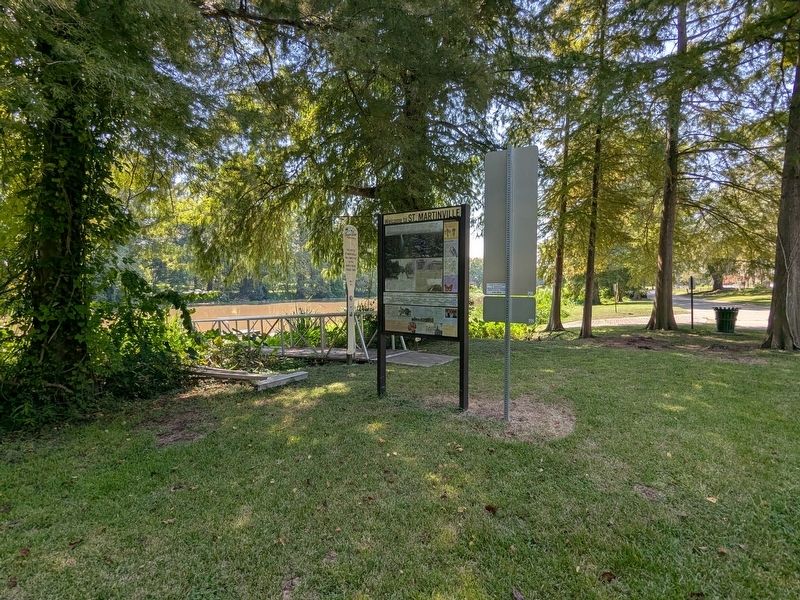
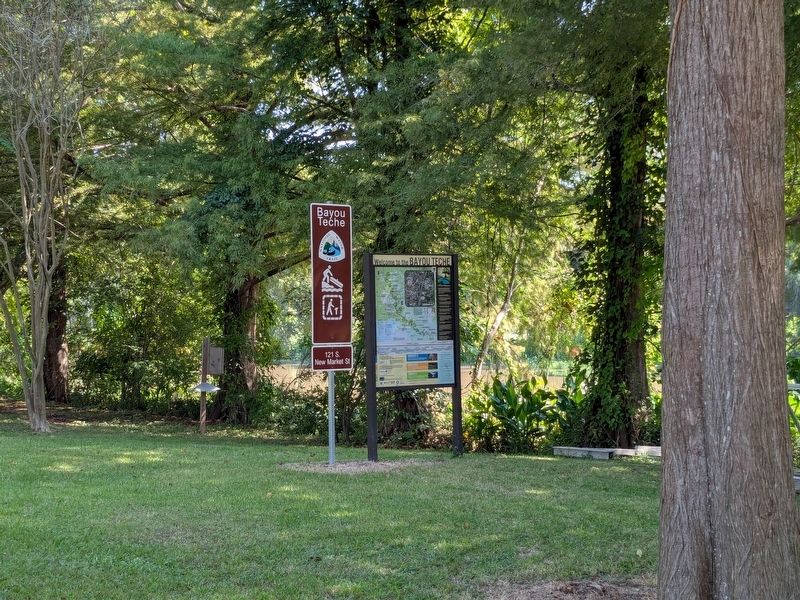
More about this marker. Located where Market Street turns at Bayou Teche
Also see . . . Official TECHE Project website. (Submitted on October 17, 2025, by Cajun Scrambler of Assumption, Louisiana.)
Credits. This page was last revised on November 2, 2025. It was originally submitted on October 17, 2025, by Cajun Scrambler of Assumption, Louisiana. This page has been viewed 131 times since then and 66 times this year. Photos: 1, 2, 3. submitted on October 17, 2025, by Cajun Scrambler of Assumption, Louisiana.
