Downtown in Texarkana in Miller County, Arkansas — The American South (West South Central)
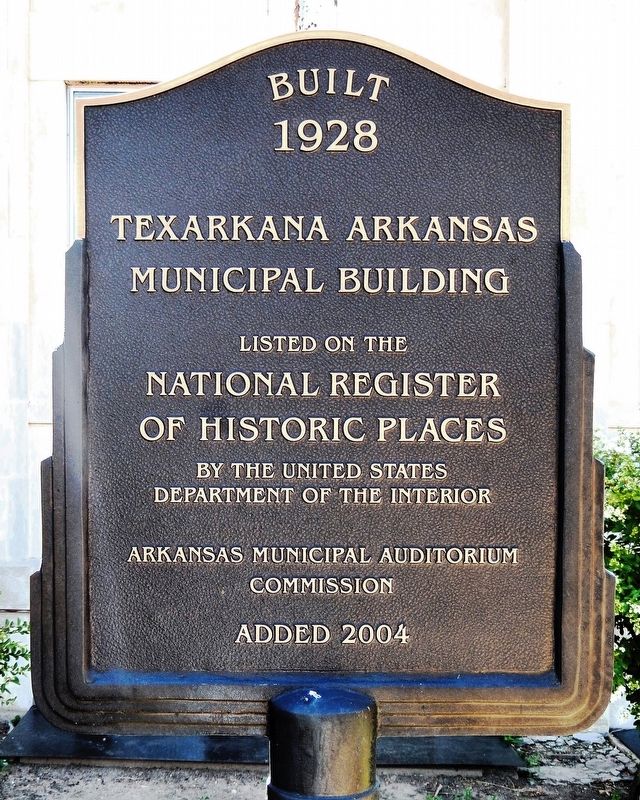
Texarkana Arkansas Municipal Building
Built 1928
Photographed by Cosmos Mariner, July 1, 2025
1. Texarkana Arkansas Municipal Building Marker
National Register of Historic Places
by the United States Department of the Interior
Added 2004
Erected by Arkansas Municipal Auditorium Commission.
Topics and series. This historical marker is listed in these topic lists: Architecture • Notable Buildings. In addition, it is included in the National Register of Historic Places (NRHP) series list. A significant historical year for this entry is 1928.
Location. 33° 25.427′ N, 94° 2.401′ W. Marker is in Texarkana, Arkansas, in Miller County. It is in Downtown. It is at the intersection of East 3rd Street and Walnut Street, on the left when traveling west on East 3rd Street. The marker is located near the northwest corner of the subject building. Touch for map. Marker is at or near this postal address: 216 Walnut Street, Texarkana AR 71854, United States of America. Touch for directions.

Regionally, this marker is in the Gulf Coastal Plain. It is also in the American South, specifically in the Upper South, and in the Piney Woods. Globally, it is in North America, the Western Hemisphere, the Western World, and the Anglosphere. Historically, it
this page online
Other nearby markers. At least 8 other markers are within walking distance of this marker: Arkansas Municipal Auditorium Walk of Fame Park (within shouting distance of this marker); Johnny Cash Performs at the Arkansas Municipal Auditorium (within shouting distance of this marker); Elvis Presley Performs at the Arkansas Municipal Auditorium (within shouting distance of this marker); Jake Charles “Jay” Franks (within shouting distance of this marker); Pat Cupp and The Flying Saucers (within shouting distance of this marker); Sandberger-Rowe Building (approx. 0.2 miles away); Booth-Rowe Building (approx. 0.2 miles away); East Broad Street Historic District (approx. 0.2 miles away). Touch for a list and map of all markers in Texarkana.
Regarding Texarkana Arkansas Municipal Building. National Register of Historic Places № 03001456.
From the National Register Nomination prepared by Ralph S. Wilcox, 10/13/2003:
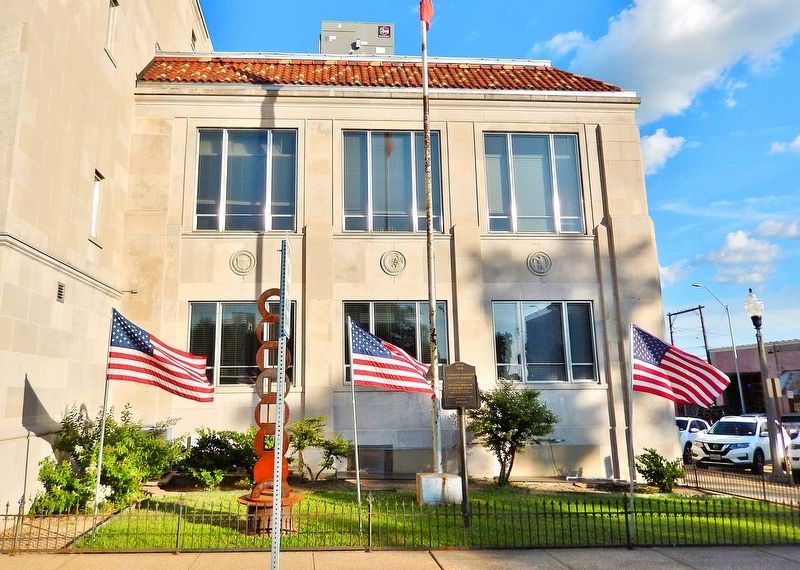
Since the building was built in 1927-1930,it has served as the municipal hub of the city. The building's three sections house the auditorium in the large center section, and the city government offices and fire station in the two flanking wings. The building is constructed out of gray stone and rests on a continuous stone foundation. It currently has metal, tripartite, Chicago-style windows in most of the openings that replaced the original multi-paned windows. The architects for the building, Witt, Seibert, and Halsey, chose a combination of the Collegiate Gothic and Art Deco styles for the design, and it remains a good example of the styles.Photographed by Cosmos Mariner, July 1, 20252. Texarkana Arkansas Municipal Building MarkerLooking south from East 3rd Street. The marker is mounted on a pole near the flagpole at the northwest corner of the building.
The Texarkana, Arkansas, Municipal Building is significant for its associations with the development of government in Texarkana, its associations with the growth of Texarkana that paralleled the growth of the railroad in the region, and for its associations with entertainment and recreation in the city. The auditorium in the building has served as a recreational and cultural gathering place for this community during much of the twentieth century. In addition, the building was built for use by Texarkana as a fire station, jail, courtroomand city offices. The construction of the building in the late 1920s was also a response to the growth of Texarkana as a result of the growth of the railroad industry in the vicinity. The Texarkana, Arkansas, Municipal Building is also an unusual example of a building designed combining the Art Deco and Collegiate Gothic styles of architecture.Photographed by Cosmos Mariner, July 1, 20253. Texarkana Arkansas Municipal Building
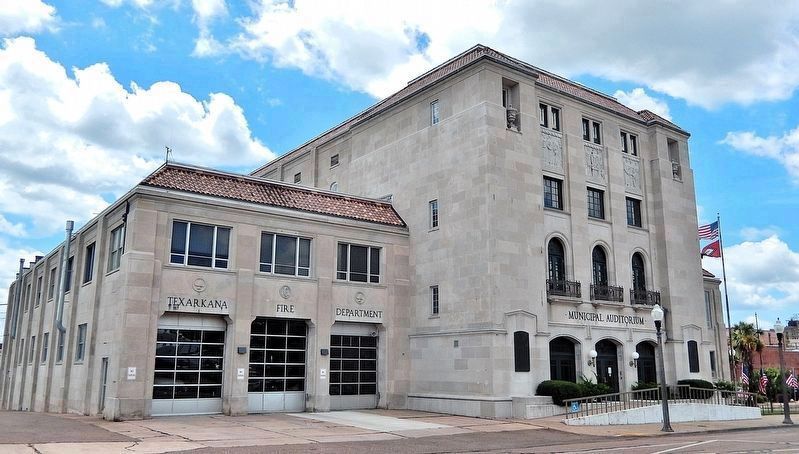
(northeast elevation)From the National Register Nomination: The left section of the front facade contains the fire station for the city. The first floor of the section contains three roll-up garage doors providing access to the three garage bays where the fire engines are stored. Above the three entrances are the words "TEXARKANA," "FIRE," and "DEPARTMENT." Medallions with fire fighting related motifs are present above the words. Each of the three bays on the second floor contains a metal, tripartite, Chicago-style window.
At the time this building was built in 1927-1930, there was no theater, concert stage, or audience space for 1,000 people in the city. While Texarkana has always been a twin city in both Texas and Arkansas, the Municipal Building served the entire community population in the twin cities for performing arts and a gathering place for civic functions. During the World War II era, the railroads through Texarkana were significant in bringing large numbers of visitors and military troops through the area. This auditorium became an important stage for emerging vocalists and musicians, and variety shows to entertain the travelers. In 1942, Louis Armstrong appeared, as well as some of the noted Big Bands like the Jay Franks Band. By the early 1950s the music scene was changing, and the Big Bands werebeing replaced with the new “rock and roll” music emerging from the Country & Western genre, often referred to as “rockabilly”. Starting in 1954, some very significant young performers were onstage at the auditorium, including several performances by Elvis Presley. In 1956, local musicians were evolving as new jazz and “rockabilly” backups to visiting artists. The Auditorium became the first place in Texarkana for a mixed-race stage performance. A significant event, called the “The Evolution of Jazz,” featured a band with a local black trumpeter, Artis L. Brewster, who was at that time only known in the Texarkana area.Photographed by Cosmos Mariner, July 1, 20254. Texarkana Arkansas Municipal Building
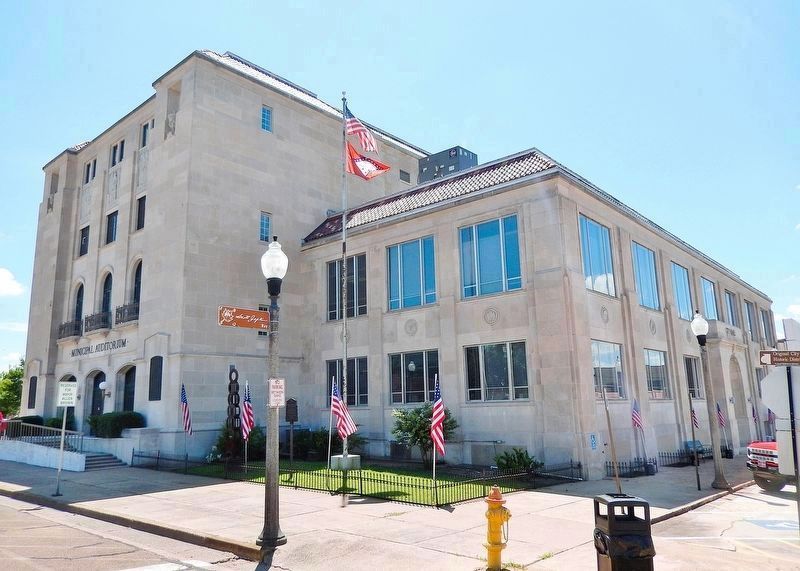
(northwest elevation)The west [right] side of the building houses the Texarkana, Arkansas City Hall and municipal offices.
Although the auditorium closed in the mid-1970s, the building has served as the fire station, city hall, and jail since it was fully opened in 1930. Although renovations have taken place on the interior, the integrity of most of the exterior architectural features has been maintained.
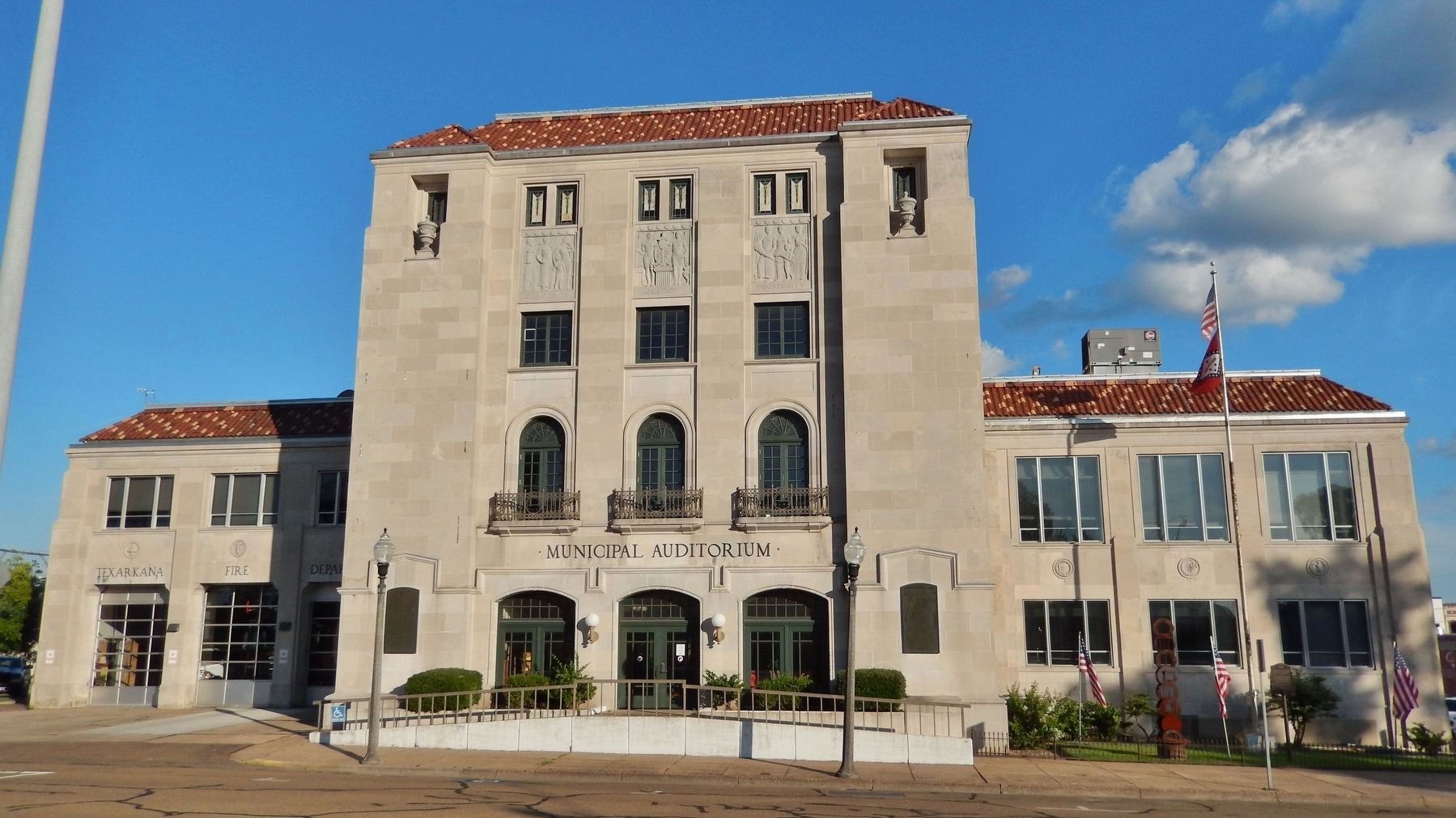
Photographed by Cosmos Mariner, July 1, 2025
5. Texarkana Arkansas Municipal Building (north/front elevation)
From the National Register Nomination: The central portion of the building contains the Municipal Auditorium. The first floor of the facade contains a central entrance with metal and glass entrance doors. A sixteen-paned fanlight window is present above the entrance. The entrance is flanked on each side by a set of former entrances that contain two wood doors with nine-panes of glass in them. Each of the former entrances is also surmounted by a sixteen-paned fanlight window. The central entrances are flanked on each side by a slight projection in the wall that contains a bronze plaque. The left plaque contains a dedication to the soldiers of Miller County who served in World War I, and the plaque on the right contains information on the architect and builder of the building as well as information on the city officials at the time of its construction.
The second floor of the auditorium contains three sets of French doors with ten panes of glass in each door. Each pair of doors has a semi-circular fanlight with spider-web glass pattern above it. In front of each set of doors is a small iron balcony with decorative spindles. From left to right, the iron balconies have the letters A.M. A., which likely stand for Arkansas Municipal Auditorium. The third floor of the auditorium space contains three pairs of eight-paned metal casement windows.
In between the third floor and top floor of the auditorium are three sets of decorative stone panels, one devoted to "CIVIC DUTY," one devoted to "JUSTICE," and one devoted to "PROSPERITY." The top floor of the auditorium contains three sets of windows in the center portion. Although they all originally had stained-glass in them, only the center two windows retain it. The other windows have single-panes of clear glass.
The second floor of the auditorium contains three sets of French doors with ten panes of glass in each door. Each pair of doors has a semi-circular fanlight with spider-web glass pattern above it. In front of each set of doors is a small iron balcony with decorative spindles. From left to right, the iron balconies have the letters A.M. A., which likely stand for Arkansas Municipal Auditorium. The third floor of the auditorium space contains three pairs of eight-paned metal casement windows.
In between the third floor and top floor of the auditorium are three sets of decorative stone panels, one devoted to "CIVIC DUTY," one devoted to "JUSTICE," and one devoted to "PROSPERITY." The top floor of the auditorium contains three sets of windows in the center portion. Although they all originally had stained-glass in them, only the center two windows retain it. The other windows have single-panes of clear glass.
Credits. This page was last revised on October 19, 2025. It was originally submitted on October 18, 2025, by Cosmos Mariner of Cape Canaveral, Florida. This page has been viewed 86 times since then and 37 times this year. Photos: 1, 2, 3, 4, 5. submitted on October 19, 2025, by Cosmos Mariner of Cape Canaveral, Florida.
