East Broad Street Historic District
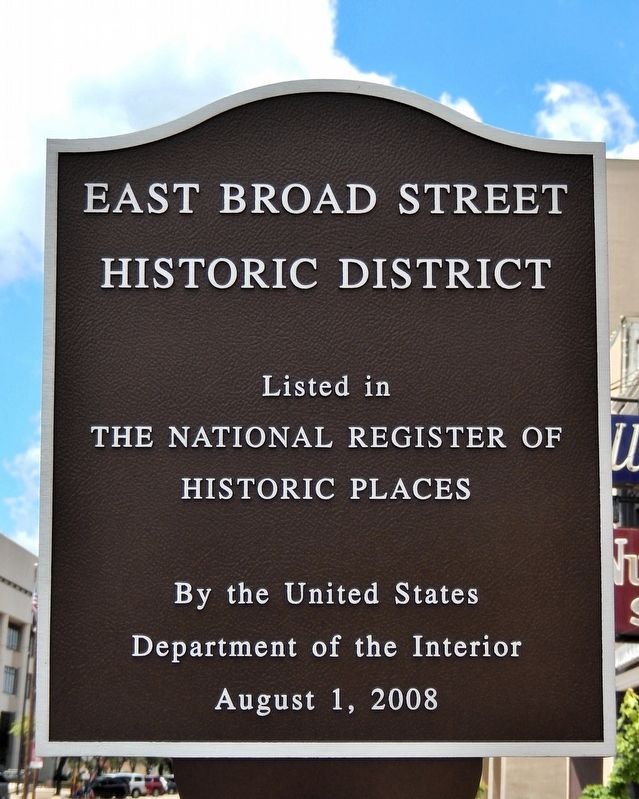
The National Register of Historic Places
by the United States Department of the Interior
August 1, 2008
Topics and series. This historical marker is listed in this topic list: Architecture. In addition, it is included in the National Register of Historic Places (NRHP) series list.
Location. 33° 25.316′ N, 94° 2.521′ W. Marker is in Texarkana, Arkansas, in Miller County. It is in Downtown. It is at the intersection of East Broad Street and Olive Street, on the right when traveling east on East Broad Street. The marker is located on the sidewalk, at the northwest corner of the intersection. Touch for map. Marker is at or near this postal address: 123 East Broad Street, Texarkana AR 71854, United States of America. Touch for directions.

Regionally, this marker is in the Gulf Coastal Plain. It is also in the American South, specifically in the Upper South, and in the Piney Woods. Globally, it is in North America, the Western Hemisphere, the Western World, and the Anglosphere. Historically, it finds itself in what was once New Spain, the territory of the
this page online
Other nearby markers. At least 8 other markers are within walking distance of this marker: Booth-Rowe Building (within shouting distance of this marker); Sandberger-Rowe Building (within shouting distance of this marker); Texas Produce Company/Richie Grocery Building (about 400 feet away, measured in a direct line); First Disciples of Christ in Texas (about 400 feet away in Texas); Offenhauser Building (about 400 feet away in Texas); Otis Williams & The Temptations Mural (about 700 feet away in Texas); Saenger Theatre (approx. 0.2 miles away in Texas); Texarkana Arkansas Municipal Building (approx. 0.2 miles away). Touch for a list and map of all markers in Texarkana.
More about this marker. This marker is installed at two locations. There is one at the east boundary of the district on East Broad Street at Olive Street and another at the west boundary on East Broad Street at Pine Street.
Regarding East Broad Street Historic District. National Register of Historic Places № 08000729.
From the National Register Nomination prepared by Sandra Taylor Smith & Ralph S. Wilcox, 1/30/2008:
TheEast Broad Street Historic District contains fifteen buildings constructed between 1886 and 1930. Of the fifteen buildings in the district, thirteen were constructed before 1920. One building was constructed c.1920 and another in 1930. Nine of the buildings in the district contribute to its historic significance. The six buildings determined non-contributing have been severely altered from their original appearance.Photographed by Cosmos Mariner, July 1, 20252. East Broad Street Historic District Marker
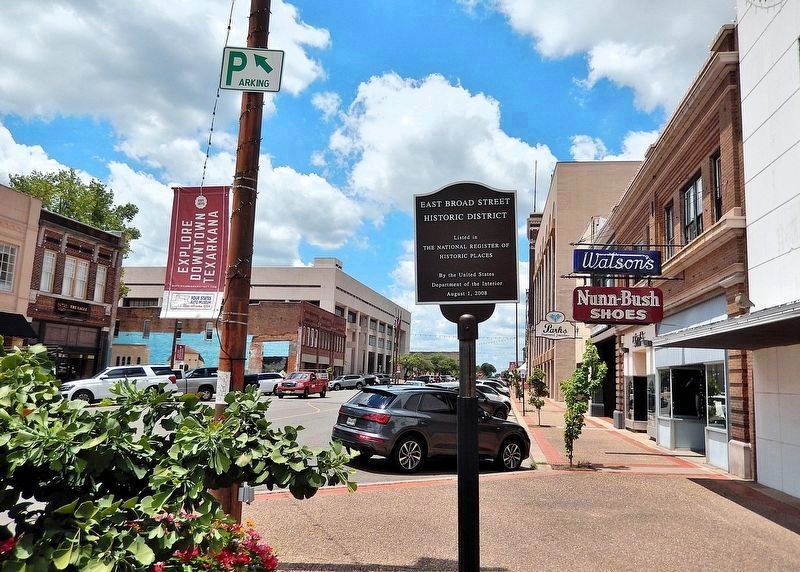
(east boundary of district)Looking west from Olive Street, along East Broad Street.1886-1899 The earliest buildings in the East Broad Street Historic District were constructed in the last two decades of the 19th century. Although non-contributing in the district due to severe alterations from its original appearance, the O'Dwyer and Ahem Building at 110 E. Broad Street, constructed c.1886, is the oldest building in the district. The front elevation of this three-story building has been drastically changed with the application of synthetic siding and new brick. Rear elevation walls, although stuccoed, indicate the original character of the building in the Italianate style — tall, narrow windows with slightly arched crowns.
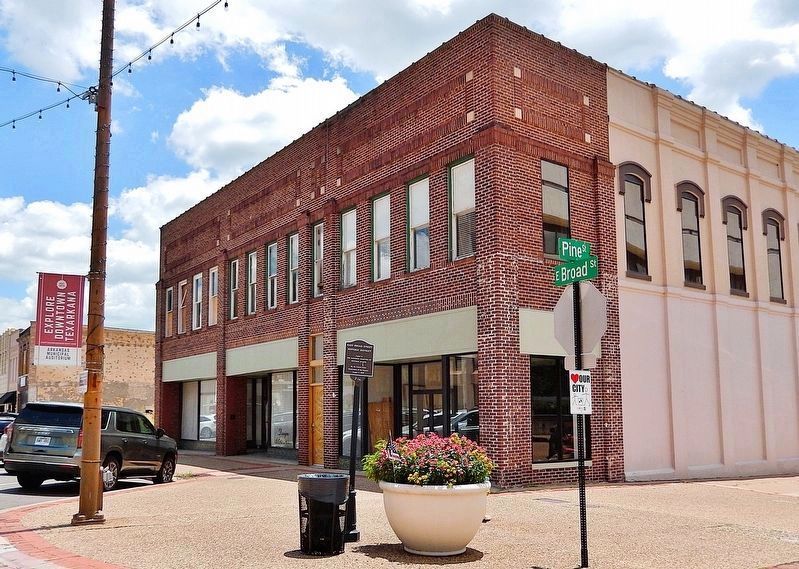
The Smith Drug Company building at 100 E. Broad, was constructed c.1890. Althoughthe front of the building has been modified, the building contributes to the historic significance of the district through its visible side elevation facing State Line Avenue, which reveals Italianate style design. Thirteen bays marked by two-story brick pilasters contain narrow window openings with segmental arched crowns. Three rows of brick bands highlight the cornice on this side of the building, indicating the original appearance of the front of the building.Photographed by Cosmos Mariner, July 1, 20253. East Broad Street Historic District Marker
(west boundary of district)Looking east from Pine Street, along East Broad Street. The Smith Drug Company building (100 E. Broad, constructed c.1890) is in the background.1900-1919 Nine of the fifteen buildings in the district were constructed from 1900 to 1919. Five of these early 20th century buildings were built in 1900.
a simple two-story brick building with minimal detail typical of many vernacular commercial buildings constructed in the early decades of the twentieth century. The two-story brick building at 119 E. Broad was also built c.1900. It presents its character through brick pilasters with cast concrete bases on the second story and a projecting cast concrete cornice.
The building at 104 E. Broad, c.1900, has two recessed storefronts on the ground floor. Nine double-hung, one-over-one windows span the width of the second story front elevation. Simple brick pattern with cast concrete insets at corners provides the minimal decorative element on this building. The brick parapet is capped by cast concrete. This building contributes to the significance of the district in its simple brick vernacular commercial design.
Higgin's Dry Goods Building at 114 E. Broad was constructed c.1900. It is
The State National Bank at 101-105 E. Broad Street was constructed c.1904. Five stories in height, the building is a flat-iron shape on the most prominent corner of State Line Avenue and Broad Street. The building has been drastically altered from its original appearance with the application of cast concrete panels and does not contribute to the historic character of the district.
The building at 116 E. Broad is a two-story brick commercial structure that retains its original features and appearance. Constructed in 1917, this building features an original wood frame storefront with kickplate and multi-pane clear story windows. Brick pilasters with cast concrete capitals and bases flank the storefront opening. A projecting cast concrete cornice is denoted by four fluted, cast concrete pilasters with Ionic capitals. A cast concrete ledge runs below second story windows marked on each end by decorative cast concrete rectangles.1920-1930 Constructed c.1920, the building at 122 E. Broad is located on the northeast corner of E. Broad and Olive Streets. The two-story building features Art Deco style detail in its geometric front detail on pilasters separating six second floor bays. The front is covered in cut stone block and wraps around to the east side. Although second story windows have been changed, the overall Art Deco application to the building is retained and this building contributes to the character of the district as the only example of Art Deco style influence.
The c.1930 building at 108 E. Broad is a simple two-story brick commercial building with little ornamentation. Second story windows have been infilled, but the building's general vernacular design contributes to the significance of the district.
Also see . . . East Broad Street Historic District (Wikipedia).
Excerpt: The District encompasses a city block of historic commercial buildings in Texarkana, Arkansas. The district includes all of the buildings on the 100 block of East Broad Street. Most of the fifteen buildings in the district were built before 1920, during Texarkana's major period of growth after the arrival of the railroad. Broad Street, just one block from the railroad, quickly became its economic center. The oldest building is the O'Dwyer and Ahern Building at 110 East Broad Street, a three-story brick-faced building constructed c. 1886. The district was listed on the National Register of Historic Places in 2008.(Submitted on October 20, 2025, by Cosmos Mariner of Cape Canaveral, Florida.)
Credits. This page was last revised on October 20, 2025. It was originally submitted on October 18, 2025, by Cosmos Mariner of Cape Canaveral, Florida. This page has been viewed 101 times since then and 43 times this year. Photos: 1, 2, 3. submitted on October 20, 2025, by Cosmos Mariner of Cape Canaveral, Florida.
