Near Adamana in Apache County, Arizona — The American Mountains (Southwest)
The Funky Worm
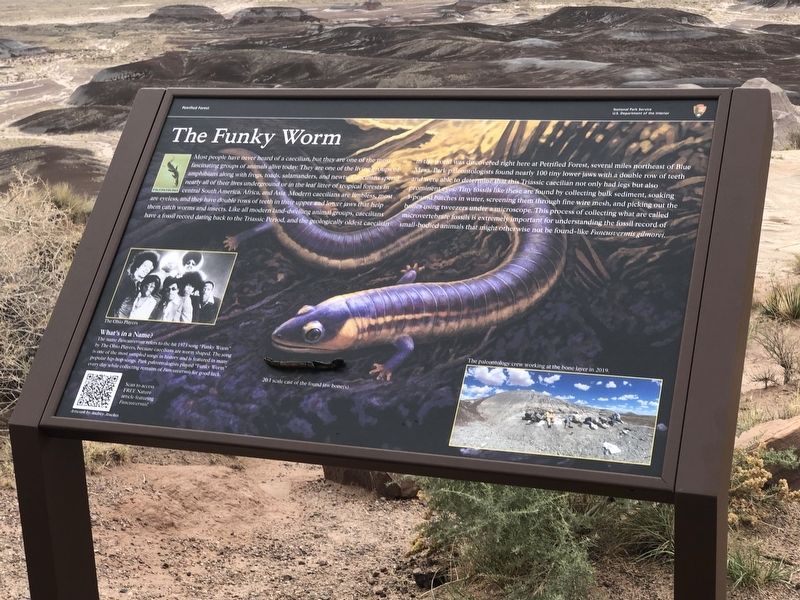
Photographed by Duane and Tracy Marsteller, September 25, 2025
1. The Funky Worm Marker
this page online
What's in a Name?
The name Funcusvermis refers to the hit 1973 song “Funky Worm” by The Ohio Players, because caecilians are worm shaped. The song is one of the most sampled songs in history and is featured in many popular hip-hop songs. Park paleontologists played “Funky Worm” every day while collecting remains of Funcusvermis for good luck.
Captions (left to right)
• The Ohio Players
• 20:1 scale cast of the found jaw bone(s)
• The paleontology crew working at the bone layer in 2019
Erected by National Park Service.
Topics. This historical marker is listed in these topic lists: Arts, Letters, Music • Paleontology. A significant historical year for this entry is 1973.
Location. 34° 56.362′ N, 109° 45.192′ W. Marker is near Adamana, Arizona, in Apache County. It is on Blue Mesa Scenic Road 2½ miles east of Petrified Forest Road, on the right when traveling north. Touch for map. Marker is in this post office area: Chambers AZ 86502, United States of America. Touch for directions.

Regionally, this marker is in Arizona’s Navajo Nation. It is also in the American Southwest, in the Mountain West, on the Colorado Plateau, and at the Four Corners. Globally, it is in North America, the Western Hemisphere, the Western World, and the Anglosphere. Historically, it finds itself in what was once New Spain, the territory of the Ancestral Puebloans, and Mexico’s Alta California.
Other nearby markers. At least 8 other markers are within 4 miles of this marker, measured as the crow flies: Metoposaur Genesis Supreme (about 400 feet away, measured in a direct line); Pioneers of Paleontology (approx. 1.4 miles away); a different marker also named Pioneers of Paleontology (approx. 1.4 miles away); Newspaper Rock Petroglyphs Archeological District (approx. 3 miles away); Work of Generations (approx. 3 miles away); Summer Solstice Marker (approx. 3.3 miles away); Roosevelt's Tree Army: The CCC (approx. 3.3 miles away); A Canvas for Ideas (approx. 3.3 miles away). Touch for a list and map of all markers in Adamana.
Another marker is no longer nearby. Newspaper Rock (was approx. 3 miles away but has been replaced with another marker now near it).
Credits. This page was last revised on October 18, 2025. It was originally submitted on October 18, 2025, by Duane and Tracy Marsteller of Murfreesboro, Tennessee. This page has been viewed 80 times since then and 36 times this year. Photo 1. submitted on October 18, 2025, by Duane and Tracy Marsteller of Murfreesboro, Tennessee.
Editor’s want-list for this marker. Wideview photograph of marker and surrounding area • Can you help?
