
Speyer, Rhineland-Palatinate, Germany — Central Europe
Boeing 747-230
"Schleswig-Holstein"
Photographed by James Hulse, May 21, 2025
1. Boeing 747-230 Marker

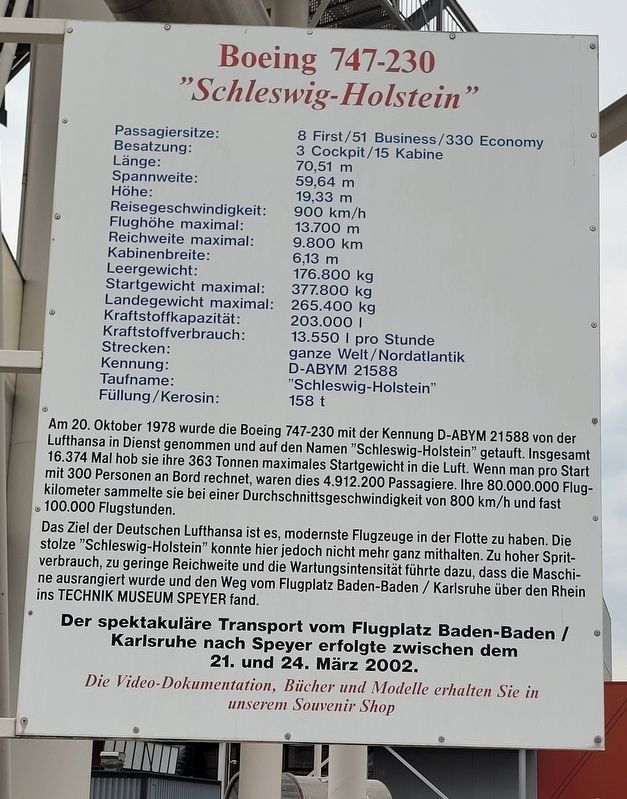
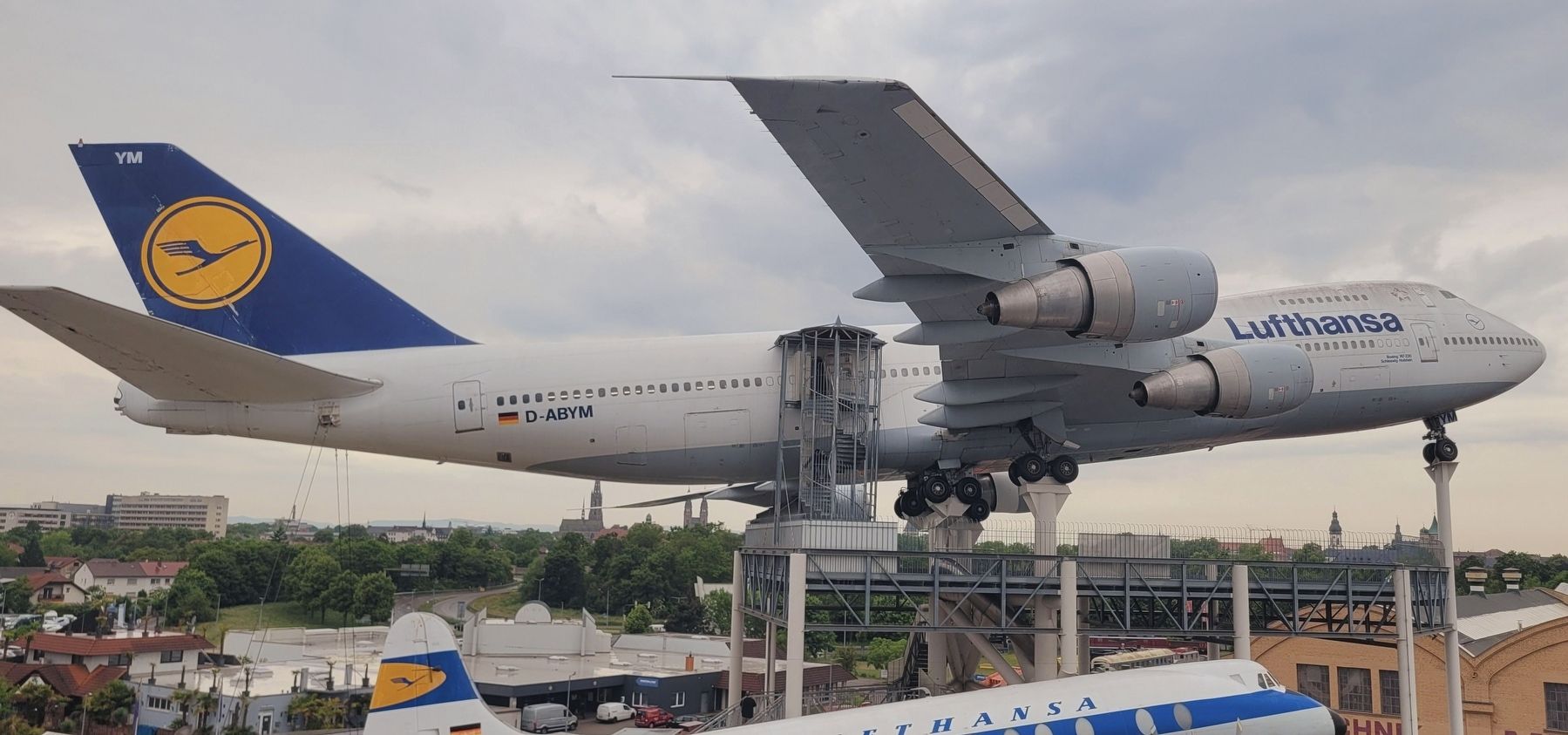
Am 20. Oktober 1978 wurde die Boeing 747-230 mit der Kennung D-ABYM 21588 von der Lufthansa in Dienst genommen und auf den Namen "Schleswig-Holstein" getauft. Insgesamt 16.374 Mal hob sie ihre 363 Tonnen maximales Startgewicht in die Luft. Wenn man pro Start mit 300 Personen an Bord rechnet, waren dies 4.912.200 Passagiere. Ihre 80.000.000 Flugkilometer sammelte sie bei einer Durchschnittsgeschwindigkeit von 800 km/h und fast 100.000 Flugstunden.
Das Ziel der Deutschen Lufthansa ist es, modernste Flugzeuge in der Flotte zu haben. Die stolze "Schleswig-Holstein" konnte hier jedoch nicht mehr ganz mithalten. Zu hoher Spritverbrauch, zu geringe Reichweite und die Wartungsintensität führte dazu, dass die Maschine ausrangiert wurde und den Weg vom Flugplatz Baden-Baden/Karlsruhe über den Rhein ins Technik Museum Speyer fand.
Der spektakuläre Transport vom Flugplatz Baden-Baden/Karlsruhe nach Speyer erfolgte zwischen dem 21. und 24. März 2002.
Die Video-Dokumentation, Bücher und Modelle erhalten Sie in unserem Souvenir Shop
Passagiersitze: 8 First/51 Business/330 Economy
Besatzung: 3 Cockpit/15 Kabine
Länge:
this page online
Spannweite: 59,64 m
Höhe: 19,33 m
Reisegeschwindigkeit: 900 km/h
Flughöhe maximal: 13.700 m
Reichweite maximal: 9.800 km
Kabinenbreite: 6,13 m
Leergewicht: 176.800 kg
Startgewicht maximal: 377.800 kg
Landegewicht maximal: 265.400 kg
Kraftstoffkapazität: 203.000 l
Kraftstoffverbrauch: 13.550 l pro Stunde
Strecken: ganze Welt/Nordatlantik
Kennung: D-ABYM 21588
Taufname: "Schleswig-Holstein"
Füllung/Kerosin: 158 t
On October 20, 1978, the Boeing 747-230 with the registration D-ABYM 21588 entered service with Lufthansa and was named "Schleswig-Holstein." It lifted its 363-ton maximum takeoff weight into the air a total of 16,374 times. Assuming 300 people on board per takeoff, this equated to 4,912,200 passengers. It accumulated 80,000,000 flight kilometers at an average speed of 800 km/h and logged nearly 100,000 flight hours.
Deutsche Lufthansa's goal is to have the most modern aircraft in its fleet. However, the proud "Schleswig-Holstein" could no longer quite keep pace. Excessive fuel consumption, limited range, and the intensive maintenance required led to the aircraft being scrapped
Photographed by James Hulse, May 21, 2025
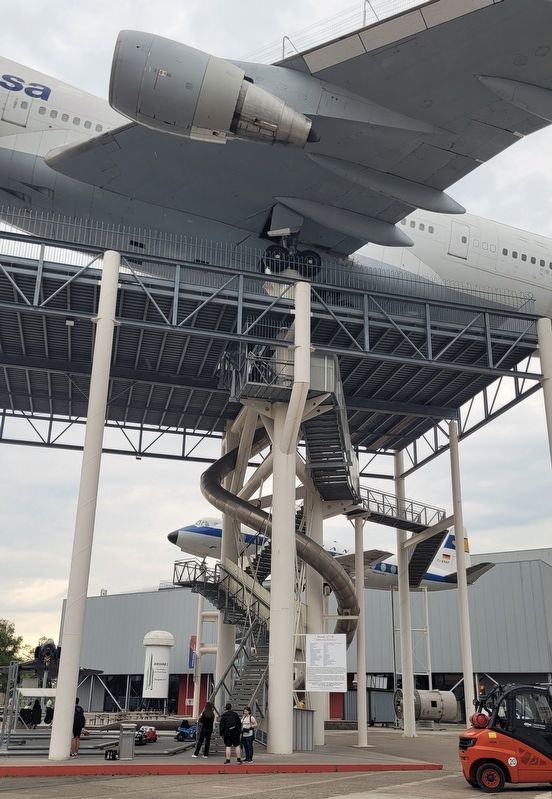
2. The entrance stairs to the Boeing 747-230 and Marker
The spectacular transport from Baden-Baden/Karlsruhe Airport to Speyer took place between March 21 and 24, 2002.
The video documentation, books, and models are available in our souvenir shop.
Passenger seats: 8 First/51 Business/330 Economy
Crew: 3 Cockpit/15 Cabin
Length: 70.51 m
Wingspan: 59.64 m
Height: 19.33m
Cruise speed: 900 km/h
Maximum altitude: 13,700 m
Maximum range: 9,800 km
Cabin width: 6.13 m
Empty weight: 176,800 kg
Maximum takeoff weight: 377,800 kg
Maximum landing weight: 265,400 kg
Fuel capacity: 203,000 l
Fuel consumption: 13,550 l per hour
Routes: Worldwide/North Atlantic
Registration: D-ABYM 21588
Name: "Schleswig-Holstein"
Fuel capacity/kerosene: 158 t
Erected by Technik Museen Sinsheim Speyer.
Topics. This historical marker is listed in this topic list: Air & Space. A significant historical year for this entry is 1978.
Location. 49° 18.655′ N, 8° 26.744′ E. Marker is in Speyer, Rheinland-Pfalz (Rhineland-Palatinate). It is at the intersection of Am Technik Museum and Geibstraße on Am Technik
Photographed by James Hulse, May 21, 2025
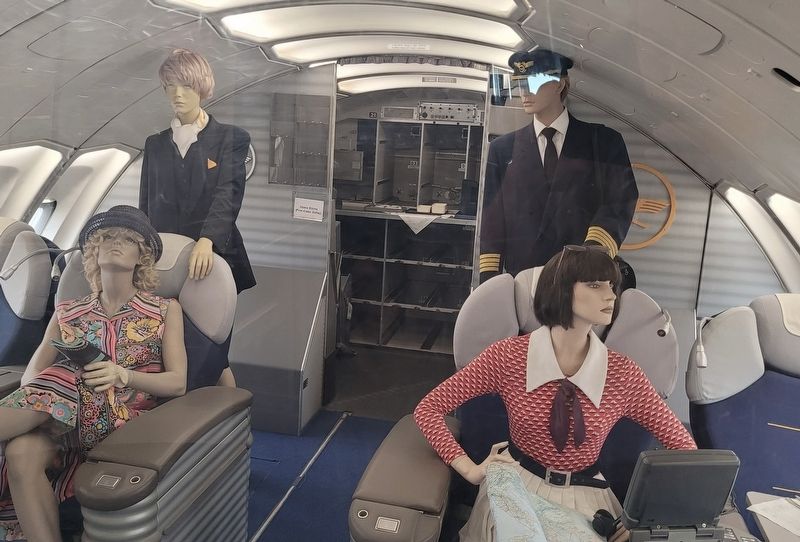
3. First Class Seating area on the Boeing 747-230

Regionally, this marker is on the German Upper Rhine. Globally, it is in Europe, the European Union, Atlantic Europe, Central Europe, the Schengen Area, Western Europe, and the Western World. Historically, it finds itself in what was once the Roman Empire, the Holy Roman Empire, and the former West Germany.
Other nearby markers. At least 8 other markers are within walking distance of this marker: Suchoi Su-22 (a few steps from this marker); Lockheed Starfighter TF-104 G (a few steps from this marker); McDonnell F-101 „Voodoo“ (a few steps from this marker); Transrapid Magnetschwebebahn / Transrapid Magnetic Levitation Train (within shouting distance of this marker); Feuerlöschboot 2 / Fireboat 2 (within shouting distance of this marker); MiG-23 BN Mikojan Gurewitsch (within shouting distance of this marker); Vickers Viscount 814 (within shouting distance of this marker); McDonnell Douglas F-15 (within shouting distance of this marker).
Photographed by James Hulse, May 21, 2025
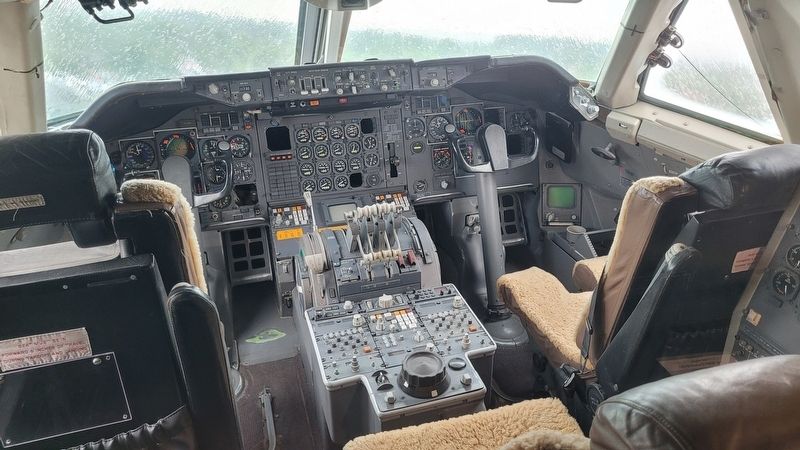
4. Cockpit of the Boeing 747-230
More about this marker. The static displays and markers are located on the grounds of the Technik Museum. There is an entrance fee to visit the museum and markers.
Also see . . . Boeing 747. Wikipedia
The Boeing 747 is a long-range wide-body airliner designed and manufactured by Boeing Commercial Airplanes in the United States between 1968 and 2023. After the introduction of the 707 in October 1958, Pan Am wanted a jet 2+1⁄2 times its size, to reduce its seat cost by 30%. In 1965, Joe Sutter left the 737 development program to design the 747. In April 1966, Pan Am ordered 25 Boeing 747-100 aircraft, and in late 1966, Pratt & Whitney agreed to develop the JT9D engine, a high-bypass turbofan. On September 30, 1968, the first 747 was rolled out of the custom-built Everett Plant, the world's largest building by volume. The 747's first flight took place on February 9, 1969, and the 747 was certified in December 1969. It entered service with Pan Am on January 22, 1970. The 747 was the first airplane called a "Jumbo Jet" as the first wide-body airliner.(Submitted on October 20, 2025, by James Hulse of Medina, Texas.)
Photographed by James Hulse, May 21, 2025
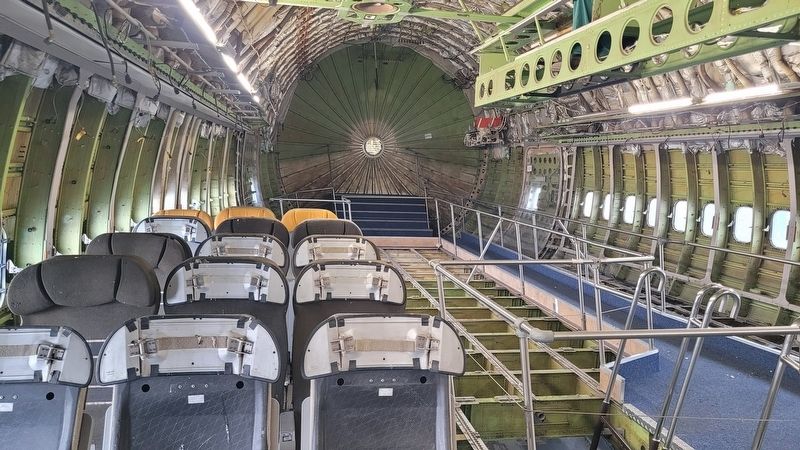
5. Inside view of the passenger area
Photographed by James Hulse, May 21, 2025
6. Boeing 747-230
Credits. This page was last revised on October 20, 2025. It was originally submitted on October 19, 2025, by James Hulse of Medina, Texas. This page has been viewed 95 times since then and 45 times this year. Photos: 1, 2, 3, 4, 5, 6. submitted on October 20, 2025, by James Hulse of Medina, Texas.
