Texarkana in Bowie County, Texas — The American South (West South Central)
Saenger Theatre

Photographed by Cosmos Mariner, July 1, 2025
1. Saenger Theatre Marker
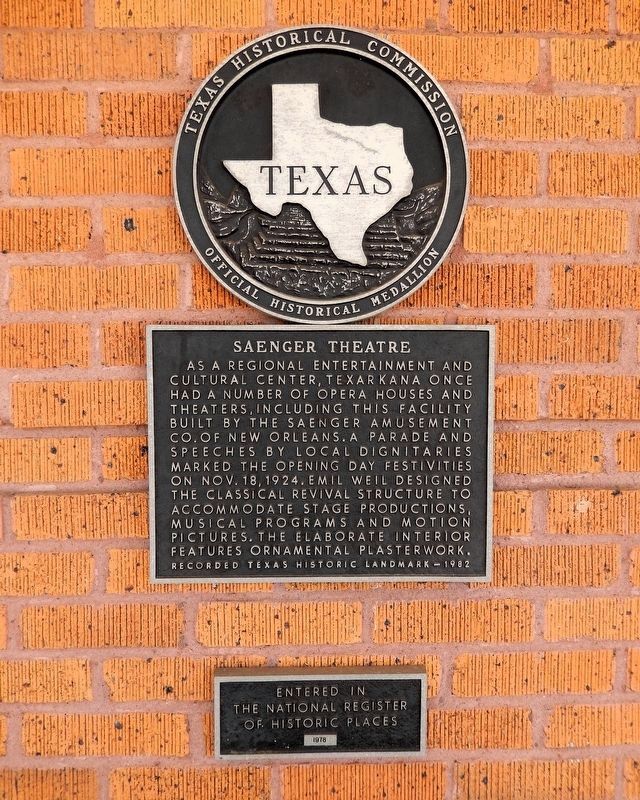
As a regional entertainment and cultural center, Texarkana once had a number of opera houses and theaters, including this facility built by the Saenger Amusement Co. of New Orleans. A parade and speeches by local dignitaries marked the opening day festivities on Nov. 18, 1924. Emil Weil designed the Classical Revival structure to accommodate stage productions, musical programs and motion pictures. The elaborate interior features ornamental plasterwork.
Recorded Texas Historic Landmark – 1982
Erected 1982 by Texas Historical Commission. (Marker Number 9507.)
Topics and series. This historical marker is listed in these topic lists: Architecture • Arts, Letters, Music • Entertainment • Notable Buildings. In addition, it is included in the National Register of Historic Places (NRHP) series list. A significant historical date for this entry is November 18, 1924.
Location. 33° 25.3′ N, 94° 2.677′ W. Marker is in Texarkana, Texas, in Bowie County. It is on Main Street just south of West 3rd Street, on the right when traveling south. The marker is mounted at eye-level directly on the east/front façade of the subject building.
this page online

Regionally, this marker is in the American South, specifically in the Deep South, and in the Piney Woods. Globally, it is in North America, a Gulf of Mexico state, the Western Hemisphere, the Western World, and the Anglosphere. Historically, it finds itself in what was once New Spain, the Republic of Texas, one of the Confederate States of America, and the Antebellum South.
Other nearby markers. At least 8 other markers are within walking distance of this marker: Otis Williams & The Temptations Mural (within shouting distance of this marker); First Disciples of Christ in Texas (about 400 feet away, measured in a direct line); Offenhauser Building (about 500 feet away); East Broad Street Historic District (approx. 0.2 miles away in Arkansas); “Ace of Clubs” House (approx. 0.2 miles away); Booth-Rowe Building (approx. 0.2 miles away in Arkansas); Sandberger-Rowe Building (approx. 0.2 miles away in Arkansas); Texas Produce Company/Richie Grocery Building (approx. 0.2 miles away in
Photographed by Cosmos Mariner, July 1, 2025
2. Saenger Theatre Marker
The Texas Historical Commission Medallion is mounted directly above the historical marker. The National Register of Historic Places marker (listed in 1978) is mounted below the historical marker.
Regarding Saenger Theatre. National Register of Historic Places № 78002897.
From the National Register Nomination prepared by Katy F. Caver, 1/30/1978:
The Saenger Theater was the largest and most opulent of any of the numerous theaters built in Texarkana. The auditorium was one of the largest in the South, having a clear span of ninety feet between walls. Built of steel, concrete and brick, the theater encompasses 24,120 square feet. There were 1,675 seats, 788 on the main floor and 887 in the balcony.
The upper rear section of the balcony was reserved for use by black patrons and reached by independent stairways. Separate lounges were also provided. The balcony lobby was reached by two slightly winding staircases, one at each end of the inner main floor lobby. Magnificent plaster work depicting Greek Mythological characters decorated the balcony lobby and three French windows each open out onto a narrow exterior balcony, walled with concrete turnposts. The projection room at the upper rear of the balcony was well ventilated as a precaution against the numerousfires caused by the highly flammable nitrate film used at the time, and was built with restrooms for the operator.Photographed by Cosmos Mariner, July 1, 20253. Saenger Theatre MarkerThe marker is mounted between the two window bays on the facade.
The lobby floors are fashioned of alternate black and white marble squares. The walls are of marble as are the bases of the ticket booths. The ticket booths are further decorated with turned wooden pediments supporting the glass windows. Entering the outer foyer of the main orchestra floor, one passes through elliptical arches supported by plaster columns with Ionic capitals. The arches are decorated with plaster work figures depicting Greek theater and mythology. Ornamental plaster sculpture is abundant in the decoration of the proscenium arch and the boxes. There are two boxes on each side of the stage, all with private entrances. The ceiling in the main auditorium is literally covered with gilded plaster work, cleverly concealing speakers and heating vents.
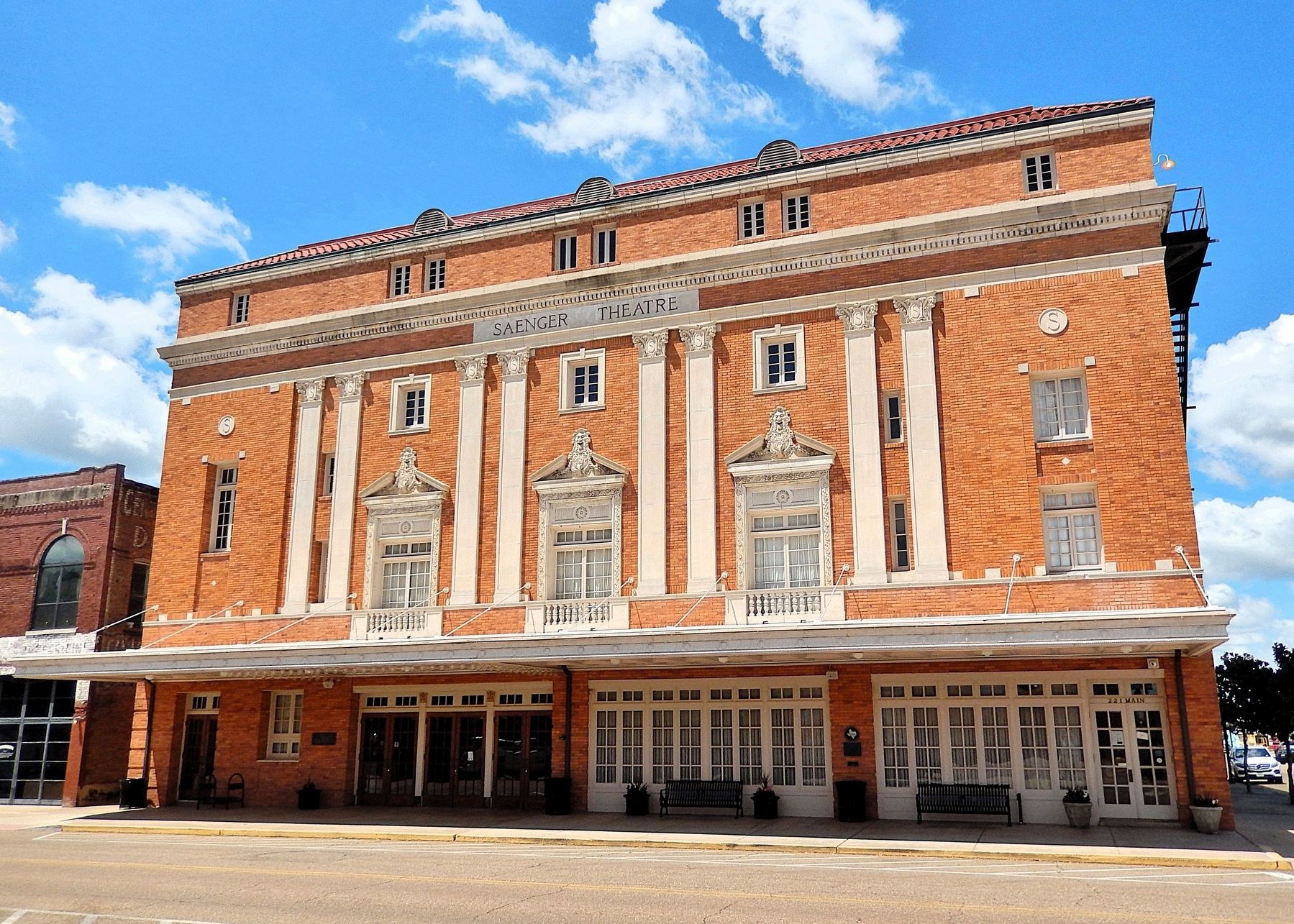
The stage, 35 feet by 100 feet, was adaptable to a variety of live theater productions. Eight dressing rooms, with make-up tables intact, are located under the stage. The orchestra pit is large enough to accommodate a full orchestra. The organ console was locatednear the orchestra pit in full view of the audience. It was of maximum size for the theater space.Photographed by Cosmos Mariner, July 1, 20254. Saenger Theatre (east/front elevation)From the National Register Nomination: The exterior of the building appears rather plain on first sight but actually is not. The Italian Renaissance design lends itself well to a theater building, the warm golden-colored brick is accented with concrete trimmings. The hip roof is tiled with terra cotta and contains three ventilation dormers on each of the four sides. Concrete cornices, frieze, and dentils accent the facade. Eight concrete pilasters are topped with Corinthian caps, each with an "S" in relief. The three lower balcony windows have ornamental architrave trim and are topped by a large grotesque in lion form over the top surround piece. Two symmetrical concrete pediments abut the top rail at 45-degree angles. Above the French windows are casement windows serving the upper balcony. In the center of the building between the dentils and second frieze, there is set into the brick marble panels inscribed with the name "Saenger Theater". A set of plain concrete medallions inscribed with an "S" are mounted above the upper casement window on each end. The street level under-lighted portico is corniced in stamped metal scroll work with small grotesques.

Also see . . . Saenger Theater History (PerotTheatre.org).
Excerpt: The Saenger Amusement Company of New Orleans built the theatre in 1924 to provide live entertainment for the bustling community of Texarkana. The company contracted the renowned New Orleans architect Emile Weil who created a three-story building inspired by Neo-Italian Renaissance design that showcased simplicity on the outside and opulence within. From the Grecian architecture and ornate paintings to the hand-crafted plasterwork and gold leaf trim it was a masterpiece like none other.(Submitted on October 22, 2025, by Cosmos Mariner of Cape Canaveral, Florida.)
In 1931 the Paramount-Publix Corporation purchased the Saenger theater, and it became known as the Paramount. During the 1930s and 1940s motion pictures flourished and the theatre attracted large crowds of movie-goers. Until the 1960s the theatre featured live productions and first run movies but interest in the theatre began to fade as the popularity of television was on the rise.
The City of Texarkana, Texas purchased the theatre in 1977 from S & H Theatre Corporation of New Orleans for $19,000. The city contracted the Austin firm Bell, Klein and Hoffman, who specialized in historic preservation, to carry out the restoration process. In total, the vast project cost $2.4 million dollars. Texarkana natives, H. Ross Perot and his sister Bette, contributed $800,000 towards the theatre restoration in memory of their parents. In honor of the Perot Family, the city council of Texarkana, Texas renamed the theatre the Perot Theatre.
Credits. This page was last revised on October 22, 2025. It was originally submitted on October 20, 2025, by Cosmos Mariner of Cape Canaveral, Florida. This page has been viewed 94 times since then and 51 times this year. Photos: 1, 2, 3, 4. submitted on October 22, 2025, by Cosmos Mariner of Cape Canaveral, Florida.
