
Speyer, Rhineland-Palatinate, Germany — Central Europe
Vickers Viscount 814
Photographed by James Hulse, May 21, 2025
1. Vickers Viscount 814 Marker

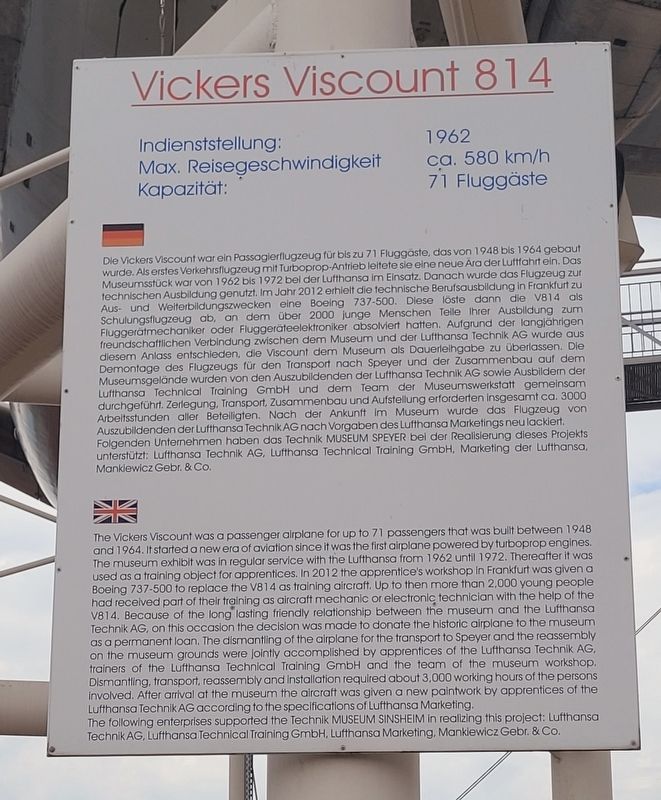
Die Vickers Viscount war ein Passagierflugzeug für bis zu 71 Fluggäste, das von 1948 bis 1964 gebaut wurde. Als erstes Verkehrsflugzeug mit Turboprop-Antrieb leitete sie eine neue Ära der Luftfahrt ein. Das Museumsstück war von 1962 bis 1972 bei der Lufthansa im Einsatz. Danach wurde das Flugzeug zur technischen Ausbildung genutzt. Im Jahr 2012 erhielt die technische Berufsausbildung in Frankfurt zu Aus- und Weiterbildungszwecken eine Boeing 737-500. Diese löste dann die V814 als Schulungsflugzeug ab, an dem über 2000 junge Menschen Teile Ihrer Ausbildung zum Fluggerätmechaniker oder Fluggeräteelektroniker absolviert hatten. Aufgrund der langjährigen freundschaftlichen Verbindung zwischen dem Museum und der Lufthansa Technik AG wurde aus diesem Anlass entschieden, die Viscount dem Museum als Dauerleihgabe zu überlassen. Die Demontage des Flugzeugs für den Transport nach Speyer und der Zusammenbau auf dem Museumsgelände wurden von den Auszubildenden der Lufthansa Technik AG sowie Ausbildern der Lufthansa Technical Training GmbH und dem Team der Museumswerkstatt gemeinsam durchgeführt. Zerlegung, Transport,
this page online
Folgenden Unternehmen haben das Technik MUSEUM SPEYER bei der Realisierung dieses Projekts unterstützt: Lufthansa Technik AG, Lufthansa Technical Training GmbH, Marketing der Lufthansa, Mankiewicz Gebr. & Co.
Indienststellung: 1962
Max. Reisegeschwindigkeit: ca. 580 km/h
Kapazität: 71 Fluggäste
The Vickers Viscount was a passenger airplane for up to 71 passengers that was built between 1948 and 1964. It started a new era of aviation since it was the first airplane powered by turboprop engines. The museum exhibit was in regular service with the Lufthansa from 1962 until 1972. Thereafter it was used as a training object for apprentices. In 2012 the apprentice's workshop in Frankfurt was given a Boeing 737-500 to replace the V814 as training aircraft. Up to then more than 2,000 young people had received part of their training as aircraft mechanic or electronic technician with the help
Photographed by James Hulse, May 21, 2025
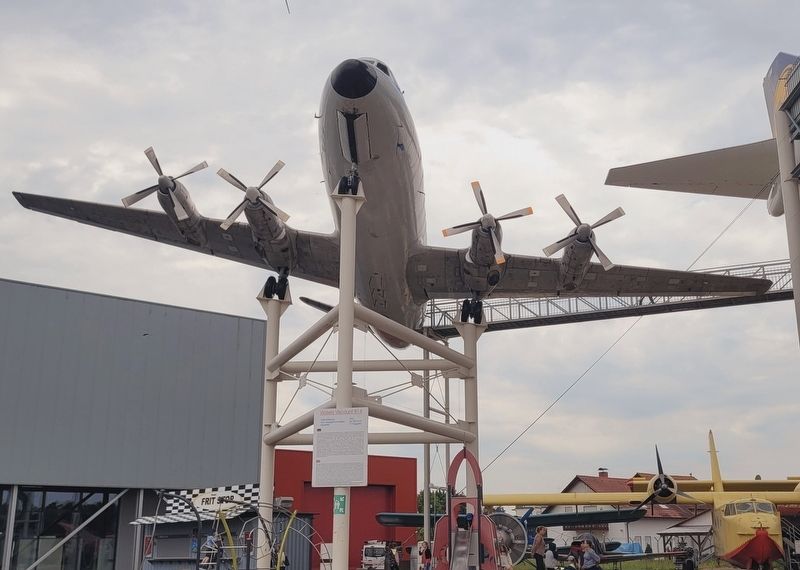
2. Vickers Viscount 814 and Marker
The following enterprises supported the Technik MUSEUM SINSHEIM in realizing this project: Lufthansa Technik AG, Lufthansa Technical Training GmbH, Lufthansa Marketing, Mankiewicz Gebr. & Co.
Commissioned: 1962
Maximum cruising speed: approx. 580 km/h
Capacity: 71 passengers
Erected by Technik Museen Sinsheim Speyer.
Topics. This historical marker is listed in this topic list: Air & Space. A significant historical year for this entry is 1948.
Location. 49° 18.638′ N, 8° 26.762′ E. Marker is in Speyer, Rheinland-Pfalz (Rhineland-Palatinate). It is at the intersection of Am Technik Museum and Geibstraße on Am Technik Museum. The marker is located in Technik Museum Sinsheim Speyer. Touch for map. Marker is at or near this postal address: Am Technik Museum 1, Speyer RP 67346, Germany. Touch for directions.

Regionally, this marker is on the German Upper Rhine. Globally, it is in Europe, the European Union, Atlantic Europe, Central Europe, the Schengen Area, Western Europe, and the Western World. Historically, it finds itself in what was once the Roman Empire, the Holy Roman Empire, and the former West Germany.
Other nearby markers. At least 8 other markers are within walking distance of this marker: McDonnell-Douglas F-4 J Phantom (within shouting distance of this marker); McDonnell-Douglas F-4 Phantom (within shouting distance of this marker); Antonow An-2 (within shouting distance of this marker); Boeing 747-230 (within shouting distance of this marker); Rheinschlepper / Rhine Tug (within shouting distance of this marker); Transrapid Magnetschwebebahn / Transrapid Magnetic Levitation Train (within shouting distance of this marker); McDonnell F-101 „Voodoo“ (within shouting distance of this marker); Feuerlöschboot 2 / Fireboat 2 (within shouting distance of this marker). Touch for a list and map of all markers in Speyer.
More about this marker. The static displays and markers are located on the grounds of the Technik Museum. There is an entrance fee to visit the museum and markers.
Also see . . . Vickers Viscount. Wikipedia
The Vickers Viscount is a retired British medium-range turboprop airliner first flown in 1948 by Vickers-Armstrongs. A design requirement from the Brabazon Committee, it entered service in 1953 and was the first turboprop-powered airliner. The Viscount was well received by the public for its cabin conditions, which included pressurisation, reductions in vibration and noise, and panoramic windows. It became one of the most successful and profitable of the first postwar transport aircraft; 445 Viscounts were built for a range of international customers, including in North America.(Submitted on October 24, 2025, by James Hulse of Medina, Texas.)
Credits. This page was last revised on October 24, 2025. It was originally submitted on October 24, 2025, by James Hulse of Medina, Texas. This page has been viewed 57 times since then and 29 times this year. Photos: 1, 2. submitted on October 24, 2025, by James Hulse of Medina, Texas.
