Dayton in Lyon County, Nevada — The American Mountains (Southwest)
The Mule Barn
| — | Sutro Tunnel Marker Trail | — |
Photographed by Jerry Klinger
1. The Mule Barn Marker
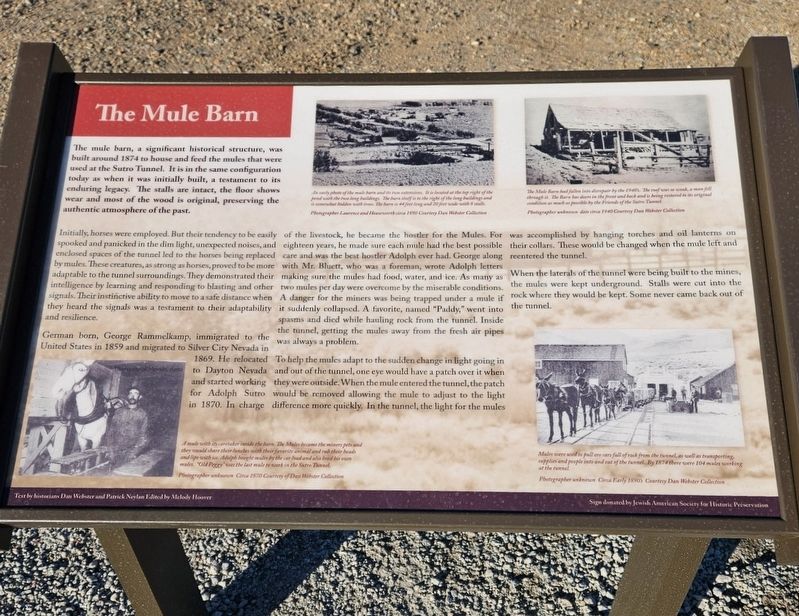
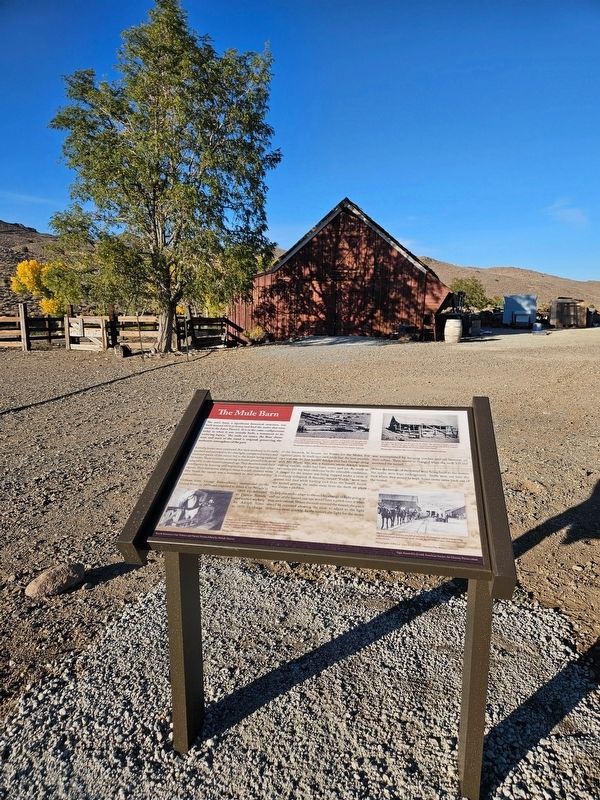
The mule barn, a significant historical structure, was built around 1874 to house and feed the mules that were used at the Sutro Tunnel. It is in the same configuration today as when it was initially built, a testament to its enduring legacy. The stalls are intact, the floor shows wear and most of the wood is original, preserving the authentic atmosphere of the past.
Initially, horses were employed, but their tendency to be easily spooked and panicked in the dim light, unexpected noises, and enclosed spaces of the tunnel led to their replacement by mules. These creatures, as strong as horses, proved to be more adaptable to the tunnel surroundings. They demonstrated their intelligence by learning and responding to blasting and other signals. Their instinctive ability to move to a safe distance when they heard the signals was a testament to their adaptability and resilience.
German-born, George Rammelkamp immigrated to the United States in 1859 and migrated to Silver City, Nevada in 1869. He relocated to Dayton, Nevada, and started working for Adolph Sutro in 1870. In charge of the livestock, he became the hostler
this page online
To help the mules adapt to the sudden change in light going in and out of the tunnel, one eye would have a patch over it outside. When the mule entered the tunnel, the patch would be removed, allowing the mule to adjust to the light difference more quickly. In the tunnel, the light for the mules was accomplished by hanging torches and oil lanterns to their collars. These would be changed when the mule left and reentered the tunnel.
When the laterals of the tunnel were being built to the mines, the mules were kept underground. Stalls were cut into the rock where they
Photographed by Jerry Klinger
2. The Mule Barn Marker
Erected 2025 by Jewish American Society for Historic Preservation.
Topics and series. This historical marker is listed in these topic lists: Animals • Industry & Commerce. In addition, it is included in the Jewish American Society for Historic Preservation. series list.
Location. 39° 16.787′ N, 119° 34.98′ W. Marker is in Dayton, Nevada, in Lyon County. It is on Sutro Tunnel Road. Marker is located within the grounds of the Sutro Tunnel restoration. It is 50' in front of the Mule Barn. Touch for map. Marker is in this post office area: Dayton NV 89403, United States of America. Touch for directions.

Regionally, this marker is in the Sierra Nevada and in Greater Reno Area. It is also in the American Mountain West. Globally, it is in North America, the Western Hemisphere, the Western World, and the Anglosphere. Historically, it finds itself in what was once New Spain and also Mexico’s Alta California.
Other nearby markers. At least 8 other markers are within 3 miles of this marker, measured as the crow flies: The Mill (here, next to this marker); The Sutro Tunnel - Machine Shop (within shouting distance of this marker); Sutro: The Town (about 300 feet away, measured in a direct line); Sutro Tunnel (about 400 feet away); The Mansion (about 700 feet away); Sutro (approx. 1.1 miles away); Lifeblood of the Mills (approx. 2.8 miles away); Camels in Dayton (approx. 2.9 miles away). Touch for a list and map of all markers in Dayton.
More about this marker. Text by historians Dan Webster and Patrick Neylan, edited by Melody Hoover.
Also see . . .
1. Friends of the Sutro Tunnel.
Before Adolph Sutro could complete his great work of the Sutro Tunnel he had to first win the hearts, minds and pocket books of the people invested in the Comstock Lode. He knew that a drainage adit would solve all of the problems facing the mines of the Comstock, just as it had been done the world over. His greatest difficulty wasn't convincing the need of such a thing it was to overcome the objections of the bankers that controlled nearly the entirety of the mines. The Sutro Tunnel would cut the banks profits and help the miners. Neither of which William Sharon and William Ralston wanted to happen.(Submitted on October 24, 2025, by Jerry Klinger of Boynton Beach, Florida.)
2. Adolph Sutro (1830–1898).
As Mark Twain wrote years after Sutro’s death in 1898: “Twenty years ago I knew Adolph Sutro well...a fine, manly beautiful character. And I have always found something of Sutro in all the Jews whom I have personally known since. A part of Sutro is sufficient equipment for an average man.”(Submitted on October 25, 2025, by Jerry Klinger of Boynton Beach, Florida.)
3. Adolf Sutro's Tunnel is Restored and Open to the Public 2023.
Video:(Submitted on October 25, 2025, by Jerry Klinger of Boynton Beach, Florida.)
Built in 1875, the Adolf Sutro Tunnel was once one of the longest and most famous tunnels in the world that was built to drain the Famous Comstock Lode of water in Virginia City, Nevada. After years of neglect, the tunnel was restored and reopened to the public thanks to the hard work of many volunteers and local organizations.
Credits. This page was last revised on October 26, 2025. It was originally submitted on October 24, 2025, by Jerry Klinger of Boynton Beach, Florida. This page has been viewed 153 times since then and 60 times this year. Photos: 1, 2. submitted on October 24, 2025, by Jerry Klinger of Boynton Beach, Florida. • Andrew Ruppenstein was the editor who published this page.
