Esther Short in Vancouver in Clark County, Washington — The American West (Northwest)
Clark County Courthouse
Photographed by William Thievon, July 31, 2025
1. Clark County Courthouse Marker
Inscription.
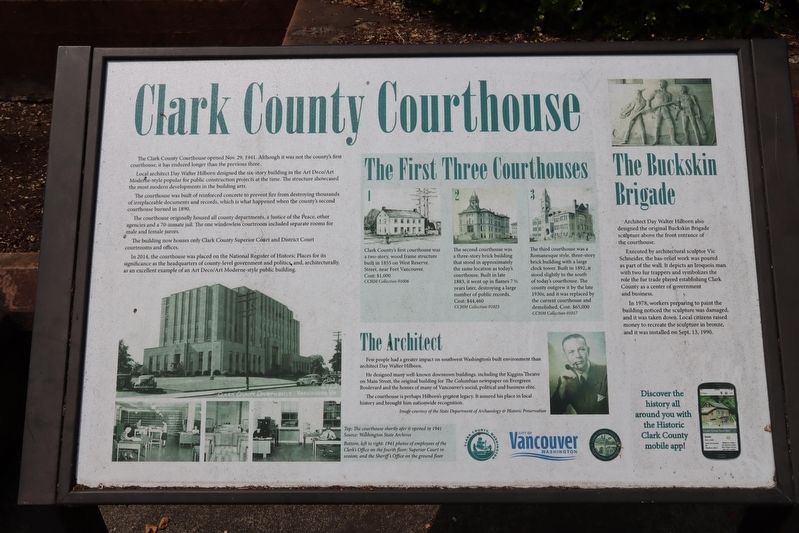
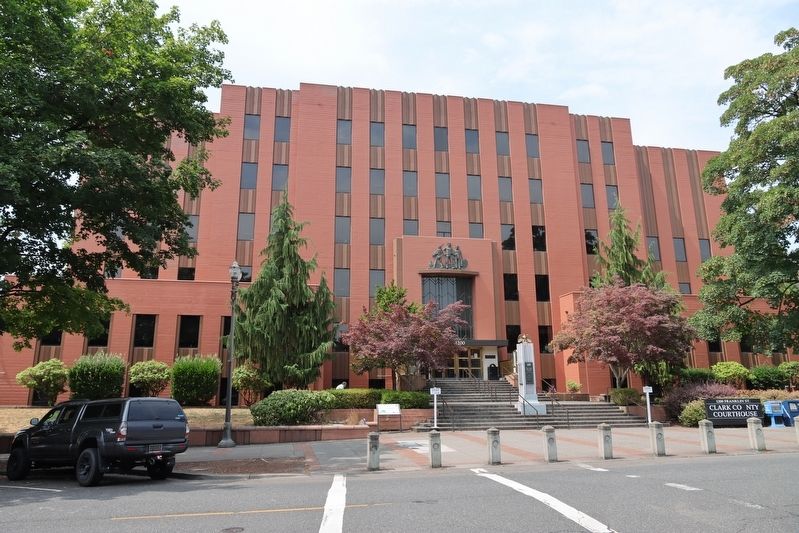
Clark County Courthouse. . The Clark County Courthouse opened Nov. 29, 1941. Although it was not the county's first courthouse, it has endured longer than the previous three. Local architect Day Walter Hilborn designed the six-story building in the Art Deco/Art Moderne-style popular for public construction projects at the time. The structure showcased the most modern developments in the building arts. The courthouse was built of reinforced concrete to prevent fire from destroying thousands of irreplaceable documents and records, which is what happened when the county’s second courthouse burned in 1890. The courthouse originally housed all county departments, a Justice of the Peace, other agencies and a 70-inmate jail. The one windowless courtroom included separate rooms for male and female jurors. The building now houses only Clark County Superior Court and District Court courtrooms and offices. In 2014, the courthouse was placed on the National Register of Historic Places for its significance as the headquarters of county-level government and politics, and, architecturally, as an excellent example of an Art Deco/Art Moderne-style public building., The Buckskin Brigade , Architect Day Walter Hilborn also designed the original Buckskin Brigade sculpture above the front entrance of the courthouse. Executed by architectural sculptor Vic Schneider, the bas-relief work was poured as part of the wall. It depicts an Iroquois man with two fur trappers and symbolizes the role the fur trade played establishing Clark County as a center of government and business. In 1978, workers preparing to paint the building noticed the sculpture was damaged, and it was taken down. Local citizens raised money to recreate the sculpture in bronze, and it was installed on Sept. 13, 1990., The Architect , Few people had a greater impact on southwest Washington’s built environment than architect Day Walter Hilborn. He designed many well-known downtown buildings; including the Kiggins Theatre on Main Street; the original building for The Columbian newspaper on Evergreen Boulevard and the homes of many of Vancouver’s social, political and business elite. The courthouse is perhaps Hilborn’s greatest legacy. It assured his place in local history and. brought him nationwide recognition., The First Three Courthouses , 1. Clark County’s first courthouse was a two-story, wood frame structure built in 1855 on West Reserve Street, near Fort Vancouver. Cost: $1,000, 2. The second courthouse was a three-story brick building that stood in approximately the same location as today’s courthouse. Built in late 1883, it went up in flames 7 ½ years later, destroying a large number of public records. Cost: $44,460, 3. The third courthouse was a Romanesque style, three-story brick building with a large clock tower. Built in 1892, it stood slightly to the south of today’s courthouse. The county outgrew it by the late 1930s, and it was replaced by the current courthouse and demolished. Cost: $65,000, Captions , (Photo #1) Top: The courthouse shortly after it opened in 1941, Source: Washington State Archives , (Photo #2) Bottom, left to right: 1941 photos of employees of the Clerk's Office on the fourth floor; Superior Court in session; and the Sheriff's Office on the ground floor , (Photo #3) Image courtesy of the State Department of Archaeology and Historic Preservation
The Clark County Courthouse opened Nov. 29, 1941. Although it was not the county's first courthouse, it has endured longer than the previous three. Local architect Day Walter Hilborn designed the six-story building in the Art Deco/Art Moderne-style popular for public construction projects at the time. The structure showcased the most modern developments in the building arts. The courthouse was built of reinforced concrete to prevent fire from destroying thousands of irreplaceable documents and records, which is what happened when the county’s second courthouse burned in 1890. The courthouse originally housed all county departments, a Justice of the Peace, other agencies and a 70-inmate jail. The one windowless courtroom included separate rooms for male and female jurors. The building now houses only Clark County Superior Court and District Court courtrooms and offices. In 2014, the courthouse was placed on the National Register of Historic Places for its significance as the headquarters of county-level government and politics, and, architecturally, as an excellent example of an Art Deco/Art Moderne-style public building.
The Buckskin Brigade
Architect Day Walter Hilborn also designed the original Buckskin Brigade sculpture above the front entrance of the courthouse. Executed by architectural sculptor Vic Schneider,
Click or scan to see this page online
the bas-relief work was poured as part of the wall. It depicts an Iroquois man with two fur trappers and symbolizes the role the fur trade played establishing Clark County as a center of government and business. In 1978, workers preparing to paint the building noticed the sculpture was damaged, and it was taken down. Local citizens raised money to recreate the sculpture in bronze, and it was installed on Sept. 13, 1990.
The Architect
Few people had a greater impact on southwest Washington’s built environment than architect Day Walter Hilborn. He designed many well-known downtown buildings; including the Kiggins Theatre on Main Street; the original building for The Columbian newspaper on Evergreen Boulevard and the homes of many of Vancouver’s social, political and business elite. The courthouse is perhaps Hilborn’s greatest legacy. It assured his place in local history and. brought him nationwide recognition.
The First Three Courthouses
1. Clark County’s first courthouse was a two-story, wood frame structure built in 1855 on West Reserve Street, near Fort Vancouver. Cost: $1,000
2. The second courthouse was a three-story brick building that stood in approximately the same location as today’s courthouse. Built in late 1883, it went up in flames 7 ½ years later, destroying a large number of public records. Cost: $44,460
3.
Photographed by William Thievon, July 31, 2025
2. Clark County Courthouse with Marker
The third courthouse was a Romanesque style, three-story brick building with a large clock tower. Built in 1892, it stood slightly to the south of today’s courthouse. The county outgrew it by the late 1930s, and it was replaced by the current courthouse and demolished. Cost: $65,000
Captions (Photo #1) Top: The courthouse shortly after it opened in 1941, Source: Washington State Archives (Photo #2) Bottom, left to right: 1941 photos of employees of the Clerk's Office on the fourth floor; Superior Court in session; and the Sheriff's Office on the ground floor (Photo #3) Image courtesy of the State Department of Archaeology & Historic Preservation
Erected by City of Vancouver, Clark County Historical Preservation Commission.
Topics. This historical marker is listed in this topic list: Architecture. A significant historical date for this entry is November 29, 1941.
Location. 45° 37.816′ N, 122° 40.636′ W. Marker is in Vancouver, Washington, in Clark County. It is in Esther Short. It is at the intersection of Franklin Street and W 12th Street, on the right when traveling south on Franklin Street. Touch for map. Marker is at or near this postal address: 1200 Franklin St, Vancouver WA 98660, United States of America. Touch for directions.

Regionally, this marker is in Greater Portland Area and in Southwest Washington State. It is also on the American Pacific Coast, in the Pacific Northwest, and in the Lewis & Clark Corridor. Globally, it is in North America, the Pacific Rim, the Western Hemisphere, the Western World, and the Anglosphere.
Credits. This page was last revised on November 2, 2025. It was originally submitted on October 27, 2025, by William Thievon of Hofheim am Taunus, Germany. This page has been viewed 114 times since then and 63 times this year. Photos:1, 2. submitted on October 27, 2025, by William Thievon of Hofheim am Taunus, Germany. • James Hulse was the editor who published this page.
