Boone in Boone County, Iowa — The American Midwest (Upper Plains)
First National Bank

Photographed by Cosmos Mariner, September 17, 2025
1. First National Bank Marker
This property has been placed on the
National Register of Historic Places
by the United States Department of the Interior
Topics and series. This historical marker is listed in these topic lists: Architecture • Notable Buildings. In addition, it is included in the National Register of Historic Places (NRHP) series list. A significant historical year for this entry is 1916.
Location. 42° 3.819′ N, 93° 52.793′ W. Marker is in Boone, Iowa, in Boone County. It is at the intersection of 8th Street and Story Street, on the left when traveling west on 8th Street. The marker is mounted at eye-level on the northwest corner of the subject building. Touch for map. Marker is at or near this postal address: 900 8th Street, Boone IA 50036, United States of America. Touch for directions.

Regionally, this marker is in the American Midwest and in the Corn Belt. Globally, it is in North America, the Western Hemisphere, the Western World, and the Anglosphere. Historically, it finds itself in what was once the territory of the Mississippian Culture and also the Louisiana Purchase.
Other nearby markers. At least 8 other markers are
this page online
Regarding First National Bank. National Register of Historic Places № 88003232.
From the National Register Nomination prepared by Ralph J. Christian, 5/1988:
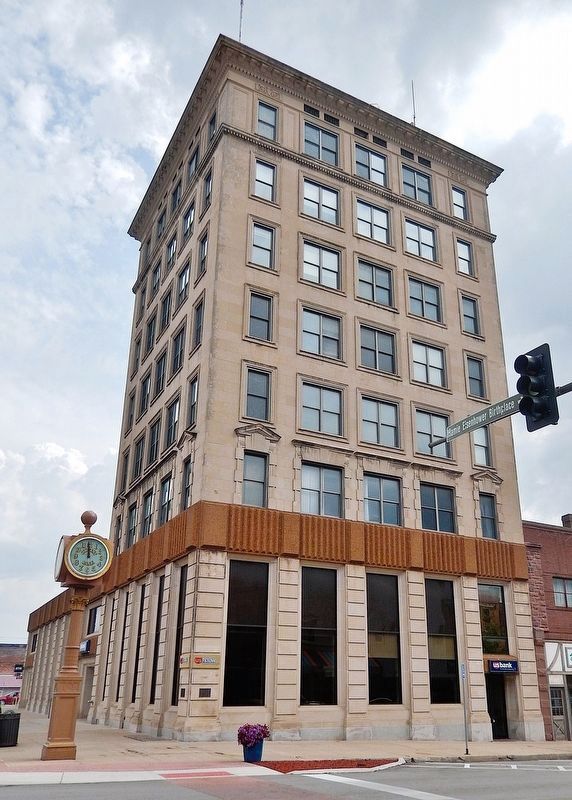
Situated on a prominent corner location in Boone's downtown commercial district, the eight-story First National Bank Building has been that city's primary visual landmark since its completion in 1916. The edifice is typical of Proudfoot & Bird tall buildings in its tripartite division into base, shaft, and capital and use of materials. In this instance, sawed rusticated ashlar is utilized on the pilasters of the two-storybase to achieve a feeling of solidity; the five-story shaft is dressed in smooth-faced stone; and the one-story crown or capital, with its fine detailing and highly decorative overhanging cornice is an unusually fine example of the airy cornice treatment employed by the firm. In terms of stylistic influences, the basic form of the building and the construction technology employed in its erection is Chicago Commercial, but the ornament applied to the skin of the edifice is Classical Revival and typifies Proudfoot and Bird's somewhat conservative approach to architectural design.Photographed by Cosmos Mariner, September 17, 20252. First National Bank MarkerThere are 2 identical markers mounted on the northwest corner of the building, one facing 8th Street and another facing Story Street.
Originally, this building featured a rather elaborate two-story banking room on the interior, but this and other significant interior features were obliterated by remodeling in the late 1970's. At the same time, a two-story high addition, intended to be sympathetic, was added to the east side of the building, and a beltcourse of brown aggregate material was placed over the beltcourse at the top of the base to tie them together visually. Windows and doors in the base section were removed and redesigned, but the stonework was retained. Windows on the upper floorswere removed as well, but the original configuration was retained.Photographed by Cosmos Mariner, September 17, 20253. First National Bank Building
(west elevation)
The First National Bank, which was established in 1884, hired Proudfoot, Bird & Rawson in 1915 to design this building after fire destroyed their old edifice in this same location. Because of that experience, the bank insisted on fireproof construction, and T.C. Wardell of Chicago, said to be a specialist in that type of building, was hired as superintendent of construction.
Construction started in 1915 and was completed early in 1916 at a cost of $115,000. That project was part of a larger building boom in Boone that year that saw the completion of modern business blocks on four prominent corners in the downtown district. This project also appears to have led to residential commissions for Proudfoot and Bird as well. In 1919 John H. Herman, the bank's Vice President, hired the firm to design his residence at 711 Story Street.
Because of its location on what soon became part of the Lincoln Highway and in the heart of the downtown business district, the building quickly became the city's most prominent landmark, not only for local people but the motoring public. In 1935,the bank was acquired by Citizen's National Bank, and the name was changed to reflect the new ownership. Although the Lincoln Highway (U.S. 30) has been relocated outside town, and the bank has been modified somewhat, it continues to visually dominate Boone and provide a locational reference point.Photographed by Cosmos Mariner, September 17, 20254. First National Bank Building (northeast elevation)This view highlights the circa 1970 sympathetic 2-story addition on the east side of the building. Today the main front entrance is on this facade.


Related markers. Click here for a list of markers that are related to this marker.
Also see . . . First National Bank (Wikipedia).
Excerpt: First National Bank, now known as US Bank, was established in 1884, and their building at this location was destroyed in a fire in 1914. The eight-story bank and office building that replaced it is the work of the Des Moines architectural firm of Proudfoot, Bird & Rawson. The architecture combines the styling of the Neoclassical style with the form and construction technology of the Chicago Commercial School. The building was listed on the National Register of Historic Places in 1989. The bank has subsequently been acquired by US Bank, and the building now uses their name.(Submitted on October 28, 2025, by Cosmos Mariner of Cape Canaveral, Florida.)

Photographed by Cosmos Mariner, September 17, 2025
5. First National Bank Building (northwest elevation)
From the National Register Nomination: The First National Bank Building is a five-bay by five-bay, 50-foot square, eight-story building with a frame of structural steel beams, girders, and columns, which are encased in concrete for fireproofing. At foundation level, the base of the building is sheathed in Georgia granite while Bedford limestone covers the building on its west and north sides. The east and south elevations feature Twin City vitrified brick of a greyish ecru color to match the Bedford stone. Windows are generally of the one-over-one sash variety and are set in rectangular stone-trimmed surrounds and are placed singly on the corner bays and paired on the inner ones. Floors are all of concrete and tile construction, as is the flat roof, which is finished with a tile surface.
The decorative vocabulary of this building, like many Proudfoot and Bird Buildings, is Classical Revival although the basic form and construction technology is drawn from the Chicago Commercial School, which in turn drew on classical inspiration for its organizational format.
Another noteworthy classical revival element is the freestanding clock located near the northwest corner of the building and adjacent to the intersection of Story and Eighth Streets. This bronze clock, manufactured by the Howard Company of New York, is eighteen feet high and has four 3-foot dials.
The decorative vocabulary of this building, like many Proudfoot and Bird Buildings, is Classical Revival although the basic form and construction technology is drawn from the Chicago Commercial School, which in turn drew on classical inspiration for its organizational format.
Another noteworthy classical revival element is the freestanding clock located near the northwest corner of the building and adjacent to the intersection of Story and Eighth Streets. This bronze clock, manufactured by the Howard Company of New York, is eighteen feet high and has four 3-foot dials.
Credits. This page was last revised on October 28, 2025. It was originally submitted on October 28, 2025, by Cosmos Mariner of Cape Canaveral, Florida. This page has been viewed 73 times since then and 37 times this year. Photos: 1, 2, 3, 4, 5. submitted on October 28, 2025, by Cosmos Mariner of Cape Canaveral, Florida.
