Central Area in Salem in Marion County, Oregon — The American West (Northwest)
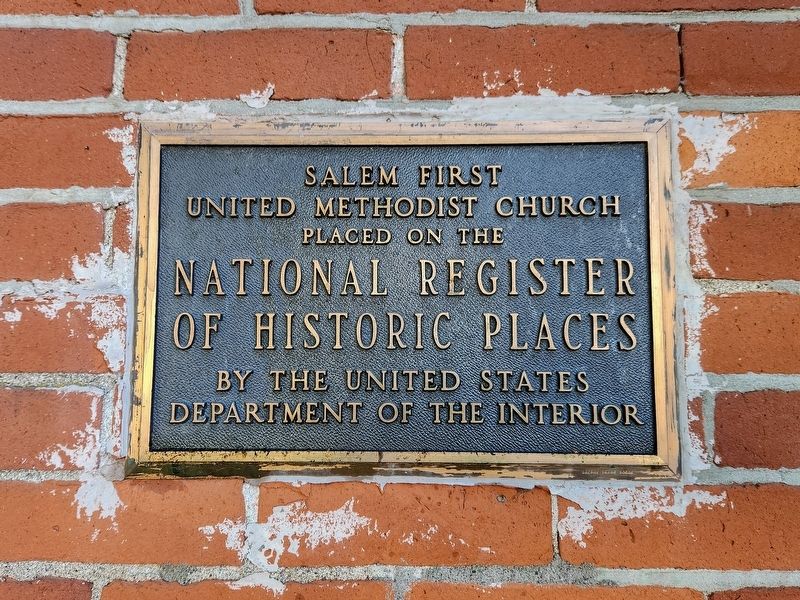
Salem First United Methodist Church
Photographed by Douglass Halvorsen, October 14, 2025
1. Salem First United Methodist Church Marker
National Register of Historic Places
by the United States Department of the Interior
Erected by United States Department of the Interior.
Topics and series. This historical marker is listed in this topic list: Religion & Religious Structures. In addition, it is included in the National Register of Historic Places (NRHP) series list.
Location. 44° 56.338′ N, 123° 2.125′ W. Marker is in Salem, Oregon, in Marion County. It is in the Central Area. It is at the intersection of State Street and Church Street, on the right when traveling east on State Street. Touch for map. Marker is at or near this postal address: 600 State Street, Salem OR 97301, United States of America. Touch for directions.

Regionally, this marker is in Oregon Wine Country and in the Willamette Valley. It is also on the American Pacific Coast, in the Pacific Northwest, and in the Lewis & Clark Corridor. Globally, it is in North America, in the Cascade Range, on the Ring of Fire, on the Pacific Rim, in the Western Hemisphere, in the Western World, and in the Anglosphere.
this page online
Other nearby markers. At least 8 other markers are within walking distance of this marker: Bligh Building (about 500 feet away, measured in a direct line); Elsinore Theatre (about 500 feet away); Salem’s Chinatown (about 600 feet away); Claire Maybelle Phillips (about 600 feet away); John Hughes Company/New Salem Hotel Building (about 600 feet away); Oregon Spirit of ‘45 (about 600 feet away); Salem’s Theatrical History (about 600 feet away); The Grand Hotel (about 600 feet away). Touch for a list and map of all markers in Salem.
Also see . . . National Register of Historic Places Inventory-Nomination Form (1983). Statement of Significance:
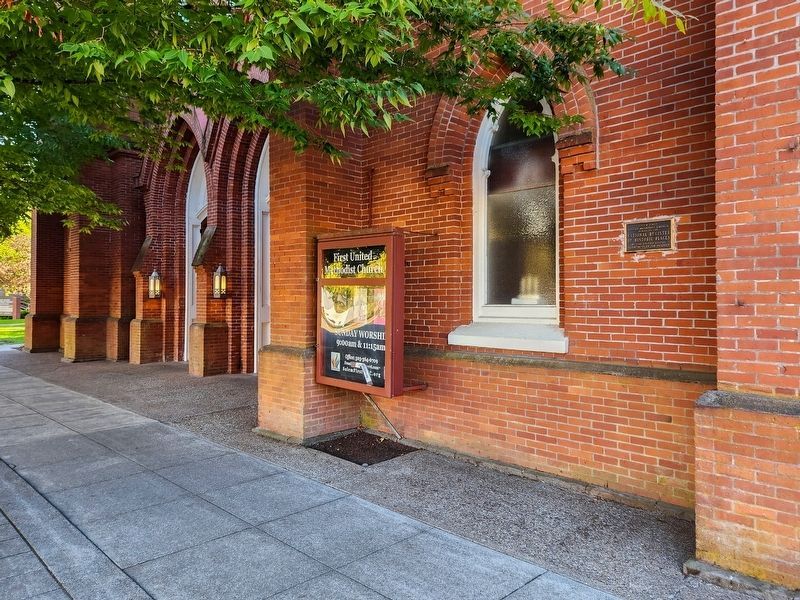
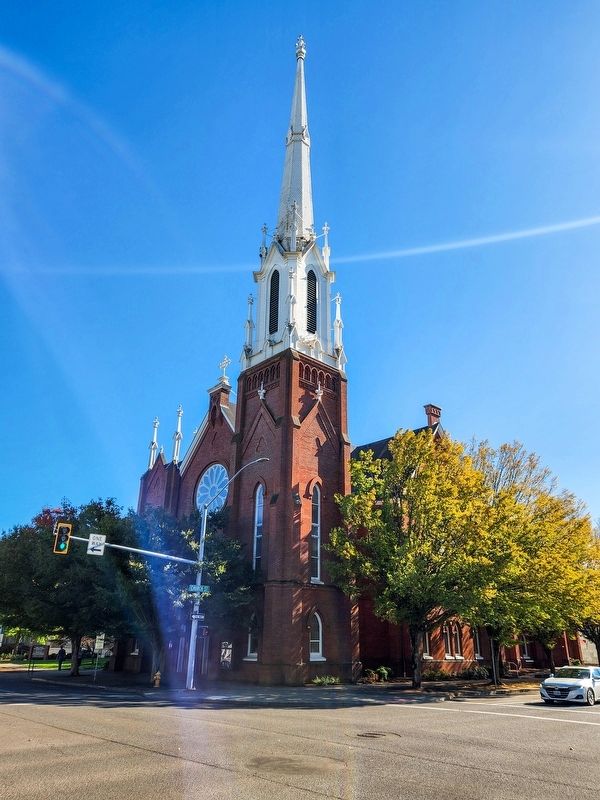
The First Methodist Episcopal Church of Salem, in the capital city of Oregon, is a pivotal landmark facing the elongated town square occupied by county, state and federal government buildings. Its location at the intersection of Church and State Streets is symbolically apt. The church was built between 1871 and 1878 from plans supplied by Chicago architect Cass Chapman and reduced in scale by one eighth. Salem contractor and architect Wilbur F. Boothby was engaged in 1877 to prepare(Submitted on October 28, 2025, by Douglass Halvorsen of Klamath Falls, Oregon.)plans and supervise completion of the final stages of construction. With its modified cruciform plan, its multiplicity of gables, buttresses, pointed arch openings, and its pinnacled belfry and spire, it embodies the distinctive characteristics of the Gothic Revival Style. The sizable brick church was enlarged by two major additions in 1935 and in 1967 in response to growth of the congregation and diversification of the ministry. Major renovation work was carried out from 1951 to 1953, and while the chancel was altered substantially, the auditorium is spatially intact. The evolutionary development of the property reflects a vigorous and progressive downtown church which has occupied the same prominent corner site since 1852. Salem was settled in 1841 by members of the Methodist Mission in Oregon and was platted in 1850. Proceeds from the sale of lots in the townsite supported the Methodists' Oregon Institute, the educational enterprise which became Willamette University. While the present church is successor to the original Methodist Church on the site, it is nonetheless rooted through its congregation to the beginnings of Salem andPhotographed by Douglass Halvorsen, October 14, 20252. Salem First United Methodist Church MarkerThe marker is located to the right of the main entrance to the church, facing State Street.to the beginnings of Methodism in Oregon. In addition to its historical associations, the church is significant to the city and state as a well-maintained and relatively rare example of its architectural type possessing integrity of location, setting, feeling, design, materials, and workmanship. It is now the only church building in Salem antedating 1880 and its spire is one of the very few tall Gothic Revival spires remaining in Oregon.Photographed by Douglass Halvorsen, October 14, 20253. Salem First United Methodist Church
The First Methodist Church of Salem is significant to the state also as an embodiment of church organization which had its beginnings in Oregon in the Methodist Mission founded in 1834 by the Reverend Jason Lee (1803-1845). The importance of the Methodist Mission in Oregon was not just that it was the first among several missions to the Indians in the Pacific Northwest, nor that it was at its height in 1841 the largest single foreign missionary enterprise to have been launched from the United States. The primary purpose of the mission under Jason Lee was to convert the native population to Methodism, and toward that end, satellite stations were set up throughout the region--at Nisqually on Puget Sound, Clatsop Plains on the coast, and The Dalles on the Columbia River. While some tentative success was realized among the Indians of the middle Columbia at "Wascopam", the Methodists eventually were discouraged in their prosyletizing efforts among the scattered and decimated tribes of the Willamette Valley, where the base of their operations was laid.
Enlarged and expanded by additions of 1935 and 1967, "First Church" has continued to serve a growing congregation and church school, Willamette University, and the changing needs of the community and the ministry to the present day. Following the 1939 Declaration of Union by the Uniting Conference of three related denominations—the Methodist Episcopal Church, the Methodist Episcopal Church South, and the Methodist Protestant Church, the downtown church became known as the First Methodist Church of Salem. It was in 1968 that the current style. First United Methodist Church of Salem, was adopted in response to the Uniting Conference which merged the Methodist Church and the Evangelical United Brethren Church."
Because it is descended from the first Methodist church organized in the Oregon Country, the First United Methodist Church of Salem enjoys special stature in the Oregon-Idaho Conference today. It is host to the annual meetings of the Conference three out of every four years. The church enjoys equivalent stature in the community. Not only is it a landmark in the urban center, it has been the setting of innumerable social and public service events throughout the years.
Credits. This page was last revised on October 31, 2025. It was originally submitted on October 28, 2025, by Douglass Halvorsen of Klamath Falls, Oregon. This page has been viewed 45 times since then and 19 times this year. Photos: 1, 2, 3. submitted on October 28, 2025, by Douglass Halvorsen of Klamath Falls, Oregon. • Andrew Ruppenstein was the editor who published this page.
