Franklin in St. Mary Parish, Louisiana — The American South (West South Central)
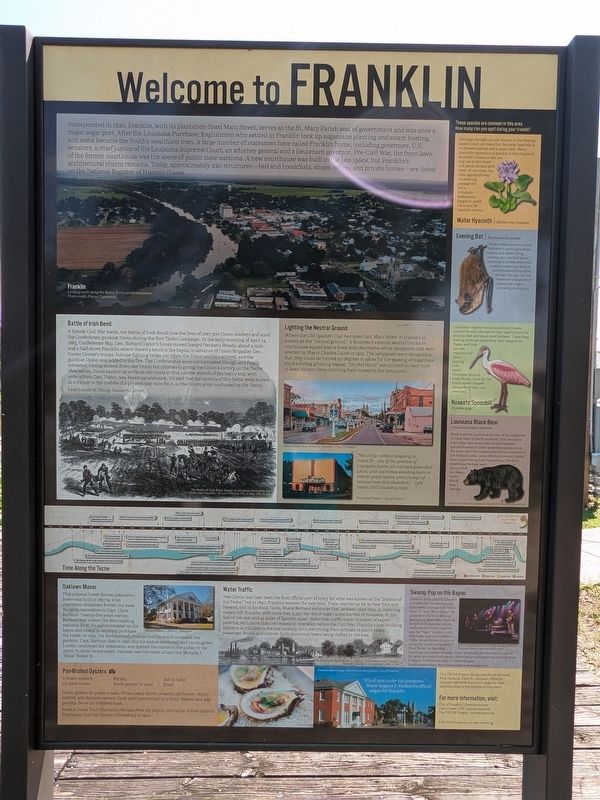
Welcome to Franklin
Photographed by Cajun Scrambler, September 12, 2025
1. Welcome to Franklin Marker
Incorporated in 1820, Franklin, with its plantation-lined Main Street, serves as the St. Mary Parish seat of government and was once a major sugar port. After the Louisiana Purchase, Englishmen who settled in Franklin took up sugarcane planting and steam boating. and some became the South's wealthiest men. A large number of statesmen have called Franklin home, including governors, U.S. senators, a chief justice of the Louisiana Supreme Court, an attorney general and a lieutenant governor. Pre-Civil War, the front lawn of the former courthouse was the scene of public slave auctions. A new courthouse was built in the late 1960s, but Franklin's architectural charm remains. Today, approximately 420 structures-bed and breakfasts, shops, offices and private homes-are listed on the National Register of Historic Places.
Battle of Irish Bend
A bloody Civil War battle, the Battle of Irish Bend took the lives of over 300 Union soldiers and sunk the Confederate gunboat Diana during the first Teche Campaign. In the early morning of April 14, 1863, Confederate Maj. Gen. Richard Taylor's forces moved toward Nerson's Woods, about
this page online
Learn more at Young-Sanders Center.
Lighting the Neutral Ground
Where the Old Spanish Trail becomes East Main Street in Franklin is known as the "neutral ground." A boulevard extends several blocks to courthouse square and is lined with decorative white lampposts that were erected by Mayor Charles Lauve in 1915. The lampposts were designed so that they could be turned 90 degrees to allow for the passing of sugarcane trucks during grinding season. "Do Not Hitch"
Photographed by Cajun Scrambler, September 12, 2025
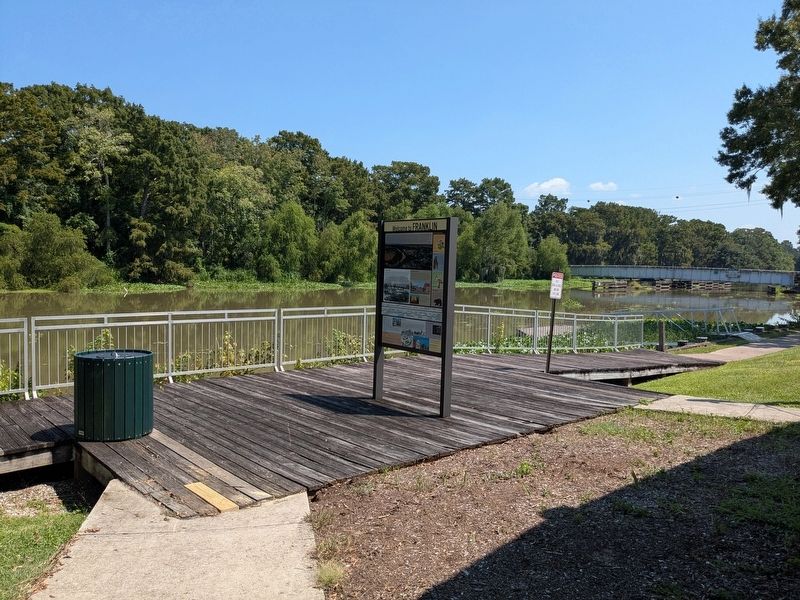
2. Welcome to Franklin Marker
"We will go without stopping to Franklin-one of the prettiest of Louisiana towns, all cool and green and white, with old homes standing back on smooth green lawns, amid clumps of banana trees and oleanders." - Lyle Saxon, Old Louisiana, 1929
Oaklawn Manor
This colossal Greek Revival plantation home was built in 1837 by Irish statesman Alexander Porter, but owes its 1920s restoration to Capt. Clyde Barbour. Twenty-five years earlier, Barbour had viewed the deteriorating mansion from his paddlewheeler on the bayou and vowed to someday purchase the home. In 1925, the Barbours refurbished the home and recreated the gardens. Capt. Barbour died in 1930, but his widow remained, and his daughter, Lucille, continued the restoration and opened the manor to the public in the 1950s. In more recent years, Oaklawn was the home of late Gov. Murphy J. "Mike" Foster Jr.
Pan-Broiled Oysters
2 dozen oysters
1/3 stick butter
Parsley
Black pepper to taste
Salt to taste
Toast
Drain oysters on paper towels. When heavy skillet is warm, add butter. When melted,

Photographed by Cajun Scrambler, September 12, 2025
3. Welcome to Franklin Marker
Water Traffic
New Iberia may have been the first official port of entry for what was known as the "District of the Teche," but in 1830, Franklin became the new port. Trade reached as far as New York and Havana, and in his book Teche, Shane Bernard estimates that between 1842-1843, 91 seafaring vessels left Franklin with more than 5,350 barrels of sugar; 9,200 barrels of molasses; 81,700 feet of live oak; and 95 bales of Spanish moss. Steamboat traffic made this level of export possible, with more than 100 vessels in operation before the Civil War. Franklin's boat building industry is still alive in the 21st century, with everything from airboats to patrol boats, passenger ferries and custom-built aluminum boats being crafted in the area.
"It's all here under the lampposts."
- Mayor Eugene P. Foulcard's official slogan for Franklin
Swamp Pop on the Bayou
Franklin-born Johnny Chauvin is known for his swamp pop and covers of songs like "Fools Rush In" and "Blue Moon." He plays with his Mojo Band at the annual Black Bear Festival, as well as at regional venues, casinos and events. Chauvin and Ed "Tiger" Verdin, a city employee, started the Bayou Teche Music Series in 2020 to bring live music to Franklin's Main Street on Saturday Johnny Chauvin and the Mojo Band perform Johnny Chauvin and the Majo Band mornings and some evenings. Local musicians are welcome to join in for jams, and music education, mentorship and exploring oral histories of Bayou Teche are all part of the series' goal.
Find a complete Bayou Teche music playlist at techeproject.org!
The TECHE Project recognizes Shane Bernard. Patti Holland, Tami St. Germain, Chloé St. Germain-Vermillion and Erin Bass for their contributions to the content of this panel
For more information, visit:
City of Franklin franklin-la.com Cajun Coast VCB | cajuncoast.com The TECHE Project | techeproject.org
Erected 2021 by The TECHE Project.
Topics. This historical marker is listed in this topic list: Settlements & Settlers.
Location. 29° 47.57′ N, 91° 29.976′ W. Marker is in Franklin, Louisiana, in St. Mary Parish. It is on Teche Drive near Commercial Street. Touch for map. Marker is at or near this postal address: 605 Teche Dr, Franklin LA 70538, United States of America. Touch for directions.

Regionally, this marker is in one of Louisiana’s River Parishes, in Acadiana — Cajun Country, and specifically in Bayou Country. It is also in the American South, specifically in the Deep South, on the Gulf Coast, and in the Great River Road Region. Globally, it is in North America, a Gulf of Mexico state, the Western Hemisphere, the Western World, and the Anglosphere. Historically, it finds itself in what was once New Spain, Acadia, the territory of the Mississippian Culture, the Louisiana Purchase, one of the Confederate States of America, and the Antebellum South.
Other nearby markers. At least 8 other markers are within walking distance of this marker: Bayou Teche (within shouting distance of this marker); Battle Of Irish Bend (about 500 feet away, measured in a direct line); The Gunboat Diana (about 500 feet away); Jared Young Sanders (about 500 feet away); Franklin (about 500 feet away); Charles Austin O'Niell (about 600 feet away); Edward V. Loustalot (about 600 feet away); St. Mary Parish Courthouse War Memorial (about 600 feet away). Touch for a list and map of all markers in Franklin.
Also see . . . Official The TECHE Project website. (Submitted on October 31, 2025, by Cajun Scrambler of Assumption, Louisiana.)
Credits. This page was last revised on October 31, 2025. It was originally submitted on October 31, 2025, by Cajun Scrambler of Assumption, Louisiana. This page has been viewed 73 times since then and 39 times this year. Photos: 1, 2, 3. submitted on October 31, 2025, by Cajun Scrambler of Assumption, Louisiana.
