Ashland in Hanover County, Virginia — The American South (Mid-Atlantic)
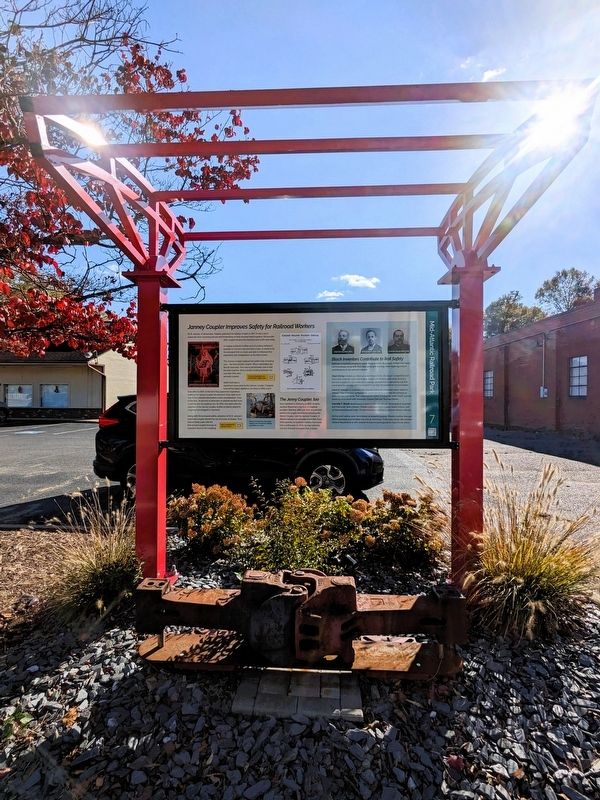
Janney Coupler Improves Safety for Railroad Workers
| — | Mid-Atlantic Railroad Park | — |
Photographed by Bernard Fisher, November 1, 2025
1. Janney Coupler Improves Safety for Railroad Workers Marker
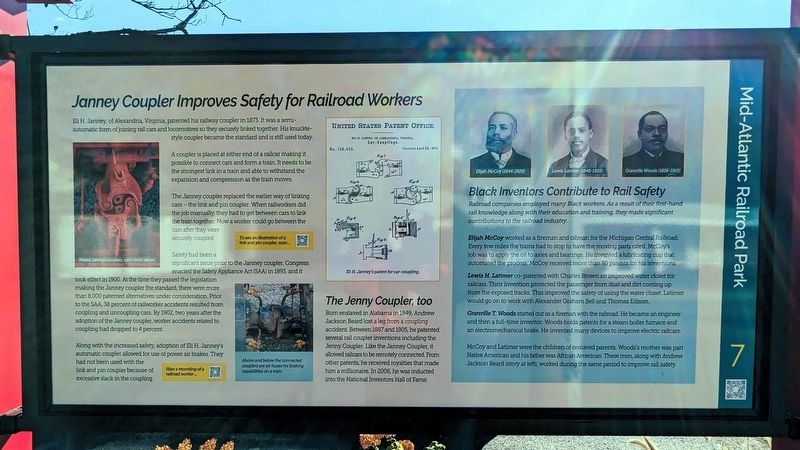
Eli H. Janney, of Alexandria, Virginia, patented his railway coupler in 1873. It was a semi-automatic form of joining rail cars and locomotives so they securely linked together. His knuckle-style coupler became the standard and is still used today.
A coupler is placed at either end of a railcar making it possible to connect cars and form a train. It needs to be the strongest link in a train and able to withstand the expansion and compression as the train moves.
The Janney coupler replaced the earlier way of linking cars - the link and pin coupler. When railworkers did the job manually, they had to get between cars to link the train together. Now a worker could go between the cars after they were securely coupled.
Safety had been a significant issue prior to the Janney coupler. Congress enacted the Safety Appliance Act (SAA) in 1893, and it took effect in 1900. At the time they passed the legislation making the Janney coupler the standard, there were more than 8,000 patented alternatives under consideration. Prior to the SAA, 38 percent of railworker accidents resulted from coupling and uncoupling cars. By 1902,
this page online
Along with the increased safety, adoption of Eli H. Janney's automatic coupler allowed for use of power air brakes. They had not been used with the link and pin coupler because of excessive slack in the coupling.
The Jenny Coupler, too
Born enslaved in Alabama in 1849, Andrew Jackson Beard lost a leg from a coupling accident. Between 1887 and 1905, he patented several rail coupler inventions including the Jenny Coupler. Like the Janney Coupler, it allowed railcars to be remotely connected. From other patents, he received royalties that made him a millionaire. In 2006, he was inducted into the National Inventors Hall of Fame.
(captions)
Mated Janney couplers, seen from above.
Above and below the connected couplers are air hoses for braking capabilities on a train.
Eli H. Janey's patent for car-coupling.
Black Inventors Contribute to Rail Safety
Railroad companies employed many Black workers. As a result of their first-hand rail knowledge along with their education and training, they made significant contributions
Photographed by Bernard Fisher, November 1, 2025
2. Janney Coupler Improves Safety for Railroad Workers Marker
Elijah McCoy worked as a fireman and oilman for the Michigan Central Railroad. Every few miles the trains had to stop to have the moving parts oiled. McCoy's job was to apply the oil to axles and bearings. He invented a lubricating cup that automated the process. McCoy received more than 50 patents for his inventions.
Lewis H. Latimer co-patented with Charles Brown an improved water closet for railcars. Their invention protected the passenger from dust and dirt coming up from the exposed tracks. This improved the safety of using the water closet. Latimer would go on to work with Alexander Graham Bell and Thomas Edison.
Granville T. Woods started out as a fireman with the railroad. He became an engineer and then a full-time inventor. Woods holds patents for a steam boiler furnace and an electromechanical brake. He invented many devices to improve electric railcars.
McCoy and Latimer were the children of enslaved parents. Woods's mother was part Native American and his father was African American. These men, along with Andrew Jackson Beard (story at left), worked during the same period to improve

Photographed by Bernard Fisher, November 1, 2025
3. Janney Coupler Improves Safety for Railroad Workers Marker
(caption) Elijah McCoy (1844-1929) • Lewis Latimer (1848-1928) • Granville Woods (1856-1910)
Erected 2025 by Mid-Atlantic Railroad Park. (Marker Number 7.)
Topics. This historical marker is listed in these topic lists: African Americans • Railroads & Streetcars. A significant historical year for this entry is 1873.
Location. 37° 45.517′ N, 77° 28.62′ W. Marker is in Ashland, Virginia, in Hanover County. It is on England Street (Virginia Route 54) west of South Taylor Street, on the left when traveling west. Touch for map. Marker is in this post office area: Ashland VA 23005, United States of America. Touch for directions.

Regionally, this marker is in Virginia’s Piedmont, in Central Virginia, and in the Richmond Metropolitan Area. It is also in the American South, specifically in the Upper South, and on the Eastern Seaboard. Globally, it is in the North Atlantic Region, North America, the Western Hemisphere, the Western World, and the Anglosphere. Historically, it finds itself in what was once the territory of the Mississippian Culture, one of the original Thirteen Colonies, one of the Confederate

Photographed by Bernard Fisher, November 1, 2025
4. Janney Coupler Improves Safety for Railroad Workers Marker
Other nearby markers. At least 8 other markers are within walking distance of this marker: Electric Train Generates Electricity for Ashland (about 600 feet away, measured in a direct line); Precision Braking, Higher Speeds... (about 800 feet away); All Eyes on the Track - Engineers and Signals (approx. 0.2 miles away); Secretariat: America's Super Horse and Virginia's Pride (approx. 0.2 miles away); Randolph-Macon College (approx. ¼ mile away); Railroad Company Sees Potential For A Town Among The Slash Pines (approx. ¼ mile away); Ashland (approx. ¼ mile away); Downtown Business Growth Fuels Ashland Expansion (approx. ¼ mile away). Touch for a list and map of all markers in Ashland.
Also see . . . Mid-Atlantic Railroad Park. (Submitted on November 2, 2025.)
Credits. This page was last revised on November 2, 2025. It was originally submitted on November 2, 2025, by Bernard Fisher of Richmond, Virginia. This page has been viewed 318 times since then and 227 times this year. Photos: 1, 2, 3, 4. submitted on November 2, 2025, by Bernard Fisher of Richmond, Virginia.
