Ashland in Hanover County, Virginia — The American South (Mid-Atlantic)
Precision Braking, Higher Speeds...
| — | Mid-Atlantic Railroad Park | — |
Photographed by Bernard Fisher, November 1, 2025
1. Precision Braking, Higher Speeds... Marker
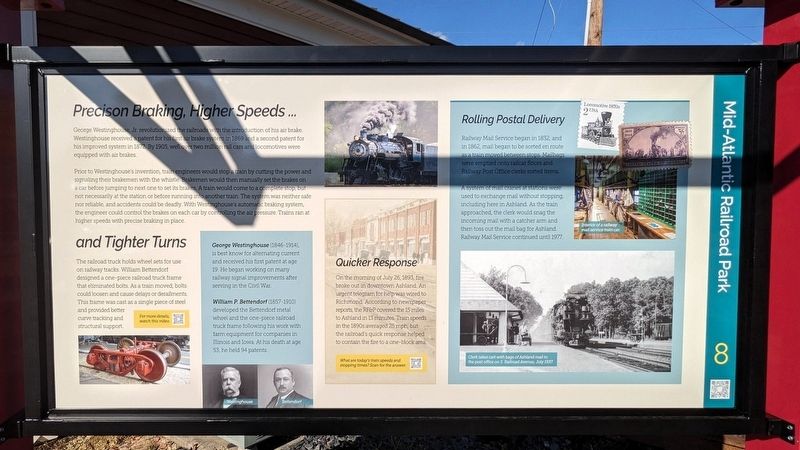
George Westinghouse, Jr. revolutionized the railroads with the introduction of his air brake. Westinghouse received a patent for his first air brake system in 1869 and a second patent for his improved system in 1872. By 1905, well over two million rail cars and locomotives were equipped with air brakes.
Prior to Westinghouse's invention, train engineers would stop a train by cutting the power and signaling their brakemen with the whistle. Brakemen would then manually set the brakes on a car before jumping to next one to set its brakes. A train would come to a complete stop, but not necessarily at the station or before running into another train. The system was neither safe nor reliable, and accidents could be deadly. With Westinghouse's automatic braking system, the engineer could control the brakes on each car by controlling the air pressure. Trains ran at higher speeds with precise braking in place.
and Tighter Turns
The railroad truck holds wheel sets for use on railway tracks. William Bettendorf designed a one-piece railroad truck frame that eliminated bolts. As a train moved, bolts could loosen and cause delays
this page online
Quicker Response
On the morning of July 26, 1893, fire broke out in downtown Ashland. An urgent telegram for help was wired to Richmond. According to newspaper reports, the RF&P covered the 15 miles to Ashland in 13 minutes. Train speeds in the 1890s averaged 25 mph, but the railroad's quick response helped to contain the fire to a one-block area.
George Westinghouse (1846-1914), is best know for alternating current and received his first patent at age 19. He began working on many railway signal improvements after serving in the Civil War.
William P. Bettendorf (1857-1910) developed the Bettendorf metal wheel and the one-piece railroad truck frame following his work with farm equipment for companies in Illinois and Iowa. At his death at age 53, he held 94 patents.
(caption) Westinghouse • Bettendorf
Rolling Postal Delivery
Railway Mail Service began in 1832, and in 1862, mail began to be sorted en route as a train moved between stops. Mailbags were emptied onto railcar floors and Railway Post
Photographed by Bernard Fisher, November 1, 2025
2. Precision Braking, Higher Speeds... Marker
A system of mail cranes at stations were used to exchange mail without stopping, including here in Ashland. As the train approached, the clerk would snag the incoming mail with a catcher arm and then toss out the mail bag for Ashland. Railway Mail Service continued until 1977.
(captions)
Interior of a railway mail service train car.
Clerk takes cart with bags of Ashland mail to the post office on S. Railroad Avenue, July 1937.
Erected 2025 by Mid-Atlantic Railroad Park. (Marker Number 8.)
Topics. This historical marker is listed in this topic list: Railroads & Streetcars. A significant historical year for this entry is 1869.
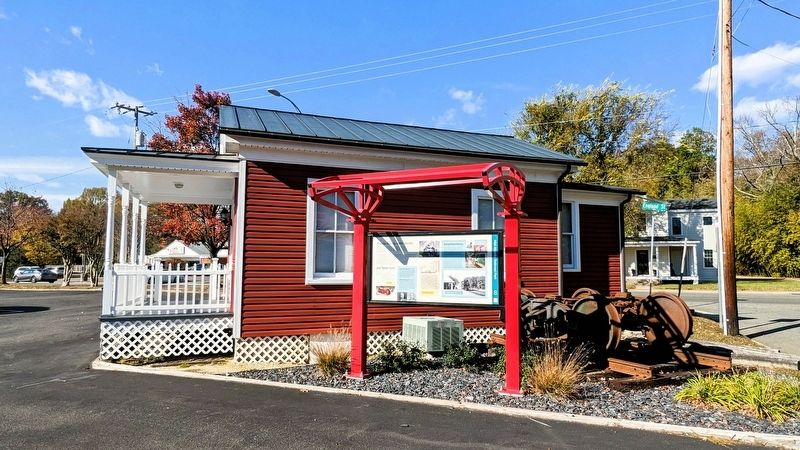
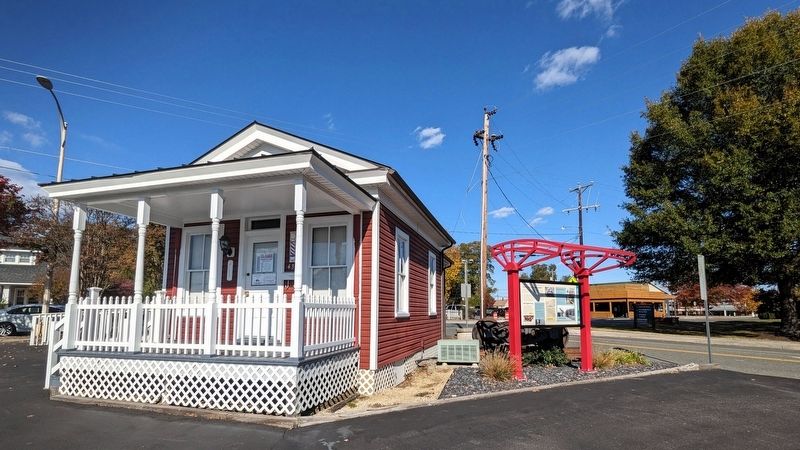
Location. 37° 45.502′ N, 77° 28.457′ W. Marker is in Ashland, Virginia, in Hanover County. It is at the intersection of South Taylor Street and England Street (Virginia Route 54), on the right when traveling south on South Taylor Street. Touch for map. Marker is at or near this postal address: 437 England St, Ashland VA 23005, United States of America. Touch for directions.

Regionally, this marker is in the Piedmont, in Central Virginia, and in the Richmond Metropolitan
Photographed by Bernard Fisher, November 1, 2025
3. Precision Braking, Higher Speeds... Marker
Other nearby markers. At least 8 other markers are within walking distance of this marker: All Eyes on the Track - Engineers and Signals (about 300 feet away, measured in a direct line); Janney Coupler Improves Safety for Railroad Workers (about 800 feet away); Ashland (approx. ¼ mile away); Henry at Hanover Courthouse (approx. ¼ mile away); Randolph-Macon College (approx. ¼ mile away); Electric Train Generates Electricity for Ashland (approx. ¼ mile away); a different marker also named Randolph-Macon College (approx. 0.3 miles away); Secretariat: America's Super Horse and Virginia's Pride (approx. 0.4 miles away). Touch for a list and map of all markers in Ashland.
Also see . . . Mid-Atlantic Railroad Park. (Submitted on November 2, 2025.)
Credits. This page was last revised on November 2, 2025. It was originally submitted on November 2, 2025, by Bernard Fisher of Richmond, Virginia. This page has been viewed 73 times since then and 43 times this year. Photos: 1, 2, 3. submitted on November 2, 2025, by Bernard Fisher of Richmond, Virginia.
