Centerville in St. Mary Parish, Louisiana — The American South (West South Central)
Welcome to Centerville
Photographed by Cajun Scrambler, September 12, 2025
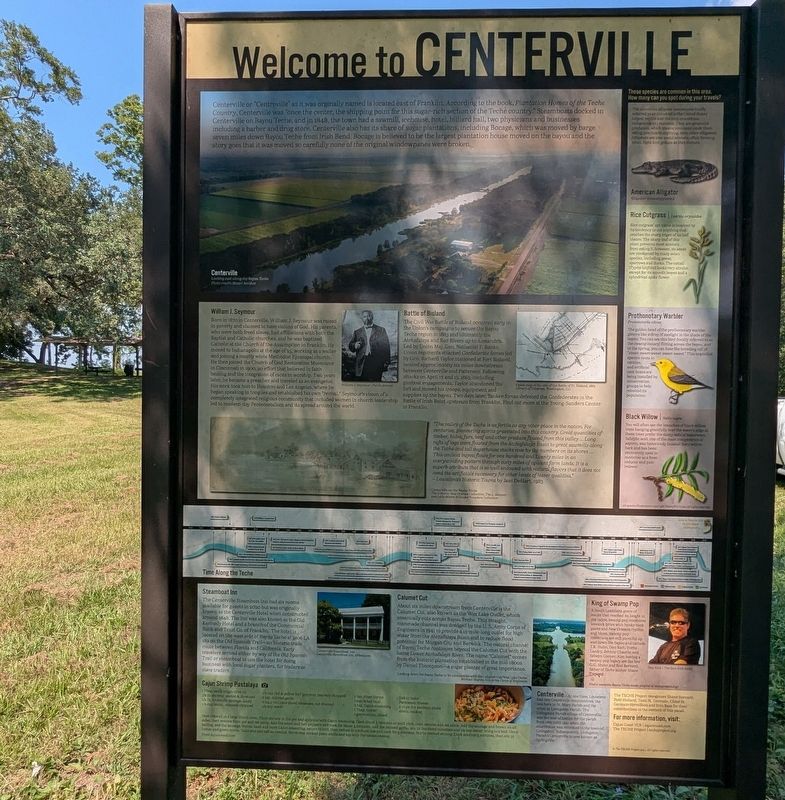
1. Welcome to Centerville Marker
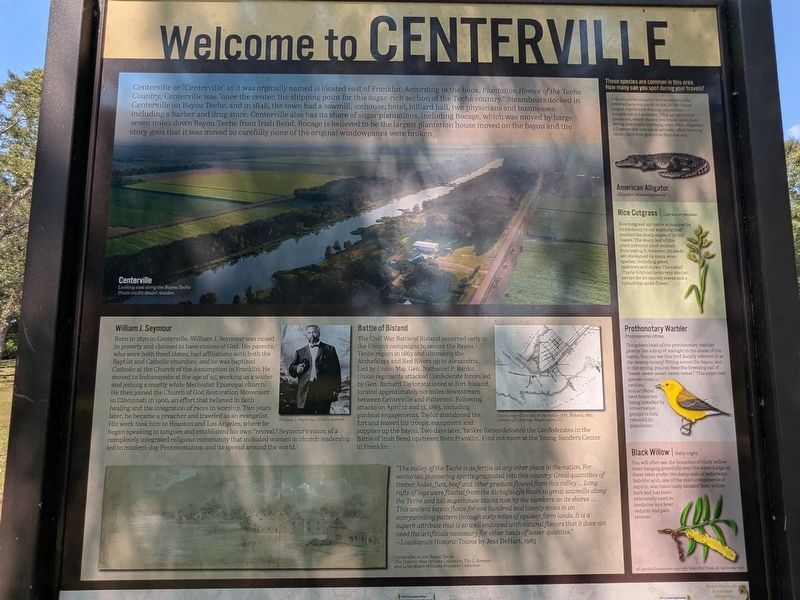
Centerville or "Centreville" as it was orginally named is located east of Franklin. According to the book, Plantation Homes of the Teche Country, Centerville was "once the center, the shipping point for this sugar-rich section of the Techè country." Steamboats docked in Centerville on Bayou Teche, and in 1848, the town had a sawmill, icehouse, hotel, billiard hall, two physicians and businesses including a barber and drug store. Centerville also has its share of sugar plantations, including Bocage, which was moved by barge seven miles down Bayou Teche from Irish Bend. Bocage is believed to be the largest plantation house moved on the bayou and the story goes that it was moved so carefully none of the original windowpanes were broken.
William J. Seymour
Born in 1870 in Centerville, William J. Seymour was raised in poverty and claimed to have visions of God. His parents, who were both freed slaves, had affiliations with both the Baptist and Catholic churches, and he was baptized Catholic at the Church of the Assumption in Franklin. He moved to Indianapolis at the age of 25, working as a waiter and joining a mostly
this page online
Battle of Bisland
The Civil War Battle of Bisland occurred early in the Union's campaigns to secure the Bayou Teche region in 1863 and ultimately the Atchafalaya and Red Rivers up to Alexandria. Led by Union Maj. Gen. Nathaniel P. Banks, Union regiments attacked Confederate forces led by Gen. Richard Taylor stationed at Fort Bisland, located approximately six miles downstream between Centerville and Patterson. Following attacks on April 12 and 13, 1863, including gunboat engagements, Taylor abandoned the fort and moved his troops, equipment and supplies
Photographed by Cajun Scrambler, September 12, 2025
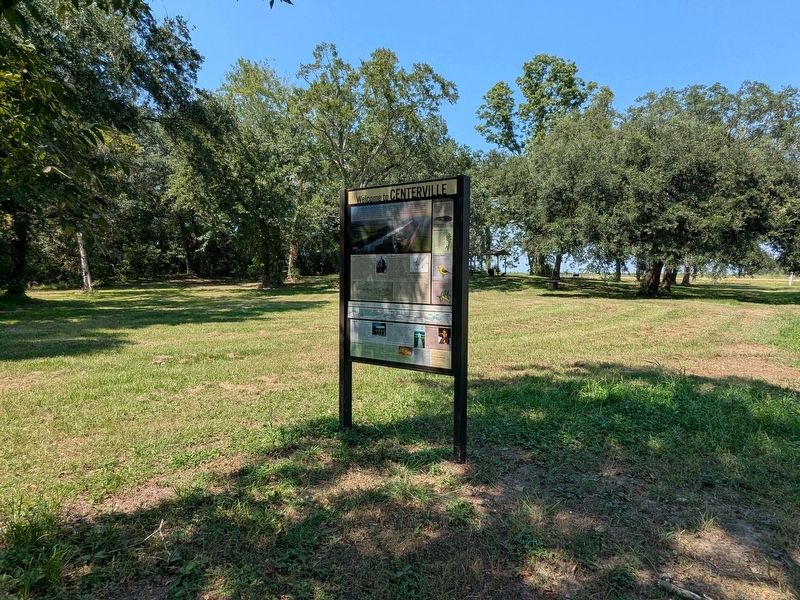
2. Welcome to Centerville Marker
"The valley of the Teche is as fertile as any other place in the nation. For centuries, pioneering spirits gravitated into this country. Great quantities of timber, hides, furs, beef and other produce flowed from this valley... Long rafts of logs were floated from the Atchafalaya Basin to great sawmills along the Teche and tall sugarhouse stacks rose by the numbers on its shores... This ancient bayou flows for one hundred and twenty miles in an everywinding pattern through sixty miles of opulent farm lands. It is a superb attribute that is so well endowed with natural flavors that it does not need the artificials necessary for other lands of lesser qualities." - Louisiana's Historic Towns by Jess DeHart, 1983
Steamboat Inn
The Centerville Steamboat Inn had six rooms available for guests in 2020 but was originally known as the Centerville Hotel when constructed around 1848. The inn was also known as the Old Kennedy Hotel and a branch of the Commercial Bank
Photographed by Cajun Scrambler, September 12, 2025
3. Welcome to Centerville Marker
Cajun Shrimp Pastalaya
1 Tbsp. extra-virgin olive oil
1/2 lb. shrimp, peeled & deveined
1/2 lb. Andouille sausage, diced
1/2 cup onion, coarsely chopped
1/2 cup red & yellow bell peppers, coarsely chopped
2 tsp. minced garlic
2 (14-5-oz.) cans diced tomatoes, not drained
1/4 cup water
1 tsp. dried thyme
1 tsp. dried basil
2 tsp. Cajun seasoning
1 Tbsp. butter
1 green onion, sliced
Salt to taste
Parmesan cheese
2 cups dry medium pasta shells, cooked
Heat olive oil in a large Dutch oven. Place shrimp in the pot and sprinkle with Cajun seasoning. Cook about 5 minutes or until pink, then remove and set aside. Add the sausage and brown on all sides, then remove from pot and set aside. Add the onion and bell peppers and cook for about 5 minutes. Add the minced garlic. Stir in the
Photographed by Cajun Scrambler, September 12, 2025
4. Welcome to Centerville Marker
Calumet Cut
About six miles downstream from Centerville is the Calumet Cut, also known as the Wax Lake Outlet, which essentially cuts across Bayou Teche. This straight, manmade channel was dredged by the U. S. Army Corps of Engineers in 1941 to provide a 15-mile-long outlet for high water from the Atchafalaya Basin and to reduce flood potential for Morgan City and Berwick. The natural channel of Bayou Teche continues beyond the Calumet Cut with the name Lower Atchafalaya River. The name "Calumet" comes from the historic plantation established in the mid-1800s by Daniel Thompson-a sugar planter of great importance.
Centerville
- At one time, Louisiana had two Centerville communities, the one here in St. Mary Parish and the other in Livingston Parish. The Livingston Parish village of Centerville was the seat of justice for the parish from 1881 until 1941 when the courthouse was relocated to the town of Livingston. Subsequently, Livingston Parish's Centerville is now known as Springville.
King of Swamp Pop
A South Louisiana genre of music that reached its height in the 1950s, swamp pop combines lovesick lyrics with honky-tonk piano and New Orleans rhythm and blues. Swamp pop musicians are still plentiful up and down the bayou and include T.K. Hulin, Don Rich, Yvette Landry, Johnny Chauvin and Selwyn Cooper. Also leaving a swamp pop legacy are the late G.G. Shinn and Rod Bernard, father of Teche author Shane Bernard.
Find a complete Bayou Teche music playlist at techeproject.org!
The TECHE Project recognizes Shane Bernard, Patti Holland, Tami St. Germain, Chloé St. Germain-Vermillion and Erin Bass for their contributions to the content of this panel.
For more information, visit:
Cajun Coast VCB | cajuncoast.com The TECHE Project | techeproject.org
Erected by The TECHE Project.
Topics. This historical marker is listed in this topic list: Settlements & Settlers.
Location. 29° 45.705′ N, 91° 25.035′ W. Marker is in Centerville, Louisiana, in St. Mary Parish. It can be reached from Verdunville Road (Parish Road 131) near Schawn Park Road, on the right when traveling south. Touch for map. Marker is at or near this postal address: 500 Verdunville Rd, Centerville LA 70522, United States of America. Touch for directions.

Regionally, this marker is in one of Louisiana’s River Parishes, in Acadiana — Cajun Country, and specifically in Bayou Country. It is also in the American South, specifically in the Deep South, on the Gulf Coast, and in the Great River Road Region. Globally, it is in North America, a Gulf of Mexico state, the Western Hemisphere, the Western World, and the Anglosphere. Historically, it finds itself in what was once New Spain, Acadia, the territory of the Mississippian Culture, the Louisiana Purchase, one of the Confederate States of America, and the Antebellum South.
Other nearby markers. At least 8 other markers are within 6 miles of this marker, measured as the crow flies: Bayou Teche (approx. 2.6 miles away); a different marker also named Bayou Teche (approx. 2.6 miles away); Swamps on the Cusp of Change (approx. 2.6 miles away); Cypress Trees (approx. 2.6 miles away); Murphy James Foster (approx. 4.4 miles away); The Battle of Irish Bend (approx. 4.6 miles away); Franklin's Historic Lampposts (approx. 5.1 miles away); Edward V. Loustalot (approx. 5.3 miles away).
More about this marker. Located in the Schawn Park on east side of Bayou Teche
Also see . . . Official The TECHE project website. (Submitted on November 2, 2025, by Cajun Scrambler of Assumption, Louisiana.)
Credits. This page was last revised on November 2, 2025. It was originally submitted on November 2, 2025, by Cajun Scrambler of Assumption, Louisiana. This page has been viewed 120 times since then and 73 times this year. Photos: 1, 2, 3, 4. submitted on November 2, 2025, by Cajun Scrambler of Assumption, Louisiana.
