Patterson in St. Mary Parish, Louisiana — The American South (West South Central)
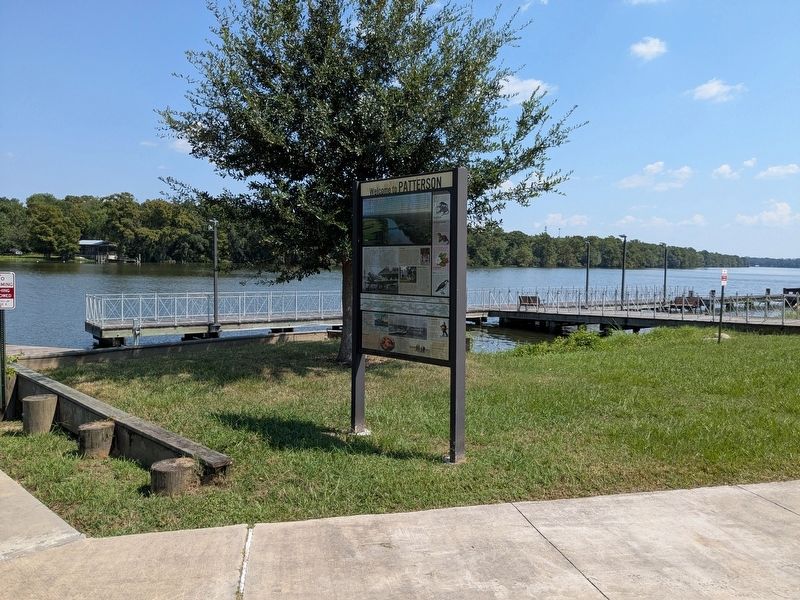
Welcome to Patterson

Photographed by Cajun Scrambler, September 12, 2025
1. Welcome to Patterson Marker
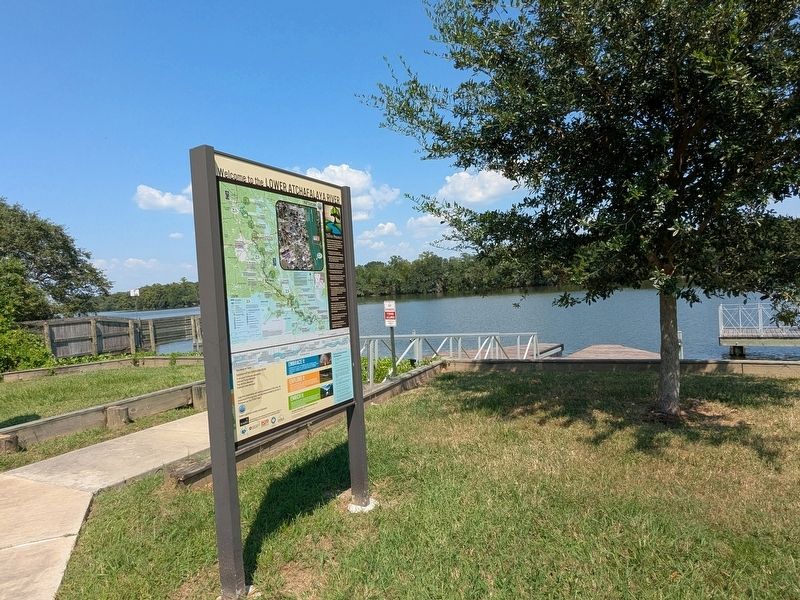
What happens when a group of Dutchmen from Pennsylvania find themselves in Bayou Teche en route from New Orleans? They take up residence. Original names for Patterson were Dutch Settlement, Dutch Town and Dutch Prairie after German settlers who arrived there in the early 1800s. Dutch is actually a mispronunciation of Deutsch, the German word for "German." The name Patterson is said to come from a "Captain Patterson" who commanded vessels up and down the bayou, according to Shane Bernard's book Teche. Bernard believes it may have been Elam Patterson, who ferried sugar from St. Mary Parish to New Orleans and settled in the area in 1832. The town was renamed Pattersonville and shortened to Patterson when it was incorporated in 1907. A 2014 proclamation by the city of Patterson declares that the waterway between Patterson and Berwick "shall forever be referred to in the official records of the City of Patterson as the Lower Atchafalaya River."
High in the Sky
Harry P. Williams was born in 1889 in Patterson, and his father was president of the F.B. Williams Cypress Co. He entered his father's lumber business after college.
this page online
First Settlers
The Chitimacha Indians were likely the first settlers in the Patterson area and built a mound complex up to 9 feet high on the east bank of Bayou Teche. The three mounds, dating to between 700-1200 A.D, also included
Photographed by Cajun Scrambler, September 12, 2025
2. Welcome to Patterson Marker
Idlewild Plantation
Now a private residence on Main Street, this historic 1850s plantation was used as a hospital during the Civil War. Idlewild was also a sort of makeshift hospital during the yellow fever epidemic of 1853. The outbreak is said to have spread from Franklin to Centerville to Pattersonville after a family of immigrants from the north arrived by steamboat. The town's population at that time was 600, and it's estimated that 500 people caught the disease, with 45 dying. On a 2019 episode of the Travel Channel show "Ghosts of Morgan City," ghost hunters investigated Idlewild, which is believed to be haunted by a nurse from the epidemic.
Cypress Capital
Did you know that Patterson was once home to the largest cypress sawmill in the world? As a result, lumbering became Louisiana's first major manufacturing industry. Patterson's sawmill was owned by Frank Williams,
Photographed by Cajun Scrambler, September 12, 2025
3. Welcome to Patterson Marker
BBQ Shrimp
15 large gulf shrimp
1 stick butter
1/2 oz. white wine
2 Tbsp. Cajun Seasoning
In a medium to large skillet, melt butter on medium heat. Stir in the white wine and Cajun seasoning. Once combined add the shrimp and stir until done (approx. 2-3 minutes).
Shrimp Boom
Patterson and the surrounding area's shrimping boom happened almost overnight. In the early 1930s, a large population of jumbo white shrimp were discovered in the deep waters of the Gulf of Mexico, Shrimpers from Florida and the east coast flocked to Berwick Bay, making Patterson the center of the new industry. By 1941,

Photographed by Cajun Scrambler, September 12, 2025
4. Welcome to Patterson Marker
"Dance the shrimp"
A process where shrimp were dried in the sun and immigrant workers walked or "danced" on them to crush the heads and shells so that they could be transferred to wooden barrels for shipping.
Back to Bayou Teche
Slide guitarist Sonny Landreth's 1992 hit from his album "Outward Bound" is a love song about returning to the bayou. A woman asks her lover to:
Lay, chèr, just a little bit longer You'll be gone so long out West Stay, cher, just a little bit longer Do pass back to Bayou Teche
The pull of Bayou Teche both in this song and throughout history is strong, and Landreth captures the haunting quality of the bayou through his signature sound and lyrics.
Find a complete Bayou Teche music playlist at techeproject.org!
The TECHE Project recognizes Shane Bernard, Patti Holland, Tami St. Germain, Chloé St. Germain-Vermillion and Erin Bass for their contributions to the content of this panel.
For more information, visit:
City of Patterson I cityofpattersonla.gov Wedell Williams Aviation and Cypress Sawmill Museum louisianastatemuseum.org Cajun Coast VCB cajuncoast.com The TECHE Project techeproject.org
Erected by The TECHE Project.
Topics. This historical marker is listed in these topic lists: Air & Space • Industry & Commerce • Settlements & Settlers.
Location. 29° 41.697′ N, 91° 18.113′ W. Marker is in Patterson, Louisiana, in St. Mary Parish. It can be reached from Main Street (State Road 182) south of Catherine Street, on the left when traveling south. Touch for map. Marker is at or near this postal address: 1156-1198 Main St, Patterson LA 70392, United States of America. Touch for directions.

Regionally, this marker is in one of Louisiana’s River Parishes, in Acadiana — Cajun Country, and specifically in Bayou Country. It is also in the American South, specifically in the Deep South, on the Gulf Coast, and in the Great River Road Region. Globally, it is in North America, a Gulf of Mexico state, the Western Hemisphere, the Western World, and the Anglosphere. Historically, it finds itself in what was once New Spain, Acadia, the territory of the Mississippian Culture, the Louisiana Purchase, one of the Confederate States of America, and the Antebellum South.
Other nearby markers. At least 8 other markers are within 6 miles of this marker, measured as the crow flies: Big - Fast - Deadly (approx. 1.3 miles away); Cypress Swamps (approx. 1.3 miles away); Williams Memorial Airport (approx. 2.6 miles away); Battle Of Bisland (approx. 4 miles away); Twin City Gospel Temple (approx. 5.1 miles away); Southwest Reef Lighthouse (approx. 5.1 miles away); Welcome to Berwick (approx. 5.2 miles away); Morgan City Floodwalls (approx. 5½ miles away). Touch for a list and map of all markers in Patterson.
More about this marker. Located in Morey Park
Also see . . . Official The TECHE Project website. (Submitted on November 2, 2025, by Cajun Scrambler of Assumption, Louisiana.)
Credits. This page was last revised on November 2, 2025. It was originally submitted on November 2, 2025, by Cajun Scrambler of Assumption, Louisiana. This page has been viewed 56 times since then and 26 times this year. Photos: 1, 2, 3, 4. submitted on November 2, 2025, by Cajun Scrambler of Assumption, Louisiana.
