Jordaan in Amsterdam, North Holland, Netherlands — Northwestern Europe
De Gangen van de Willemsstraat
⎯⎯⎯
The Alleyways of Willemsstraat
Photographed by Andrew Ruppenstein, June 20, 2025
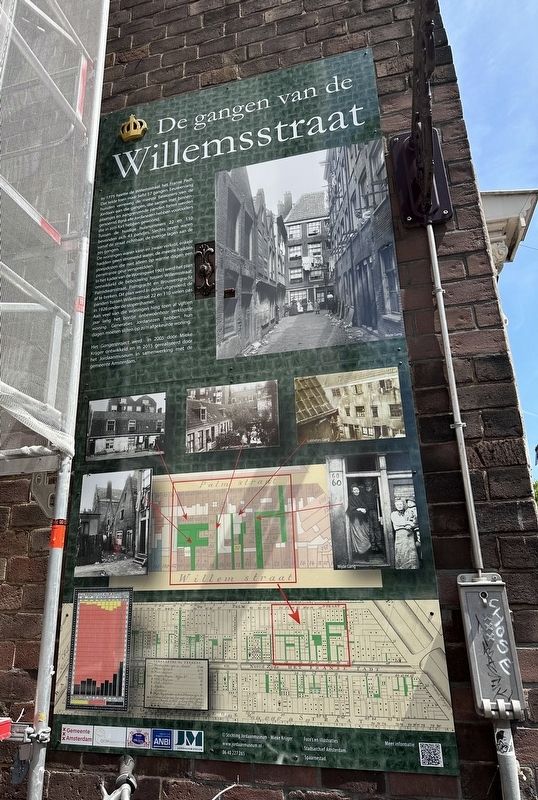
1. De Gangen van de Willemsstraat / The Alleyways of Willemsstraat Marker

In 1775 heette de Willemsstraat het Franse Padt. Dat telde toen maar liefst 57 gangen. Eeuwenlang huisden verreweg de meeste bewoners van de Jordaan aan die gangen, die samen met binnenplaatsjes en aangrenzende panden forten werden genoemd. Bijna alle Jordanezen hebben voorouders die in zo'n fort hebben gewoond.
Tussen de huidige huisnummers 22 en 110 bevonden zich 43 pandjes. Slechts zeven waren vanaf de straat zichtbaar, de overige lagen aan de zes gangen.
De woningen waren klein en zwaar verkrot, enkele hadden geen stromend water, de meeste hadden poepdozen die niet alleen op warme dagen een penetrante geur verspreidden.
In het kader van de Woningwet 1901 werd het plan ontwikkeld de bebouwing tussen Willemsstraat, Palmdwarsstraat, Palmgracht en Brouwersgracht af te breken. Dit plan werd in delen uitgevoerd; de panden tussen Willemsstraat 22 en 110 vielen pas in 1926 onder de slopershamer.
Aan veel van die woningen hing toen al vijftien jaar lang het bordje onbewoonbaar verklaarde woning. Generaties Jordanezen hebben hun dagen moeten slijten op zo'n afgekeurde woning.
Het Gangenproject werd in 2005 door Mieke Krijger ontwikkeld en in 2015 gerealiseerd door het Jordaanmuseum in samenwerking met de gemeente Amsterdam.
(English translation:)
In 1775, Willemsstraat was called the Franse Padt (“French Path”). At the time, it had no fewer than 57 alleyways. For centuries, the vast majority of Jordaan residents lived along these alleyways, which, together with the courtyards and adjacent buildings, were called forts. Almost all Jordaan residents have ancestors who lived in such a fort.
Between the current house numbers 22 and 110, there were 43 small buildings. Only seven were visible from the street; the others were situated along the six alleyways.
The houses were small
this page online
Many of these houses had already been marked "uninhabitable" for fifteen years. Generations of Jordaan residents had to live out their days in such condemned homes.
The Gangenproject was developed in 2005 by Mieke Krijger and realised in 2015 by the Jordaan Museum in collaboration with the City of Amsterdam.
Erected 2023 by Jordaanmuseum.
Topics. This historical marker is listed in these topic lists: Architecture • Settlements & Settlers. A significant historical year for this entry is 1775.
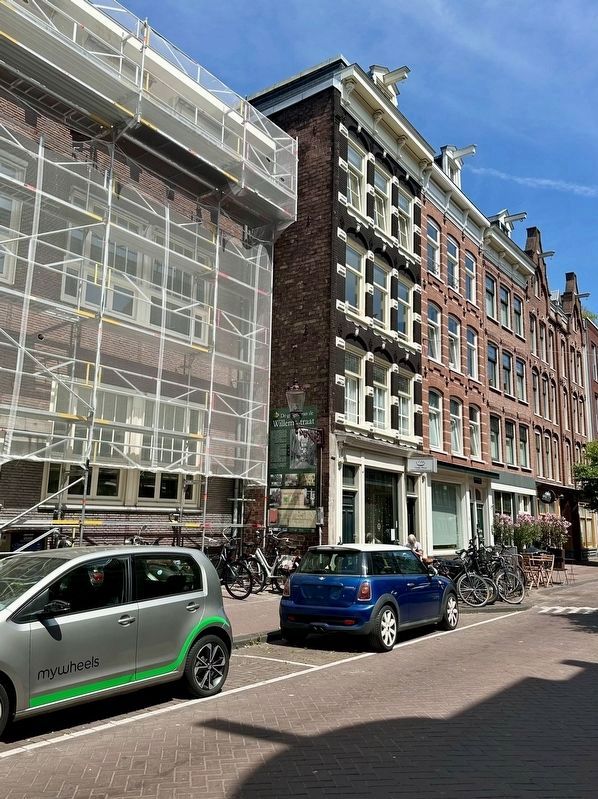
Location. 52° 22.884′ N, 4° 53.114′ E. Marker is in Amsterdam, Noord-Holland (North Holland). It is in Jordaan. It is on Willemsstraat, on the left when traveling east. Touch for map. Marker is at or near this postal address: Willemsstraat 22HS, Amsterdam,
Photographed by Andrew Ruppenstein, June 20, 2025
2. The Alleyways of Willemsstraat Marker - wide view

Regionally, it is in Europe, the European Union, Atlantic Europe, the Benelux Low Countries, the Schengen Area, Western Europe, and the Western World. Historically, it finds itself in what was once the Holy Roman Empire.
Other nearby markers. At least 8 other markers are within walking distance of this marker: Israël Querido (about 90 meters away, measured in a direct line); Februaristaking / February Strike (about 210 meters away); Noorderkerk (about 240 meters away); Hofje van Brienen (approx. 0.3 kilometers away); Kattenslootbrug (approx. 0.4 kilometers away); Haarlemmerpoort / Willemspoort (city gate) (approx. 0.4 kilometers away); Willem van Oranje-Nassau / William the Silent (approx. 0.4 kilometers away); Tenth Anniversary of Liberation (approx. half a kilometer away). Touch for a list and map of all markers in Amsterdam.
Also see . . . Gangenproject-Willemstraat (Jordaanmuseum, in Dutch). The QR code on the marker leads to this page, containing an overview of the project and additional photos and graphics. Excerpt (in translation):
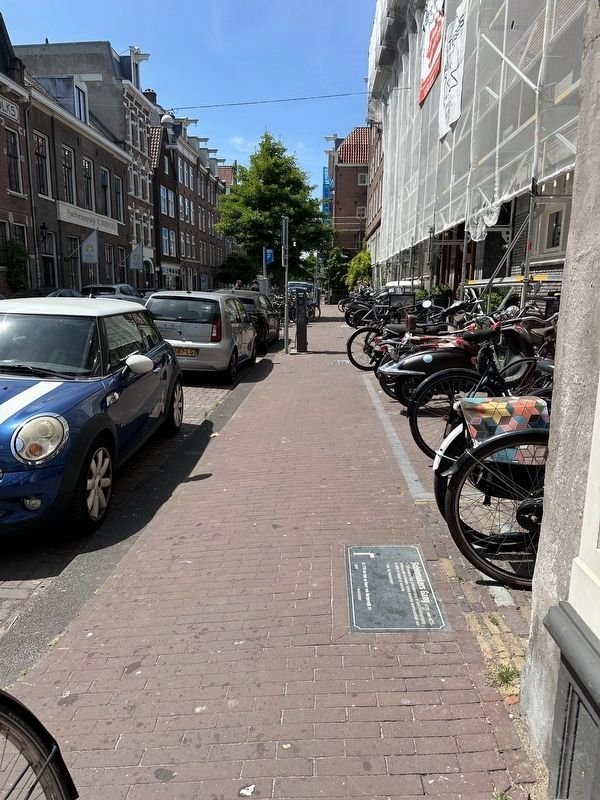
The Alleyways(Submitted on November 3, 2025.)Project - Willemsstraat 22-110 was designed in 2005 and completed in 2015. The project consists of an information panel that provides contextual information about the six reconstructed corridors in the sidewalk, including the installation of information tiles. The information panel is new and was installed on Friday, February 17, 2023. The 2015 panel was damaged; it had been cut with a utility knife and torn off at the bottom.The new panel provides access to the information below about the images shown via a QR code.Photographed by Andrew Ruppenstein, June 20, 20253. The Alleyways of Willemsstraat Marker - looking west from the markerLooking west from the marker, set in the sidewalk over a span of maybe 25 meters are a number of informational tiles, with each tile set in front of the former entrance of an alleyway, providing the name and some information about the alleyway, as well as a graphic depicting the size and shape of the alleyway. Photos of the panels follow this one, running from east to west.
Photographed by Andrew Ruppenstein, June 20, 2025
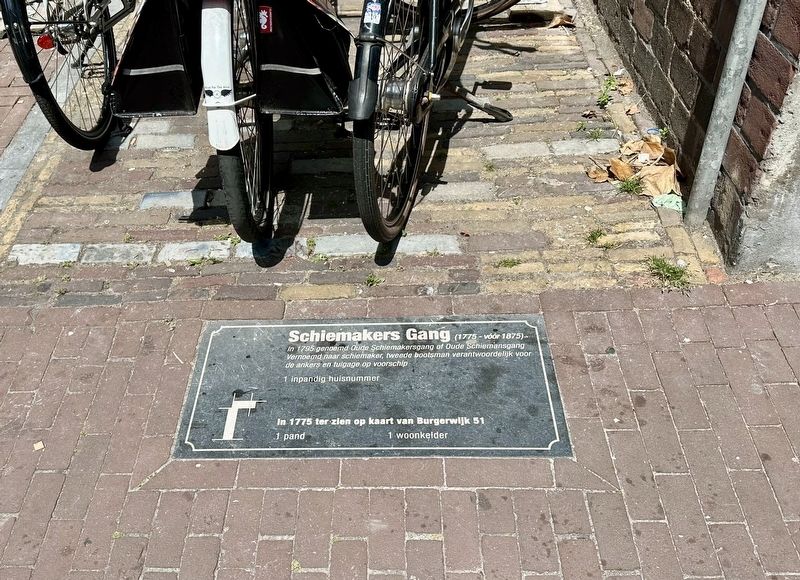
4. Schiemakers Gang
From 1775 to before 1875. One building, one address.
Photographed by Andrew Ruppenstein, June 20, 2025
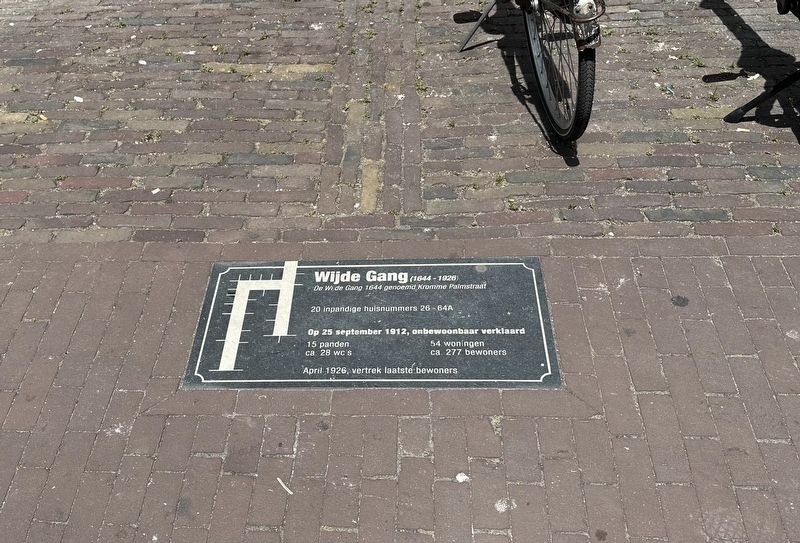
5. Wijde Gang (“Wide Alleyway”)
From 1644 to April, 1926. In 1912 there were recorded 15 buildings with 54 apartments, ca. 28 bathrooms and 277 inhabitants.
Photographed by Andrew Ruppenstein, June 20, 2025
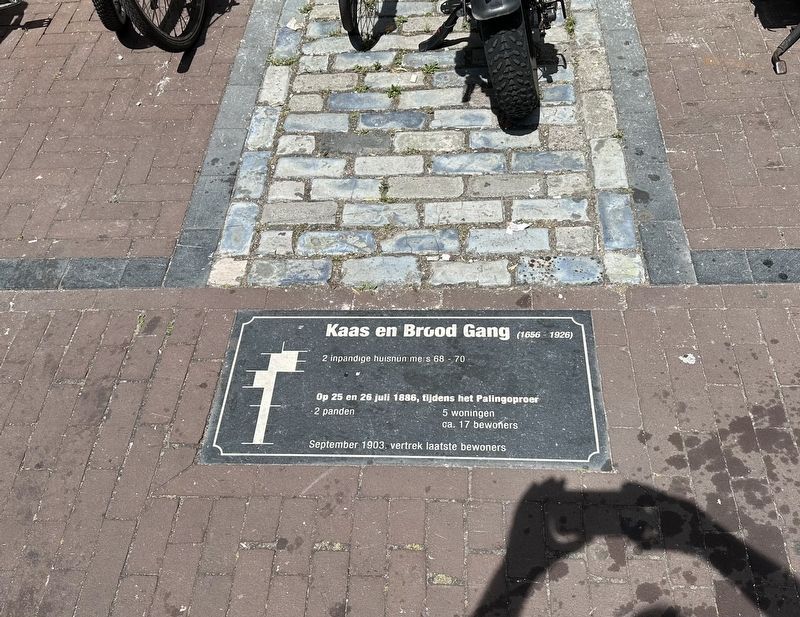
6. Kaas en Brood Gang (“Cheese and Bread Alleyway”)
From 1656 to 1926. In 1886 there were recorded 2 buildings, with 5 apartments and about 17 inhabitants.
Photographed by Andrew Ruppenstein, June 20, 2025
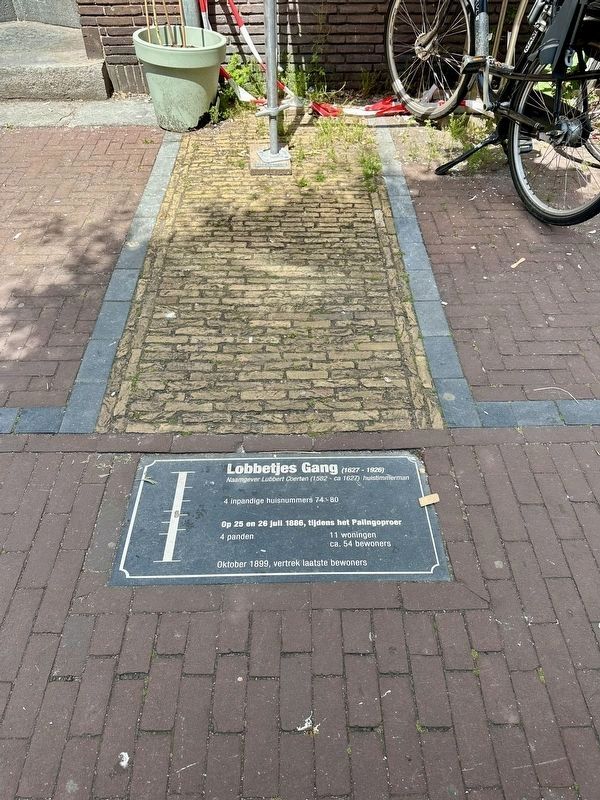
7. Lobbetjes Gang (“Lobsters Alleyway”)
From 1627 to 1926. In 1886 there were recorded 4 buildings with 11 apartments and approximately 54 inhabitants.
Photographed by Andrew Ruppenstein, June 20, 2025
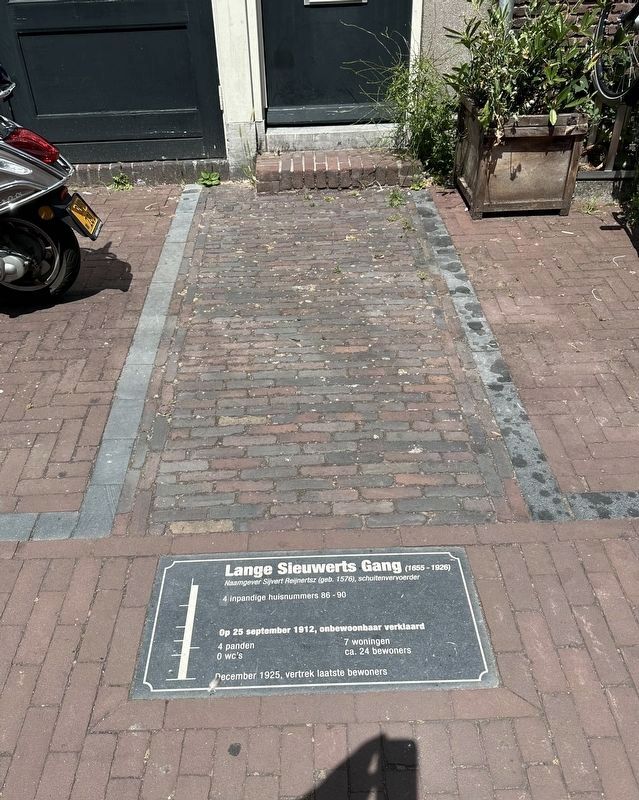
8. Lange Sieuwerts Gang
From 1655-1926. In 1912 there were recorded 4 buildings with 7 apartments, 0 bathrooms, and about 24 inhabitants.
Credits. This page was last revised on November 3, 2025. It was originally submitted on November 3, 2025, by Andrew Ruppenstein of Lamorinda, California. This page has been viewed 166 times since then and 126 times this year. Photos: 1, 2, 3, 4, 5, 6, 7, 8. submitted on November 3, 2025, by Andrew Ruppenstein of Lamorinda, California.
