Brampton in Peel Region, Ontario — Central Canada (North America)
Brampton- Flowertown of Canada
| — | Historic Brampton | — |

Photographed by Tim Boyd, November 2, 2025
1. Brampton- Flowertown of Canada Marker
For more than a century, Brampton was known as the "Flowertown of Canada". From the mid 19th century until the 1970s, hundreds of acres of land in the City were devoted to growing prize-winning orchids, hybrid roses, chrysanthemums and many other quality flowers. Most of these flowers were grown for the export market. For several decades, the municipality used a rose logo with the slogan "Brampton is Blooming”.
Flowertown had its start in the 1860s when Edward and Harry Dale began cultivating roses and other cut flowers. They established the Dale Estates, which, by 1915, became Brampton's largest employer with 215 workers in more than 1.2 million square feet of greenhouses. Many other Bramptonians learned the trade of flower growing from the Dale Estates and went on to open their own, nurseries. As a result, numerous other greenhouses dotted the landscape and Brampton, became known as the "Flowertown of Canada".
The Dale family along with Walter Calvert, William Fendley, Richard Jennings, T.W, Duggan, Gus Lagerquist and others created the Flowertown-industry. The local flower industry began a slow decline following
this page online
The impact of the flower growing industry has created a legacy that continues into the present day. In June 2002 in an effort to recapture our floral heritage, the City of Brampton introduced the "Flower City Strategy". A multi-faceted approach that focuses on the city's design, development, beautification and landscaping efforts, the Flower City Strategy strives to beautify Brampton, preserve its natural and cultural heritage and protect the environment.
The Flower City logo is a yellow rose centered in a blue rectangular shape with a white lined petal on each edge. The rose itself connects Brampton with its past as a major grower and exporter of roses. The blue rectangle represents Brampton's geographic shape and four municipal boundaries. The white lines reflect Brampton's two major river systems: the Credit River Valley and the West Humber River Valley. The cradle is a depiction of a dove, reflecting peace, harmony and a caring place.
Topics. This historical marker is listed in this topic list: Horticulture & Forestry. A significant historical year for this entry is 1860.
Location. 43° 41.61′ N,
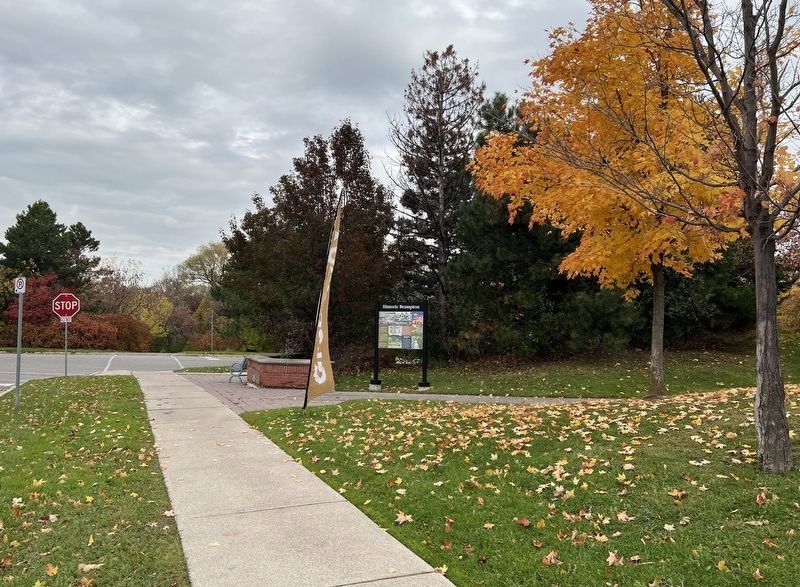
Photographed by Tim Boyd, November 2, 2025
2. Brampton- Flowertown of Canada Marker
Facing toward Ken Whillan Drive

Regionally, this marker is in Greater Toronto, specifically on the Golden Horseshoe, and in the Toronto Metropolitan Area. It is also in Central Canada. Globally, it is in North America, on the Great Lakes, in the Western Hemisphere, in the Western World, and in the Anglosphere. Historically, it finds itself in what was once a British colony, the Viceroyalty of New France, the Haudenosaunee (Iroquois) Confederacy, and Rupert’s Land.
Other nearby markers. At least 8 other markers are within walking distance of this marker: The Dale Estate / Le Domaine Dale (within shouting distance of this marker); The McKillop House (approx. half a kilometer away); The Founding of Brampton (approx. half a kilometer away); Historical Summary 27 Church Street West / Résumé historique 27 Church Street West (approx. 0.7 kilometers away); Carnegie Library (approx. 0.8 kilometers away); The Old Fire Hall (approx. 0.9 kilometers away); 20th Regiment Halton Rifles/ 36th Peel Regiment (approx. 0.9 kilometers away); The Armstrong House (approx. one kilometer away). Touch for a list and map of all markers in Brampton.
Credits. This page was last revised on November 3, 2025. It was originally submitted on November 3, 2025, by Tim Boyd of Hamilton, Ontario. This page has been viewed 88 times since then and 60 times this year. Photos: 1, 2. submitted on November 3, 2025, by Tim Boyd of Hamilton, Ontario. • Andrew Ruppenstein was the editor who published this page.
