Ayr in Adams County, Nebraska — The American Midwest (Upper Plains)
Millington
Established in 1877
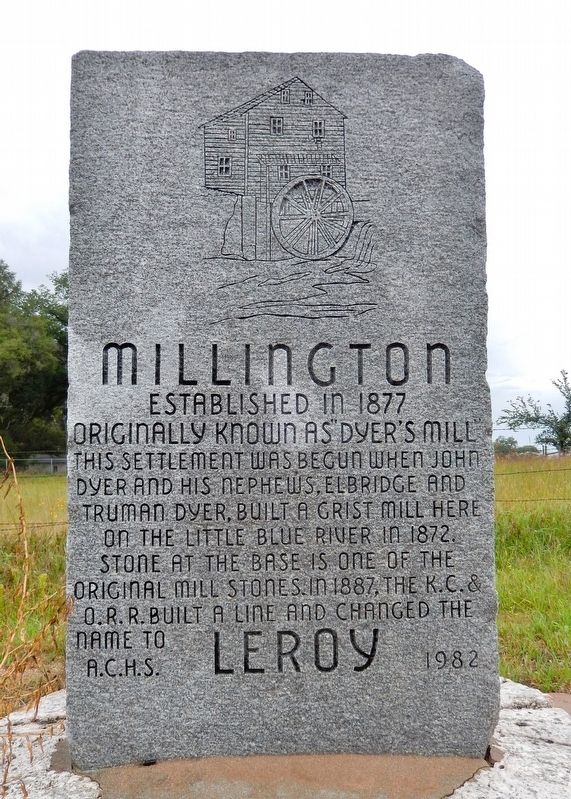
Photographed by Cosmos Mariner, September 14, 2025
1. Millington Marker
Originally known as “Dyers Mill” this settlement was begun when John Dyer and his nephews, Elbridge and Truman Dyer, built a grist mill here on the Little Blue River in 1872.
Stone at the base is one of the original mill stones. In 1887, the K.C. & O.R.R. built a line and changed the name to Leroy.
Erected 1982 by Adams County Historical Society.
Topics. This historical marker is listed in these topic lists: Industry & Commerce • Railroads & Streetcars • Settlements & Settlers. A significant historical year for this entry is 1877.
Location. 40° 27.209′ N, 98° 24.098′ W. Marker is in Ayr, Nebraska, in Adams County. It is at the intersection of American Legion Memorial Highway (U.S. 281) and Dyer Park Road, on the right when traveling north on American Legion Memorial Highway. Touch for map. Marker is at or near this postal address: 1430 Dyer Park Road, Ayr NE 68925, United States of America. Touch for directions.

Regionally, this marker is in the Smoky Hills and in Eastern Nebraska. It is also in the American Midwest, in the Corn Belt, and on the prairies. Globally, it is in North America, the Western
this page online
Other nearby markers. At least 8 other markers are within 9 miles of this marker, measured as the crow flies: Oregon Trail & Pony Express Trail (approx. 1.9 miles away); Kingston Cemetery (approx. 1.9 miles away); Crystal Lake (approx. 2 miles away); Oregon Trail (approx. 4.7 miles away); Spring Ranche (approx. 8.6 miles away); Brickyard Park (approx. 8.6 miles away); The Burlington Depot (approx. 9.1 miles away); The Kool-Aid Factory (approx. 9.1 miles away).
Also see . . .
1. Nebraska's Lost Towns (KHGI TV Archives).
(by Sara Kirkley, 5/2/2016) Excerpt: The town of Millington was growing up around a mill founded by the Dyers family in 1872. In those days, people needed the mill to ground their grain into flour and feed for animals. The railroad changed this town. "They renamed the town Leroy," said Catherine Renschler, a former head of the Adams County Historical Society turned volunteer. But, in 1905 a flood destroyed the mill dam. It would never be rebuilt. "The town just gradually faded away,"(Submitted on November 4, 2025, by Cosmos Mariner of Cape Canaveral, Florida.)said Renschler. But Nebraskans still traveled there. "Dyers Park was known as a recreational area. There was a dam here and a small lake and people came and swam and boated. This was before there were many opportunities for that type of recreation out here on the Great Plains," said Renschler.Photographed by Cosmos Mariner, September 14, 20252. Millington Marker rests upon an original millstoneLooking southwest from behind the marker. The US Highway 281 & Dyer Park Road intersection is in the background.
Today, a millstone from the town's most important business still sits at the site.

2. Kansas City & Omaha Railway (Nebraska State Historical Society pdf).
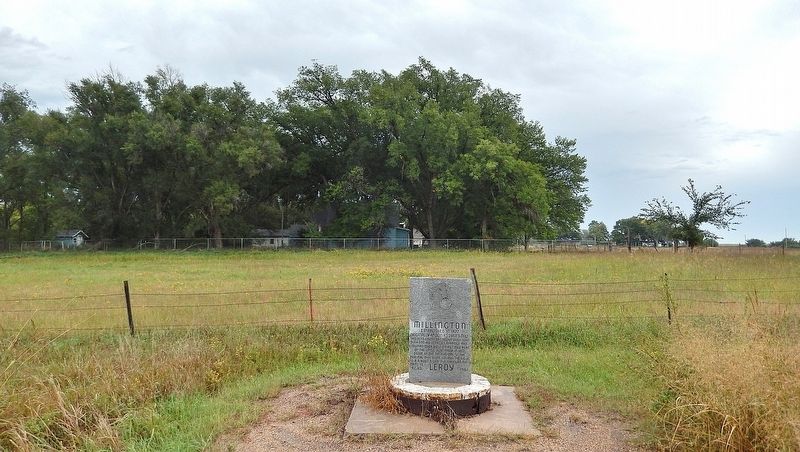
Excerpt: The initially independent St. Joseph & Denver City Railroad moved from Missouri and Kansas up the Big Sandy Creek Valley to reach Alexandria, Nebraska, then established a series of alphabet towns to Hastings in 1872. The company reorganized in 1877 as the St. Joseph & Western. As the St. Joseph & Grand Island, the same company pushed from Hastings, Nebraska, north to meet the UP mainline at Grand Island in 1879, as allowed in the Pacific Railroad Act of 1862. As the Kansas City & Omaha Railway, the company in 1886–1887 built a wandering triangle connecting Fairbury west to Alma, and north to(Submitted on November 4, 2025, by Cosmos Mariner of Cape Canaveral, Florida.)Stromsburg. UP in 1880 gained control of KC&O, which receivers reorganized in 1896, and Burlington acquired in 1902; UP regained control as the StJ&GI in the 1900s.Photographed by Cosmos Mariner, September 14, 20253. Millington MarkerLooking east from US Highway 281.
Credits. This page was last revised on November 4, 2025. It was originally submitted on November 3, 2025, by Cosmos Mariner of Cape Canaveral, Florida. This page has been viewed 113 times since then and 70 times this year. Photos: 1, 2, 3. submitted on November 4, 2025, by Cosmos Mariner of Cape Canaveral, Florida.
