Near Glenvil in Clay County, Nebraska — The American Midwest (Upper Plains)
Spring Ranche
Photographed by Cosmos Mariner, September 13, 2025
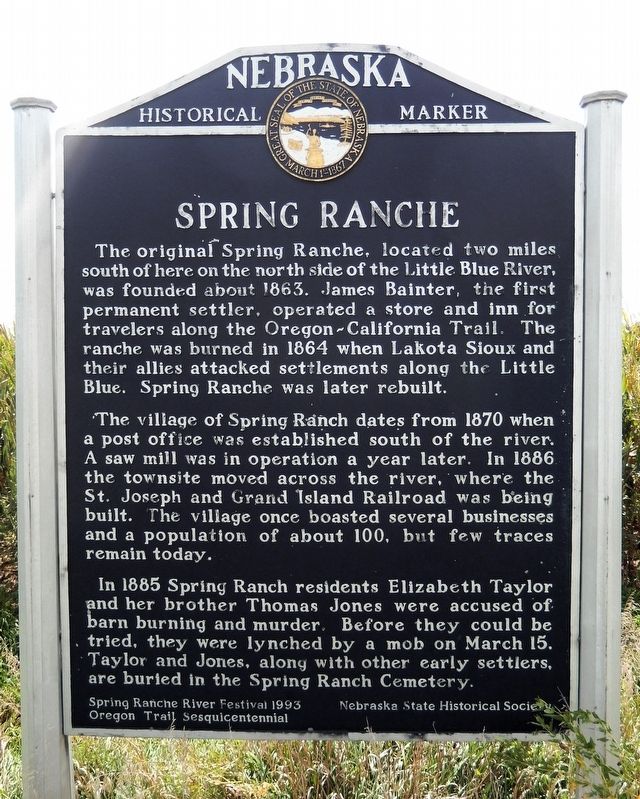
1. Spring Ranche Marker
The original Spring Ranche, located two miles south of here on the north side of the Little Blue River, was founded about 1863. James Bainter, the first permanent settler, operated a store and inn for travelers along the Oregon-California Trail. The ranche was burned in 1864 when Lakota Sioux and their allies attacked settlements along the Little Blue. Spring Ranche was later rebuilt.
The village of Spring Ranch dates from 1870 when a post office was established south of the river. A saw mill was in operation a year later. In 1886 the townsite moved across the river, where the St. Joseph and Grand Island Railroad was being built. The village once boasted several businesses and a population of about 100, but few traces remain today.
In 1885 Spring Ranch residents Elizabeth Taylor and her brother Thomas Jones were accused of barn burning and murder. Before they could be tried, they were lynched by a mob on March 15. Taylor and Jones, along with other early settlers, are buried in the Spring Ranch Cemetery
Erected 1993 by Spring Ranche River Festival 1993, Oregon Trail Sesquicentennial, Nebraska State Historical Society.
this page online
Topics and series. This historical marker is listed in this topic list: Settlements & Settlers. In addition, it is included in the Nebraska State Historical Society, and the Oregon Trail series lists. A significant historical year for this entry is 1863.
Location. 40° 26.236′ N, 98° 14.414′ W. Marker is near Glenvil, Nebraska, in Clay County. It is on Road 307 (State Highway 74) just east of Road C, on the right when traveling east. The marker is in a pull-out on the south side of Nebraska Highway 74. Touch for map. Marker is in this post office area: Glenvil NE 68941, United States of America. Touch for directions.

Regionally, this marker is in the Smoky Hills and in Eastern Nebraska. It is also in the American Midwest, in the Corn Belt, and on the prairies. Globally, it is in North America, the Western Hemisphere, the Western World, and the Anglosphere. Historically, it finds itself in what was once the Louisiana Purchase.
Other nearby markers. At least 8 other markers are within 12 miles of this marker, measured as the crow flies: Oregon Trail (approx. 4 miles away); Kingston Cemetery (approx. 6.9 miles
Photographed by Cosmos Mariner, September 13, 2025
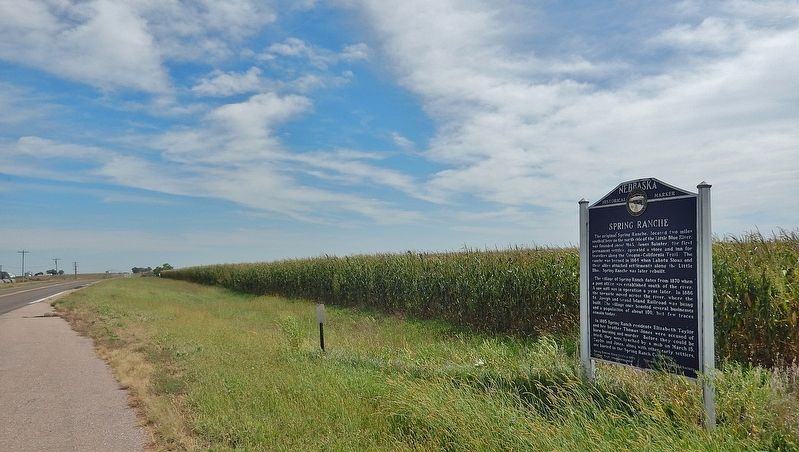
2. Spring Ranche Marker
Looking east along Nebraska Highway 74.
Also see . . . Memories abide in ghost town by Little Blue (Hastings Tribune).
(By Shay Burk 5/17/2017) Excerpt: Spring Ranche, spelled with an “e” to differentiate it from an actual ranch, was founded in 1860 by James Bainter, the first permanent resident. Bainter laid out the town site and built his home on the north side of the Little Blue River. He picked the spot because it was along the Oregon-California Trail and saw travelers passing by regularly. Floods, the lure of the big city and other causes led to the demise of the small community by the 1950s.(Submitted on November 3, 2025, by Cosmos Mariner of Cape Canaveral, Florida.)
The first bank opened in 1910 and closed in 1926. The Peck and Meston Grist Mill was built on the banks of the Little Blue River in August 1874. Reports state that people traveled 50-100 miles to have their grain ground into meal at the Spring Ranch mill. At its height, Spring Ranch had a population of 125 people. There were two grocery stores, a community band, a general store and plenty of activity.
Research into this small community includes piles of stories about one black mark in the town’s history that came in 1885. The characters share names with modern-day celebrities Elizabeth Taylor and Tom Jones. Elizabeth Taylor and her husband James came to the area and filed for land in April 1872, about the same time some of Elizabeth’s kin, including her brother Tom Jones, also came to the area. The story of these two siblings came to an end in the early morning hours of March 15, 1885, when vigilantes — whose numbers are estimated from 15 to 50 — dragged Taylor and Jones out of their beds and into an open field. There, Taylor and Jones were accused of cattle rustling and land grabbing, among other things. The siblings were hanged from a bridge near the present-day Manna Resort. Elizabeth, 36, and Tom, 33, were buried in the Spring Ranch Cemetery, with Elizabeth interred next to her husband who had died three years earlier. Their stone grave markers still stand today.
The people of Clay County came together in May 1993 not only to celebrate the 150th anniversary of the Oregon Trail, but also the history of the community of Spring Ranch that had been started because of its proximity to that busy pioneer highway. An estimated 6,200 people turned out for the Spring Ranche River Festival, which focused primarily on a re-enactment of the Taylor/Jones hangings of 1885.
Credits. This page was last revised on November 3, 2025. It was originally submitted on November 3, 2025, by Cosmos Mariner of Cape Canaveral, Florida. This page has been viewed 131 times since then and 82 times this year. Photos: 1, 2. submitted on November 3, 2025, by Cosmos Mariner of Cape Canaveral, Florida.
