Calvert Beach-Long Beach in Calvert County, Maryland — The American Northeast (Mid-Atlantic)
Tons of Fish Tons of Work

Ideal for Fishing
Flag Ponds is distinctive from the rest of Calvert County's Chesapeake shore because of the absence of high cliffs. From 1915-58, this low, flat beach and its protected harbor were an ideal camp for harvesting fishes from the bay's shallow waters. Here a colony of pound-net fishermen mended, maintained, and stored their nets; they cut and hauled the pound-net poles from the forest; and they repaired their many boats on Flag Pond's beach.
None of the boats they used survived. Even the sturdy fish lighter—the deep, wide, flat-bottomed boats used while emptying the nets—exist no more, being useless after the end of the pound-net fishery in the late 1950s.
A fishing captain typically owned several pound-nets hired a crew of six or seven strong men to set, monitor, and haul fishes from the shallow waters. They boxed most of the fishes harvested from the pound-nets, iced, and trucked them to Baltimore fish markets. By 1955, however, fish populations were declining and the costs of gear and labor rose to the point where many fishermen gave up their pound-netting operations.
Fish Trapping
Pound-nets
this page online
Similar pound-net fishing stations existed along Calvert County at Cove Point, Drum Point and Solomons Island.
The crew fished the pound-nets daily at a slack tide by:
🐟 first gliding their boat inside the pound head
🐟 then working as a team to lift the heavy netting floor
🐟 this brought the trapped fish to the surface
🐟 and by using dip nets, the crew scooped the fish into their boat.
[Captions:]
Above Left: A crew lifts the heavy net, bringing fish to the surface. Because pound-nets were navigational hazards, the cedar bush (visible on the right pole) marked the net by day, while a lantern marked its location by night.
Above Right: A wide variety of fishes were dip-netted from the pound-net into wooden shipping boxes on board the boats.
A Home Away from Home
The
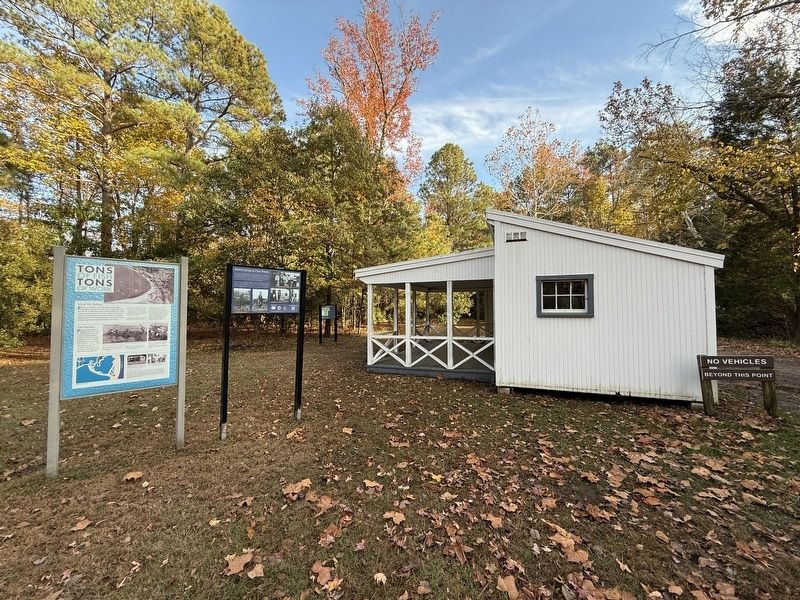
Photographed by Devry Becker Jones (CC0), November 2, 2025
2. Markers on the grounds of the "Buoy Hotel"
[Captions:]
The splendid "Buoy Hotel," as it looked ca. 1936. The 35-65 foot wooden poles, shown in the foreground, supported the pound nets. Up to 130 poles were required for a single net.
Four seasonal residents of the "Buoy Hotel" ca. 1944.
Left to right: Henry Duncan, Ira Todd, Russell Duncan, Clifford Gibson.
Topics. This historical marker is listed in these topic lists: Animals • Industry & Commerce. A significant historical year for this entry is 1955.
Location. 38° 26.973′ N, 76° 27.449′ W. Marker is in Calvert Beach-Long Beach, Maryland, in Calvert County. It is on Flag Ponds Parkway one mile east of Solomons Island Road (Maryland Route 2/4), on the left when traveling east. Touch for map. Marker is at or near this postal address: Flag Ponds Pkwy, Saint Leonard MD 20685, United States of America. Touch for directions.

Regionally, this marker is in Southern Maryland. It is also in the American South, specifically in the Upper South, in the Mid-Atlantic, in the Tidewater, in the Chesapeake Bay Region, and on the Eastern Seaboard. Globally, it is in the North Atlantic Region, North America, the Western Hemisphere, the Western World, and the Anglosphere. Historically, it finds itself in what was once one of the original Thirteen Colonies and also the Antebellum South.
Other nearby markers. At least 8 other markers are within 2 miles of this marker, measured as the crow flies: Shanty Living at Flag Ponds (here, next to this marker); The Fisherman's Trail (a few steps from this marker); All About Net-Tarring (within shouting distance of this marker); All About Flag Ponds Shoreline (within shouting distance of this marker); North Ridge Trail (about 600 feet away, measured in a direct line); St. Leonard Creek (approx. 2 miles away); Early Settlements (approx. 2 miles away); Brewhouse (approx. 2 miles away). Touch for a list and map of all markers in Calvert Beach-Long Beach.
Credits. This page was last revised on November 3, 2025. It was originally submitted on November 3, 2025, by Devry Becker Jones of Washington, District of Columbia. This page has been viewed 35 times since then and 13 times this year. Photos: 1, 2. submitted on November 3, 2025, by Devry Becker Jones of Washington, District of Columbia.
