Fairfield in Clay County, Nebraska — The American Midwest (Upper Plains)
Fairfield Carnegie Library
Photographed by Cosmos Mariner, September 13, 2025
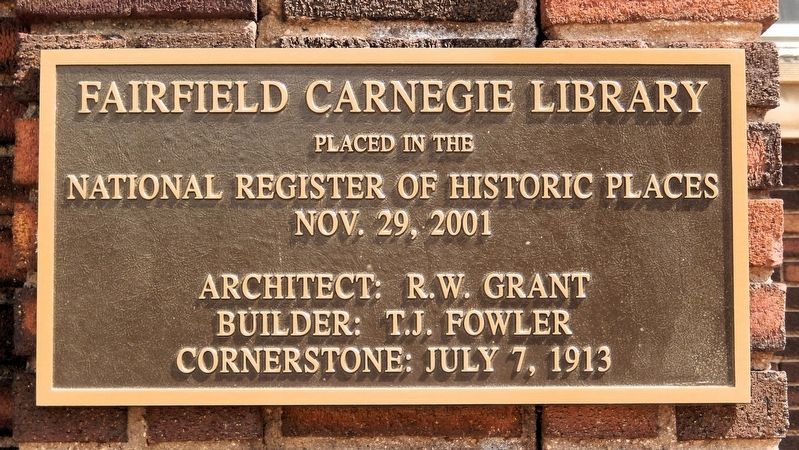
1. Fairfield Carnegie Library Marker
National Register of Historic Places
Nov. 29, 2001
Architect: R.W. Grant
Builder: T.J. Fowler
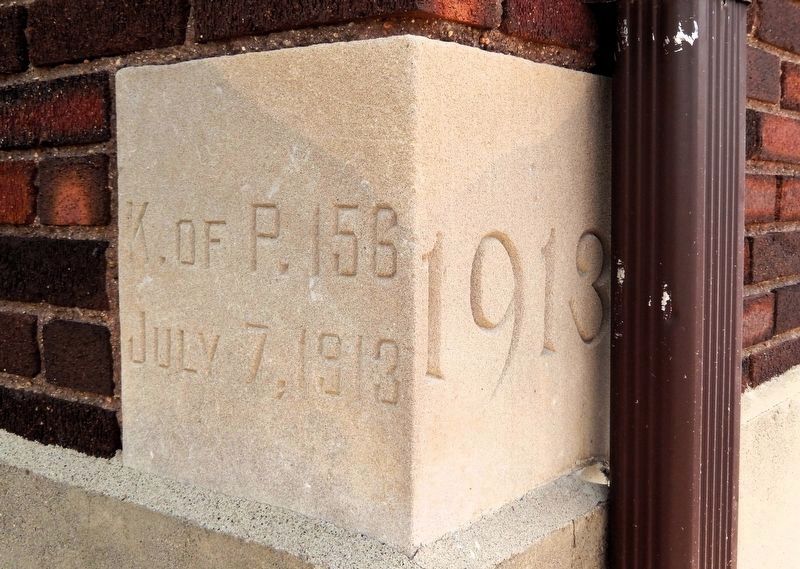
Cornerstone: July 7, 1913
Topics and series. This historical marker is listed in these topic lists: Architecture • Charity & Public Work • Education • Notable Buildings. In addition, it is included in the Carnegie Libraries, and the National Register of Historic Places (NRHP) series lists. A significant historical date for this entry is July 7, 1913.
Location. 40° 25.873′ N, 98° 6.336′ W. Marker is in Fairfield, Nebraska, in Clay County. It is at the intersection of D Street and East 5th Street, on the right when traveling north on D Street. The marker is mounted at eye-level, directly on the subject building, on the right side of the front entrance. Touch for map. Marker is at or near this postal address: 412 D Street, Fairfield NE 68938, United States of America. Touch for directions.

Regionally, this marker is in the Smoky Hills and in Eastern Nebraska. It is also in the American Midwest, in the Corn Belt, and on the prairies. Globally, it is in North America, the Western Hemisphere, the Western World,
this page online
Other nearby markers. At least 8 other markers are within 13 miles of this marker, measured as the crow flies: Oregon Trail (approx. 6.3 miles away); Clay Center (approx. 7 miles away); Spring Ranche (approx. 7.1 miles away); 1864 Indian Raids (approx. 7.2 miles away); a different marker also named Oregon Trail (approx. 9.1 miles away); a different marker also named Oregon Trail (approx. 11.2 miles away); Woodmen Hall (approx. 12.9 miles away); Harvard Jail (approx. 12.9 miles away).
Regarding Fairfield Carnegie Library. National Register of Historic Places № 01001274.
From the National Register Nomination prepared by Bill Callahan, 8/17/2001:
The Fairfield Carnegie Library was constructed in 1913. The library was designed by prolific Beatrice, Nebraska architect R. W. Grant, and was constructed by local contractor T. J. Fowler Jr.
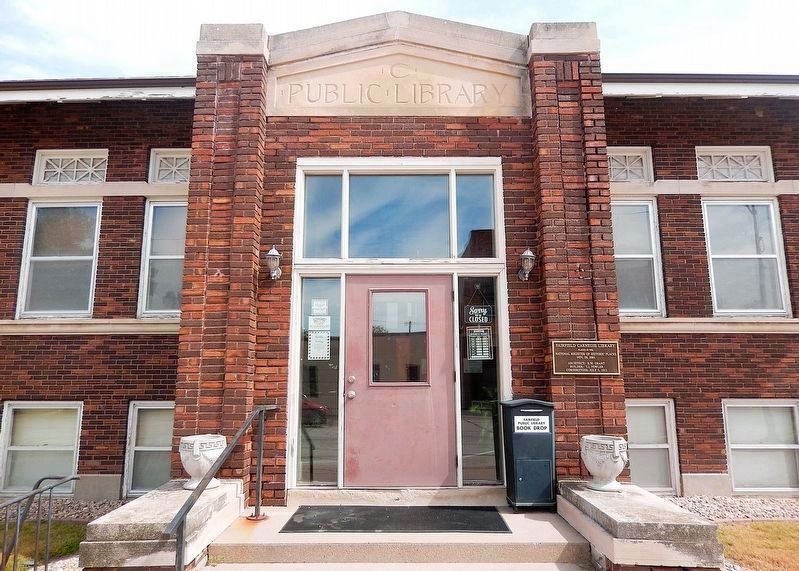
Remarkably, the upstairs is still used, with an unaltered plan, as the local public library. The main room is approximately 25' x 38' and is crammed, floor to ceiling, with books, bookcases and smallishreading areas. At some unrecorded date, the ceiling was lowered, but otherwise the interior is intact from its date of construction. This integrity extends to its use. Carnegie libraries that remain libraries without large additions or significant alterations are very rare in Nebraska.Photographed by Cosmos Mariner, September 13, 20252. Fairfield Carnegie Library entranceThe marker is mounted on the right side of the front entrance.
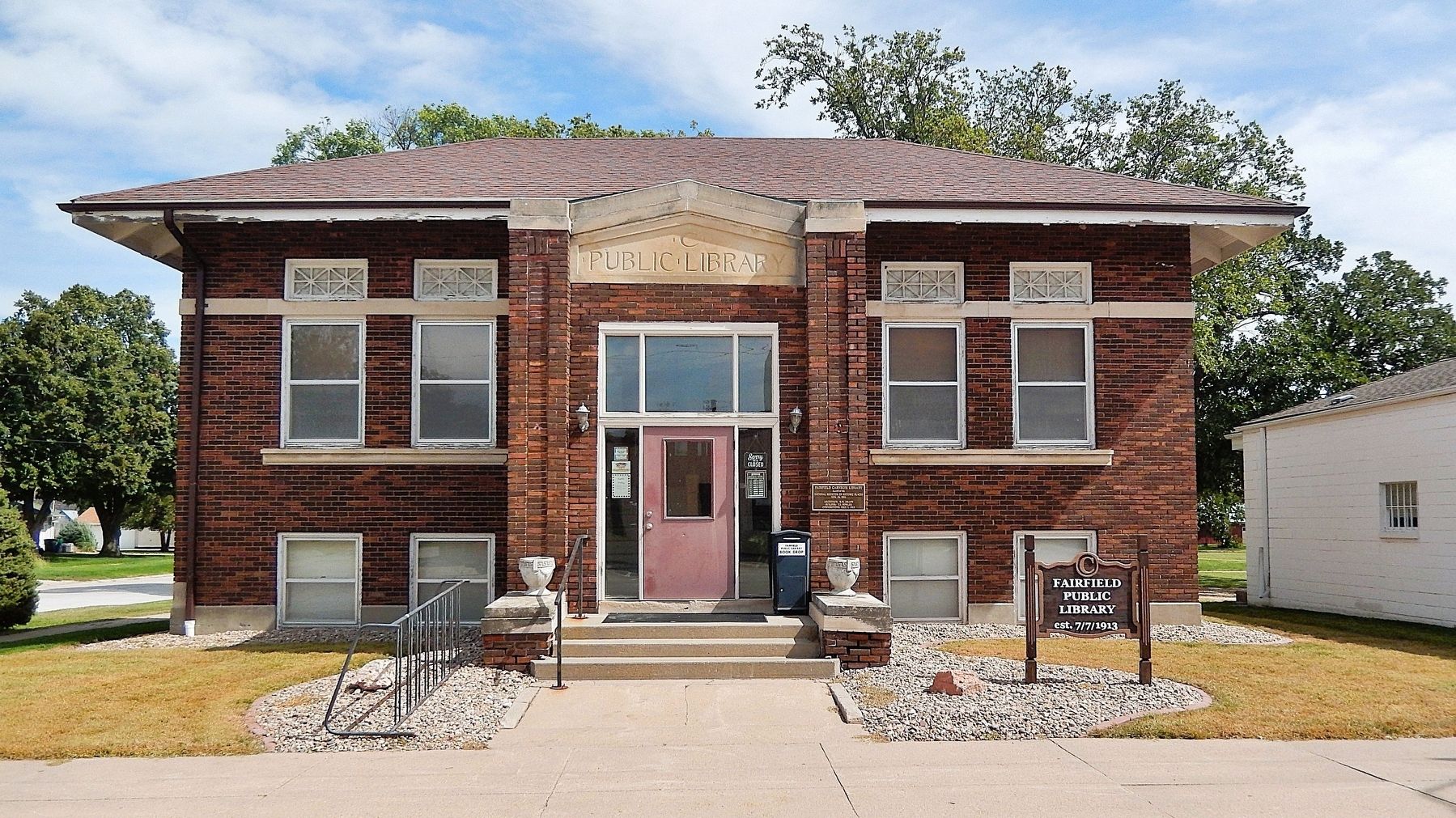
From the National Register Nomination: The west entry projects from the wall approximately nine feet and is approximately twelve feet in width. The entry door is reached by three broad concrete steps flanked by low, rectangular brick pedestals, which are in turn capped by stone. The entry door is a modern metal construction placed within the historic opening and is flanked by intact sidelights. A stone pediment with "Public Library" carved into it crowns the entryway. A capital letter "C" (for Carnegie) is carved above the "L" in "Library."
In 1912, Dr. G. H. Bentz of Fairfield circulated a petition requesting that the City of Fairfield (1920 pop. 784) construct a public library. Dr. Bentz petition was successful. In October of 1912 the Fairfield city council adopted an ordinance authorizing the construction of a library and a fund-raising subscription for the purchase of a site for its construction. The City Council pursued funding from the Carnegie Foundation for construction of the library. For their part, the Council levied a mill tax to raise $600 annually for maintenance and expenses. $1,700 was raised locally, and the Carnegie Foundation granted the city $6,000 for the construction of the library.
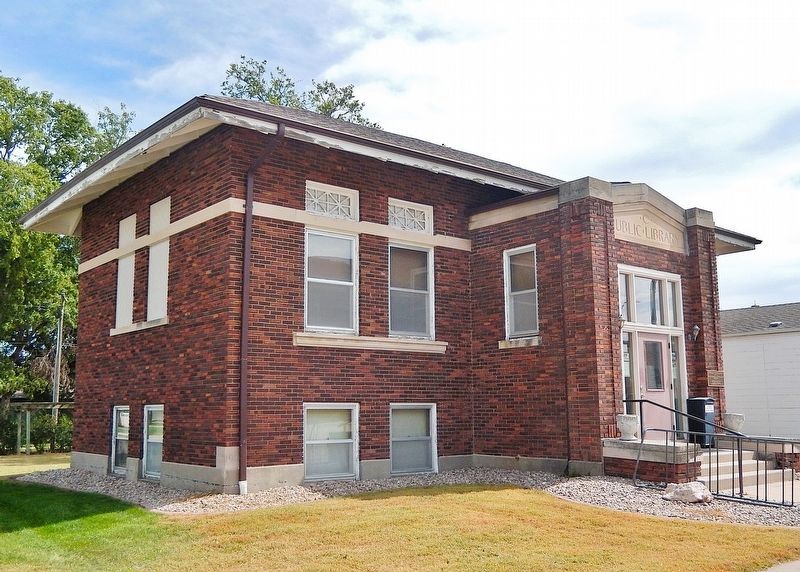
As in so many other communities around the country, Fairfield did not have a sole-use public library until the Carnegie Foundation funded its construction. The largesse of the CarnegieFoundation assisted in the creation of public library systems that continue to have profound community impacts to this day. Many small communities are served by well-established public libraries whose existence, it may be argued, is founded upon an original gift by the Carnegie Foundation.Photographed by Cosmos Mariner, September 13, 20253. Fairfield Carnegie Library (northewest elevation)From the National Register Nomination: The north facade is punctured by four windows: main floor and basement. The main floor windows are covered with metal siding, but the historic wood double hung windows remain beneath the metal. The north side basement windows are 1/1 wood double hung, and open into a museum space.
Also see . . . Fairfield Carnegie Library (Wikipedia).
Excerpt: The Fairfield Carnegie Library was designed in Prairie School style by architect R. W. Grant.(Submitted on November 4, 2025, by Cosmos Mariner of Cape Canaveral, Florida.)
Photographed by Cosmos Mariner, September 13, 2025
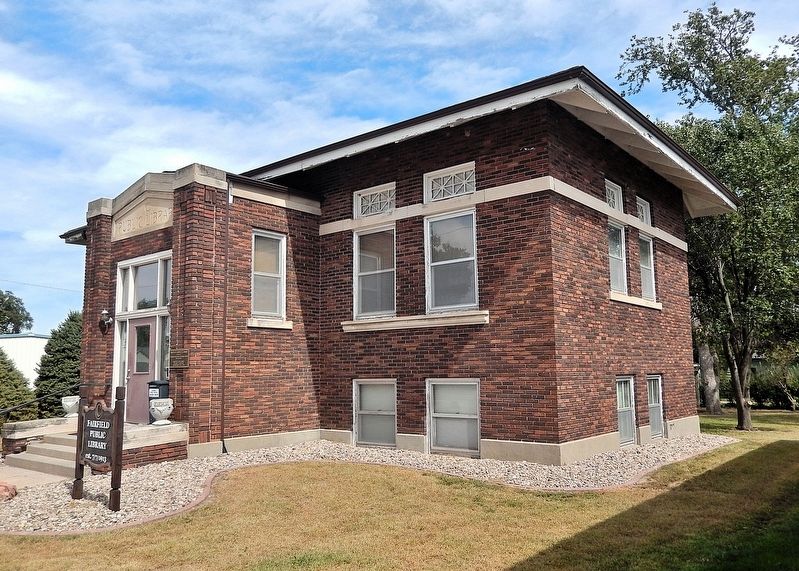
4. Fairfield Carnegie Library (southwest elevation)
Photographed by Cosmos Mariner, September 13, 2025
5. Fairfield Carnegie Library cornerstone
July 7, 1913
Photographed by Cosmos Mariner, September 13, 2025
6. Fairfield Carnegie Library (west/front elevation)
From the National Register Nomination: The library is a one-story dark brick structure with a raised basement. The bricks are slightly variegated in color, giving a lighter appearance to a building that would have otherwise had a monolithic and austere overall look. The Fairfield Carnegie Library's roof is hipped, covered with asphalt shingles, and has prominent overhanging eaves with exposed rafters. The structure is rectangular in form, approximately 25' x 48', and the primary facade of the building faces west.
Credits. This page was last revised on November 4, 2025. It was originally submitted on November 3, 2025, by Cosmos Mariner of Cape Canaveral, Florida. This page has been viewed 116 times since then and 60 times this year. Photos: 1, 2, 3, 4, 5, 6. submitted on November 3, 2025, by Cosmos Mariner of Cape Canaveral, Florida.
