Woodland in Southeast Washington in Washington, District of Columbia — The American Northeast (Mid-Atlantic)
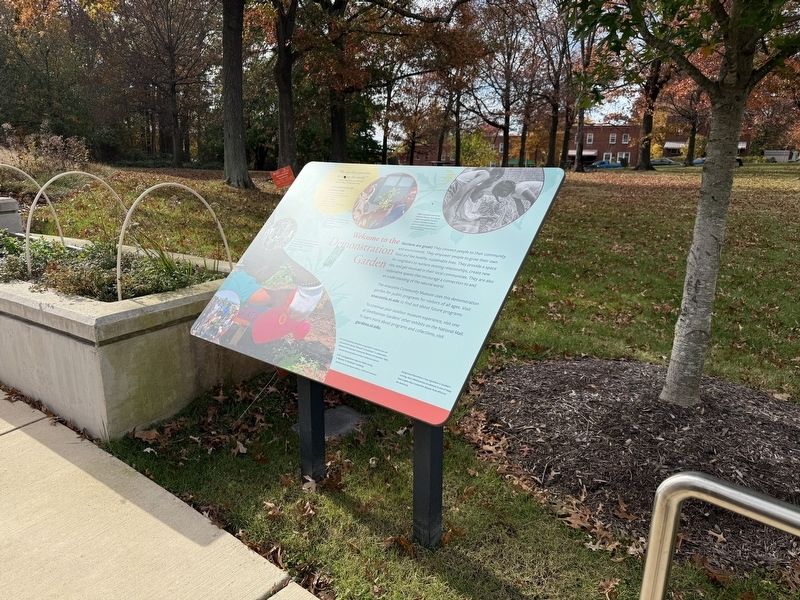
Welcome to the Demonstration Garden

Photographed by Devry Becker Jones (CC0), November 4, 2025
1. Welcome to the Demonstration Garden Marker
Gardens are great! They connect people to their community and environment. They empower people to grow their own food and live healthy, sustainable lives. They provide a space for neighbors to nurture existing relationships, create new ties, and get involved in their local communities. They are also restorative spaces that encourage a connection to and understanding of the natural world.
The Anacostia Community Museum uses this demonstration garden for public programs for visitors of all ages. Visit anacostia.si.edu to find out about future programs.
To continue your outdoor museum experience, visit one of Smithsonian Gardens' other exhibits on the National Mall. To learn more about programs and collections visit gardens.si.edu.
"We can love ourselves by loving the earth."
- Wangari Maathai, activist and Nobel Peace Prize Laureate
The Benefits of Gardening
• Supports healthy lifestyles
• Encourages exercise and movement
• Helps reduce stress
• Promotes dialogue
• Cultivates community
• Connects you to nature and to the past
• Protects the environment
[Captions:]
Left: Elementary school students tend the flower and vegetable gardens at the Anacostia Community Museum as part of a summer science project in 1982.
Right: Anacostia Community Museum garden facilitator Derek Thomas leads a garden workshop.
Right: Anacostia Community Museum educator Zora Martin Felton and students tend the museum's gardens in 1982 as part of a summer science project.
Far Left: Workshop attendees and gardeners celebrate the end of a workshop during "Bloomin' in Southeast," a collaboration between the Anacostia Community Museum and Martha's Table.
Left: A young gardener helps her father during a "Bloomin' in Southeast" workshop.
Background illustration: A key ingredient in Southern cooking, okra (Abelmoschus esulentus) is one of many food staples that crossed the Atlantic from Africa to the Americas.
Erected by Smithsonian
this page online
Topics. This historical marker is listed in these topic lists: Charity & Public Work • Education • Horticulture & Forestry. A significant historical year for this entry is 1982.
Location. 38° 51.42′ N, 76° 58.626′ W. Marker is in Southeast Washington in Washington, District of Columbia. It is in Woodland. It can be reached from the intersection of Fort Place Southeast and Pearson Place Southeast, on the right when traveling east. Touch for map. Marker is at or near this postal address: 1901 Fort Pl SE, Washington DC 20020, United States of America. Touch for directions.

Regionally, this marker is in the Washington Metropolitan Area. It is also in the American Northeast, in the Upper South, in the Mid-Atlantic, in the Tidewater, and in the Chesapeake Bay Region. Globally, it is in North America, the Western Hemisphere, the Western World, and the Anglosphere.
Other nearby markers. At least 8 other markers are within walking distance of this marker: The Anacostia River: Pride and Preservation (a few steps from this marker); A Museum Without Walls (a few steps from this marker); The Anacostia River: People and Places
Photographed by Devry Becker Jones (CC0), November 4, 2025
2. Welcome to the Demonstration Garden Marker
Another marker is no longer nearby. Thurgood Marshall (was within shouting distance of this marker but has been permanently removed).

Credits. This page was last revised on November 4, 2025. It was originally submitted on November 4, 2025, by Devry Becker Jones of Washington, District of Columbia. This page has been viewed 49 times since then and 14 times this year. Photos: 1, 2, 3. submitted on November 4, 2025, by Devry Becker Jones of Washington, District of Columbia.
