
Hastings in Adams County, Nebraska — The American Midwest (Upper Plains)
Hastings College Campus Historic District

Photographed by Cosmos Mariner, September 14, 2025
1. Hastings College Campus Historic District Marker
In 1944, President Franklin Delano Roosevelt signed the Servicemen’s Readjustment Act, known as the G.I. Bill of Rights. This ushered in sweeping changes to America’s colleges and universities by paying for the tuition of World War II veterans and their spouses. With higher education more accessible, college enrollment nearly doubled nationwide. Hastings College campus’s physical development is representative of its postwar increase in enrollment.
At Hastings College, enrollment doubled from 524 students in 1943 to 1,138 in 1946. Roughly half of students enrolled in 1946 were using the G.I. Bill. Such a large increase in the student population required a building campaign that expanded or modified much of the prewar campus fabric. Wooden structures were moved in from the nearby Naval Ammunition Depot to temporarily accommodate the increased enrollment. Eventually these were replaced by new permanent buildings. A number of buildings that make up the college’s modern configuration were built as a direct response to the effects of the G.I. Bill, including the French Memorial Chapel in 1948, Weyer Hall in 1950, and Fuhr Hall
this page online
Erected 2020 by Hastings College & History Nebraska. (Marker Number 576.)
Topics and series. This historical marker is listed in these topic lists: Architecture • Education • War, World II. In addition, it is included in the Former U.S. Presidents: #32 Franklin D. Roosevelt, and the National Register of Historic Places (NRHP) series lists. A significant historical year for this entry is 1944.
Location. 40° 35.479′ N, 98° 22.432′ W. Marker is in Hastings, Nebraska, in Adams County. It can be reached from Turner Avenue just south of University Avenue, on the right when traveling north. The marker is located along the sidewalk on the south side of Calvin H. French Memorial Chapel. It is on the Hastings College campus, ½ block east of Turner Avenue. Touch for map. Marker is at or near this postal address: 716 Turner Avenue, Hastings NE 68901, United States of America. Touch for directions.

Regionally, this marker is in the Smoky Hills and in Eastern Nebraska. It is also in the American Midwest, in the Corn Belt, and on the prairies. Globally, it is in North America, the Western Hemisphere, the Western World,

Photographed by Cosmos Mariner, September 14, 2025
2. Hastings College Campus Historic District Marker
Looking northeast; the southwest corner of Calvin H. French Memorial Chapel is in the background.
Other nearby markers. At least 8 other markers are within walking distance of this marker: McCormick Hall (about 300 feet away, measured in a direct line); The Art Center (about 300 feet away); 1883 American Elm (about 600 feet away); Heartwell Park Historic District (approx. 0.3 miles away); Liberal Hall (approx. 0.8 miles away); The Stitt Building (approx. 0.8 miles away); The Victory Building (approx. 0.8 miles away); Replica of the Statue of Liberty (approx. 0.9 miles away). Touch for a list and map of all markers in Hastings.
Regarding Hastings College Campus Historic District. National Register of Historic Places № 100001393.
From the National Register Nomination prepared by Brian Whetstone, 4/3/2017:
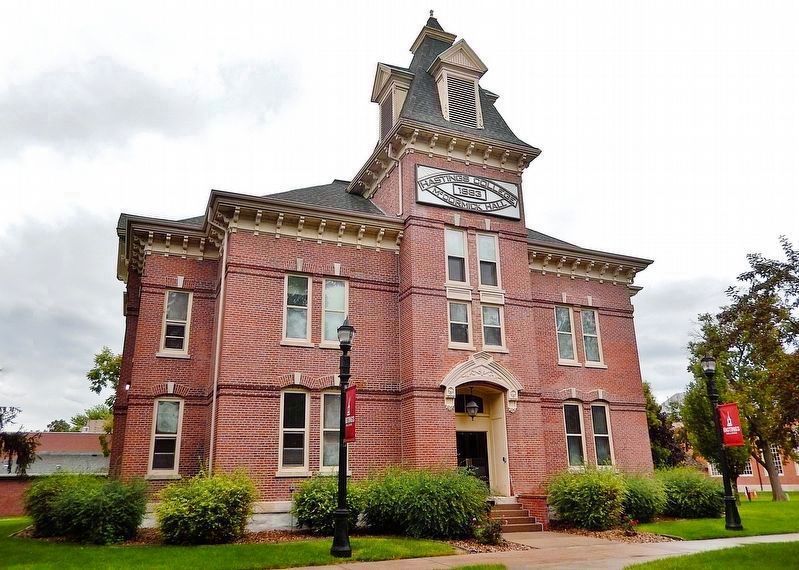
Hastings College is located east of downtown Hastings in what was originally known as the College Addition. The Hastings College Historic District is surrounded by residential neighborhoods today. Hastings College was initially rurally located at the time of its occupation in 1884. The area around campus expanded rapidly throughoutthe late 19th and early 20th centuries — especially in the years leading up to and during WWII to accommodate the immense population boom spurred by the establishment of the Naval Ammunition Depot (NAD) in 1942. As a result of its location between downtown Hastings and the NAD, the college was poised to assist in training civilians and soldiers and progressed with a building campaign that transformed the college over the course of the twentieth century.Photographed by Cosmos Mariner, September 14, 20253. McCormick HallFrom the National Register Nomination: McCormick Hall was the first building constructed on campus from 1883‐1884. Named for primary donor, Cyrus McCormick, McCormick Hall is a two‐story Italianate brick structure with a three‐story entrance tower. In the early years of the college, McCormick Hall served as the primary classroom building and housed the departments of English, math, speech, drama, and chemistry. The college chapel was located in a room on the second floor and was later turned into the little theatre. Because of its association and importance to early college activity, McCormick Hall was added to the National Register of Historic Places in 1975.
Buildings within the district represent a wide variety of styles from every period of campus development, visually unified by the use of red brick and limestone design elements. There are sixteen buildings located within the campus’ historic district boundary; twelve of these are contributing and four are noncontributing. The district retains a high degree of integrity representative of campus growth from the end of WWI to 1969 and overall retains its integrity of location, design, setting, materials, workmanship, feeling, and association.
Related markers. Click here for a list of markers that are related to this marker. Hastings College Campus Historic District
Also see . . . Whetstone leads Hastings College in historic designation (Hastings College).
Photographed by Cosmos Mariner, September 14, 2025
4. Calvin H. French Memorial Chapel
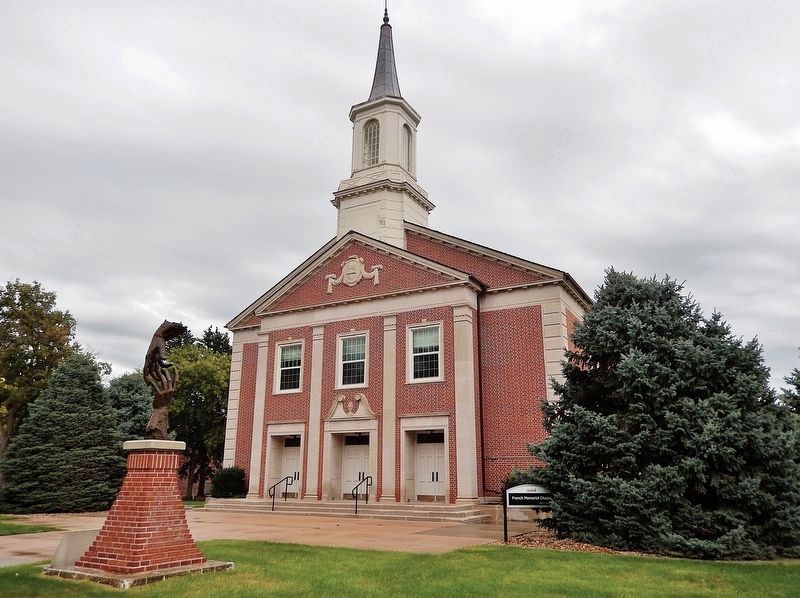
From the National Register Nomination: The Calvin H. French Memorial Chapel — named after former Hastings College president Calvin French — was designed by the Lincoln‐based architecture firm of Davis and Wilson. Located between McCormick Hall and the Daughterty Center, The French Chapel dominates the center of campus at the head of the circle drive. Since 1921 construction of a new chapel had been a central issue in the development of campus. Unable to raise sufficient funds in the 1920s, campus administration instead chose to erect a veritable wooden shack just north of Ringland Hall that would temporarily serve the campus until the construction of a new chapel. This shack was expanded throughout the intervening years between 1921 and 1950 and was incredibly insufficient to provide enough space for the burgeoning student population of the college following WWII.
Construction on the French Memorial Chapel began in 1948 and was completed in 1950. The French Memorial Chapel is a Georgian Revival T‐plan front‐gabled two‐story plus partial basement structure with a steel and brick framing system and a brick and stone exterior. The central, front‐gabled block of the chapel has two smaller one‐story gabled wings attached perpendicularly to the north and south facades near the east façade. The north, one‐story wing was initially used as a music library, and the south wing was a separate, smaller memorial chapel.
Construction on the French Memorial Chapel began in 1948 and was completed in 1950. The French Memorial Chapel is a Georgian Revival T‐plan front‐gabled two‐story plus partial basement structure with a steel and brick framing system and a brick and stone exterior. The central, front‐gabled block of the chapel has two smaller one‐story gabled wings attached perpendicularly to the north and south facades near the east façade. The north, one‐story wing was initially used as a music library, and the south wing was a separate, smaller memorial chapel.
Excerpt: Following significant research and effort by senior history major Brian Whetstone, a significant portion of the Hastings College campus has been added by the National Park Service to the National Register of Historic Places (NRHP) as a local historic district. The Hastings College Historic District designation includes 12 buildings on campus for their historic significance in the College’s post World War II growth:(Submitted on November 4, 2025, by Cosmos Mariner of Cape Canaveral, Florida.)
• McCormick Hall (completed in 1884) NOTE: McCormick Hall was listed on the Historic Register in 1975 but is also now part of the larger historic district.
• Taylor Hall (three phases: 1921, 1938 and 1949)
• Calvin H. French Memorial Chapel (1950)
• Weyer Hall (1950)
• Fuhr Hall (1956)
• Bronc Hall (1960)
• Hazelrigg Student Union (1962)
• Hurley-MacDonald Hall (1962)
• Perkins Library (1963)
• Altman Hall (1963)
• Kiewit Building, which was previously the art center and Carnegie Library that was joined to the P.L. Johnson Gymnasium (1906, 1925 and 1969)
• Former maintenance building just north of Kiewit (1961)
Credits. This page was last revised on November 5, 2025. It was originally submitted on November 4, 2025, by Cosmos Mariner of Cape Canaveral, Florida. This page has been viewed 74 times since then and 38 times this year. Photos: 1, 2, 3, 4. submitted on November 4, 2025, by Cosmos Mariner of Cape Canaveral, Florida.
