Montmartre in Paris in Département de Paris, Île-de-France, France — Western Europe
Le Passe-Muraille
⎯⎯⎯
The Man Who Could Walk Through Walls
| — | Histoire de Paris | — |

Photographed by Andrew Ruppenstein, April 11, 2025
1. Le Passe-Muraille / The Man Who Could Walk Through Walls Marker

"Il y avait à Montmartre un excellent homme nommé Dutilleul qui possédait le don singulier de passer à travers les murs sans en être incommode. Modeste employé de troisième classe dans un ministère, il se découvre fortuitement cet étrange pouvoir, et l'utilise d'abord pour rendre fou un sous-chef de service qui l'abreuvait d'humiliations Vient alors, après quelques fructueux cambriolages signes "Garou-Garou", le tour du directeur de la Santé, impuissant à garder un prisonnier qui sort déjeuner dans le quartier et l'appelle innocemment pour régler la note... L'amour perd cependant notre héros, figé à l'intérieur de la muraille au sortir d'une nuit passionnée. Depuis, "certaines nuits d'hiver, dans la solitude sonore de la rue Norvins" seuls les accords de guitare joués par le peintre Gen Paul "pénètrent au coeur de la pierre comme des gouttes de lune"... L'apre lucidité de Marcel Aymé s'en donne à coeur joie dans ce recueil de nouvelles paru en 1943, qui dénonce d'un coup discret de baguette magique, narquoise irruption du fantastique dans un quotidien trop bien réglé, la médiocrité
this page online
The Man Who Could Walk Through Walls
"There lived in Montmartre an excellent man named Dutilleul who possessed the singular gift of passing through walls without causing any inconvenience. A humble third-class clerk in a government ministry, he fortuitously discovers this strange power and first uses it to drive mad a junior department head who heaped humiliations upon him. Then, after a few successful burglaries, the "Garou-Garou" (a play on words combining "Garou" and "Garou," meaning "Werewolf"), comes the turn of the Director of Health, powerless to guard a prisoner who goes out for lunch in the neighborhood and innocently calls him to settle the bill... Love, however, is the undoing of our hero, frozen inside the wall after a passionate night. Since then, "on certain winter nights, in the sonorous solitude of Rue Norvins," only the guitar chords played by the painter Gen Paul "penetrate the heart of the stone like drops of moonlight"... Marcel Aymé's stark lucidity revels in this. In this collection of short stories published in 1943, which denounces with a discreet wave of a magic

Photographed by Andrew Ruppenstein, April 11, 2025
2. Le Passe-Muraille / The Man Who Could Walk Through Walls Marker - wide view
The marker is visible here to the right of the building entrance on the corner.
Topics and series. This historical marker is listed in this topic list: Arts, Letters, Music. In addition, it is included in the Histoire de Paris series list. A significant historical year for this entry is 1943.
Location. 48° 53.262′ N, 2° 20.258′ E. Marker is in Paris, Île-de-France, in Département de Paris. It is in Montmartre. It is at the intersection of Place Marcel Aymé and Rue Girardon, on the left when traveling east on Place Marcel Aymé. Touch for map. Marker is at or near this postal address: 2 Place Marcel Aymé, Paris, Île-de-France 75018, France. Touch for directions.

Regionally, it is in the North Atlantic Region, Europe, the European Union, Atlantic Europe, the Schengen Area, Western Europe, a coastal Mediterranean country, and the Western World. Historically, it finds itself in what was once a French colony and also the Roman Empire.
Other nearby markers. At least 8 other markers are within walking distance of this marker: Marcel Aymé (a few steps from this marker); Gen-Paul (a few steps from this
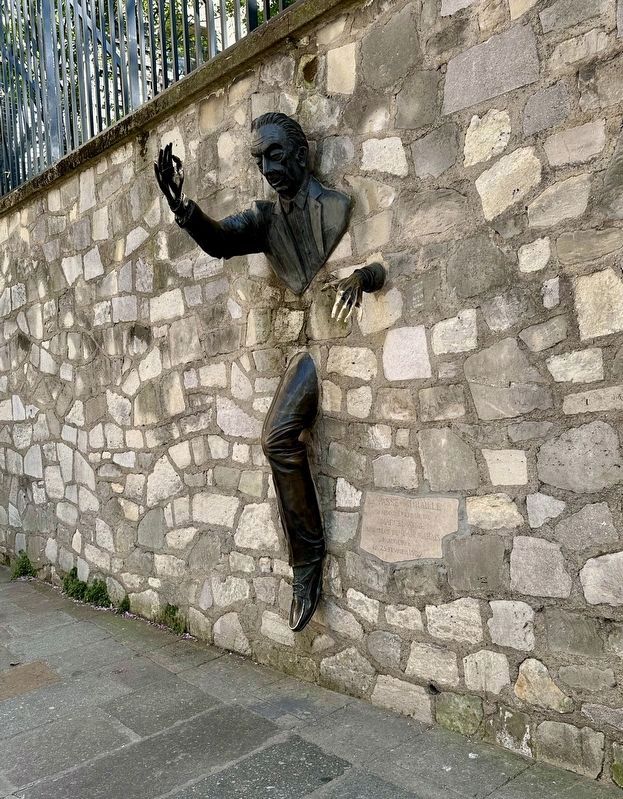
Photographed by Andrew Ruppenstein, April 11, 2025
3. Le Passe-Muraille (“The Walker Through Walls”) by Jean Marais (1989)
…He then falls in love with a married woman, whose husband goes out every night and leaves her locked in her bedroom. Dutilleul uses his power to enter her bedroom and spend the night with her while her husband is away. One morning, Dutilleul has a headache and takes two pills he finds in the bottom of his drawer. His headache goes away, but later that night, as he is leaving his lover's house, he notices a feeling of resistance as he is passing through the walls. The pills Dutilleul had thought were aspirin are, in fact, the medicine his doctor had prescribed for him a year earlier. As he is passing through the final outer wall of the property, he notices he is no longer able to move. He realizes his mistake too late. The medicine suddenly takes effect, and Dutilleul ends up trapped in the wall, where he remains to this day. - Wikipedia
Also see . . .
1. Le Passe-muraille (Wikipedia). Overview:
The passer-through-walls (French: Le Passe-muraille), translated as The Man Who Walked through Walls, The Walker-through-Walls or The Man who Could Walk through Walls, is a short story published by Marcel Aymé in 1941.(Submitted on November 8, 2025.)
2. Marcel Aymé (Wikipedia). Overview:
Marcel Aymé (29 March 1902 – 14 October 1967) was a French novelist and playwright, who also wrote screenplays and works for children.(Submitted on November 8, 2025.)
Additional keywords. panneau
Credits. This page was last revised on November 17, 2025. It was originally submitted on November 8, 2025, by Andrew Ruppenstein of Lamorinda, California. This page has been viewed 94 times since then and 54 times this year. Photos: 1, 2, 3. submitted on November 8, 2025, by Andrew Ruppenstein of Lamorinda, California.
