
Downtown El Paso in El Paso County, Texas — The American South (West South Central)
Caples Building
⎯⎯⎯
Torre Caples

Photographed by Mansfieldphoto.com, October 3, 2025
1. Caples Building / Torre Caples Marker
 The Caples Building, a Romanesque style structure designed by Henry C. Trost, was built in 1909. Originally five stories tall, two additional floors were added to the building in 1915-1916. The fifth floor offices offered sweeping views of El Paso and Ciudad Juárez. In early 1911, provisional president Francisco I. Madero announced that El Paso would be the center of the revolutionary movement in the United States. The offices located in rooms 507 and 508 of the Caples Building became the headquarters of the Madero junta. Junta members included included provisional Chihuahua Governor Abraham González, who operated the government-in-exile and met with the press and issued communiqués. The loose coalition of junta members soon included Francisco "Pancho” Villa, former professor Braulio Hernández, attorney Frederico González-Garza, Alberto Fuentes, and Castulo Herrera (who reportedly fired the first shot of the Revolution).
El Paso physician, Ira J. Bush, known as the "Gringo Doctor," helped form a revolutionary medical corps for the movement, and Giuseppe Garibaldi, grandson of the famous Italian patriot, also joined the junta. When the Unites States government issued warrants for Madero and González, they fled to Mexico but left their staffs at the Caples Building. Those left behind continued to recruit troops, purchase arms, and promote the revolutionary cause.
La Torre Caples, una estructura de estilo romanesca, diseñada por Henry C. Trost, fue construida en 1909. Inicialmente contaba con solo cinco pisos, pero se agregaron dos pisos adicionales entre 1915-1916. Del quinto piso se apreciaban vistas panorámicas de las ciudades de El Paso y Juárez.
A principios de 1911, el presidente provisional Francisco I. Madero, anunció que la ciudad de El Paso serviría como centro del movimiento
this page online
El médico Paseño, Ira J. Bush conocido como el Médico Gringo, ayudó en formar un cuerpo médico revolucionario para el movimiento y Giuseppe Garibaldi, nieto del famoso patriota italiano, también se unió a la coalición. Cuando el gobierno estadounidense emitió ordenes de arresto en contra de Madero y González, estos huyeron a México, dejando detrás a sus equipos en la Torre Caples. Los que quedaron siguieron con el reclutamiento de tropas, compra de armas y promoción de la causa.
Erected by El Paso Historical Commission.
Topics. This historical marker is listed in this
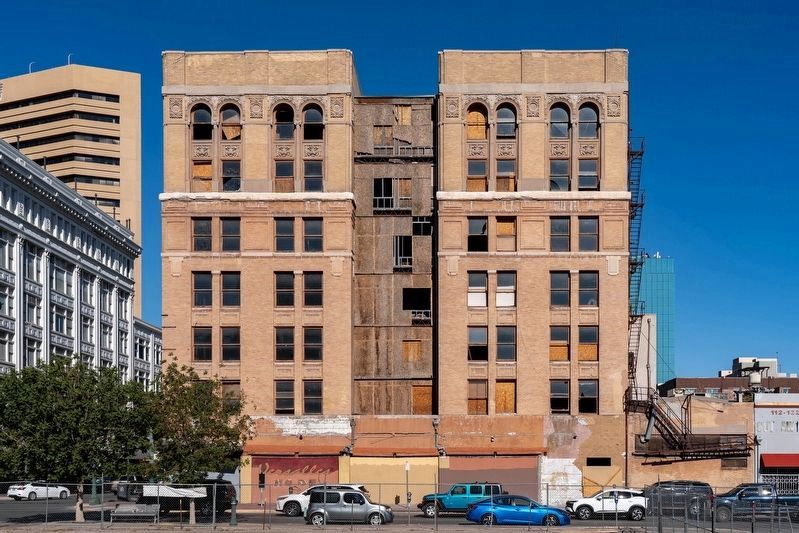
Photographed by Mansfieldphoto.com, October 3, 2025
2. Caples Building / Torre Caples Marker
The marker is located along the sidewalk on the left side of the building.
Location. 31° 45.49′ N, 106° 29.208′ W. Marker is in El Paso, Texas, in El Paso County. It is in Downtown El Paso. It is at the intersection of North Mesa Street and E San Antonio Ave, on the right when traveling north on North Mesa Street. The marker is located along the west side of the building on the sidewalk. Touch for map. Marker is at or near this postal address: 100a N Mesa St, El Paso TX 79901, United States of America. Touch for directions.

Regionally, this marker is in Texas’ Trans-Pecos & Big Bend Region. It is also in the American Southwest. Globally, it is in North America, a Gulf of Mexico state, the Western Hemisphere, the Western World, and the Anglosphere. Historically, it finds itself in what was once New Spain, the Republic of Texas, and one of the Confederate States of America.
Other nearby markers. At least 8 other markers are within walking distance of this marker: John Wesley Hardin (within shouting distance of this marker); Elite Confectionary (about 300 feet away, measured in a direct line); Nine of Primitive El Paso's Patriotic Heroes (about 400 feet away); Singer Building (about 400 feet away); Site of United States Courthouse (about 500 feet away); The Martin Building (about 600 feet away); El Paso's Chinese Community (about 600 feet away); LULAC (about 600 feet away). Touch for a list and map of all markers in El Paso.
Also see . . . Richard Caples Building. Wikipedia (Submitted on November 9, 2025, by James Hulse of Medina, Texas.)
Credits. This page was last revised on November 9, 2025. It was originally submitted on November 9, 2025, by James Hulse of Medina, Texas. This page has been viewed 64 times since then and 16 times this year. Photos: 1, 2. submitted on November 9, 2025, by James Hulse of Medina, Texas.
