Castricum, North Holland, Netherlands — Northwestern Europe
Dingstal
Photographed by Andrew Ruppenstein, March 21, 2025
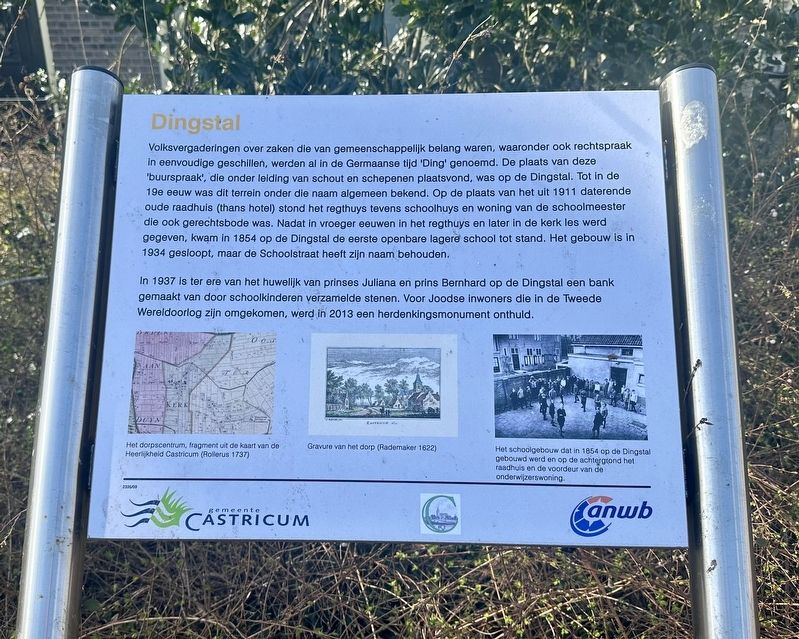
1. Dingstal Marker

In 1937 is ter ere van het huwelijk van prinses Juliana en prins Bernhard op de Dingstal een bank gemaakt van door schoolkinderen verzamelde stenen. Voor Joodse inwoners die in de Tweede Wereldoorlog zijn omgekomen, werd in 2013 een herdenkingsmonument onthuld.
Public assemblies on matters of common interest, including the administration of justice in simple disputes,
this page online
In 1937, a bench was built on the Dingstal in honor of the wedding of Princess Juliana and Prince Bernhard, made of stones collected by schoolchildren. A memorial was unveiled in 2013 for Jewish residents who died in World War II.
Erected by Gemeente Castricum, ANWB. (Marker Number 2335/03.)
Topics. This historical marker is listed in these topic lists: Education • Government & Politics. A significant historical year for this entry is 1911.
Location. 52° 32.815′ N, 4° 39.867′ E. Marker is in Castricum, Noord-Holland
Photographed by Andrew Ruppenstein, March 21, 2025
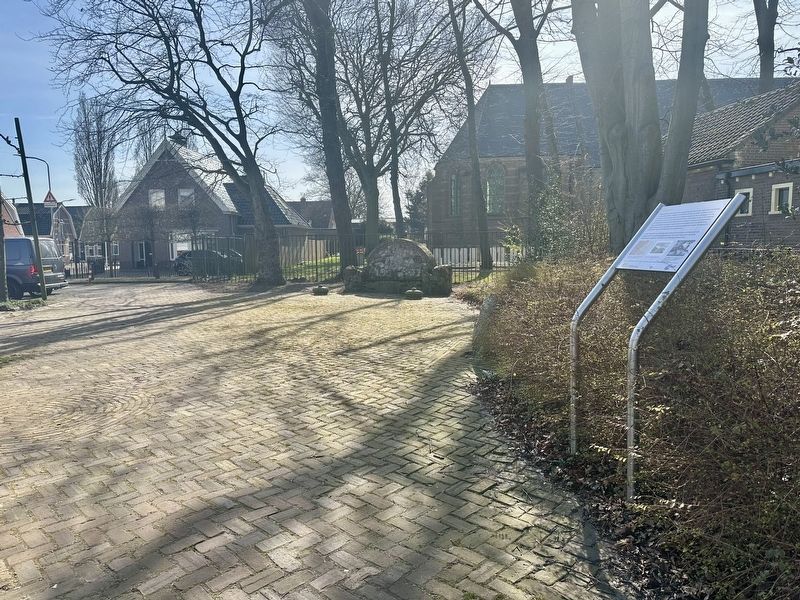
2. Dingstal Marker - wide view
The marker is visible here on the right, and the bench built by schoolchildren (mentioned on the marker), is visible in the center but further back.

Regionally, it is in Europe, the European Union, Atlantic Europe, the Benelux Low Countries, the Schengen Area, Western Europe, and the Western World. Historically, it finds itself in what was once the Holy Roman Empire.
Other nearby markers. At least 8 other markers are within walking distance of this marker: Castricum Holocaust Memorial (a few steps from this marker); Voormalig Raadhuis / Former Town Hall (a few steps from this marker); Kogel / Cannonball (within shouting distance of this marker); Dorpskerk Protestantse Gemeente / Protestant Community Village Church (within shouting distance of this marker); Jan Hoberg Memorial (approx. 0.3 kilometers away); De rooms-katholieke Sint-Pancratiuskerk / The Roman Catholic Saint Pancratius Church (approx. 0.3 kilometers away); Woonhuis en Stolpboerderij / House and Farmhouse (approx. half a kilometer away); Monument Slag bij Castricum / Battle of Castricum Monument (approx. half a kilometer away). Touch for a list and map of all markers in Castricum.
Also see . . . Het oude raadhuis in de Dorpstraat (Oud Castricum, in Dutch). On the name Dingstal (in translation):
In the Middle Ages, justice was administered at a Dingplaats (“place of worship”). Numerous words still recall this, such as geding (“brief proceedings”), bedingen (“terms”), and mededinger (“rival”). Instead of plaats, stoel (“chair”) was sometimes used. We no longer use this word in that sense, but zetel (“seat”) does: the International Court of Justice “sits” in The Hague.(Submitted on November 11, 2025.)
For centuries, Castricum had a Dingstoel, also called Dingstal. It was located on the site where the town hall would later be built.…
Credits. This page was last revised on December 8, 2025. It was originally submitted on November 10, 2025, by Andrew Ruppenstein of Lamorinda, California. This page has been viewed 85 times since then and 53 times this year. Photos: 1. submitted on November 10, 2025, by Andrew Ruppenstein of Lamorinda, California. 2. submitted on November 11, 2025, by Andrew Ruppenstein of Lamorinda, California.
