Alma in Harlan County, Nebraska — The American Midwest (Upper Plains)
Alma Carnegie Library
Photographed by Cosmos Mariner, September 12, 2025
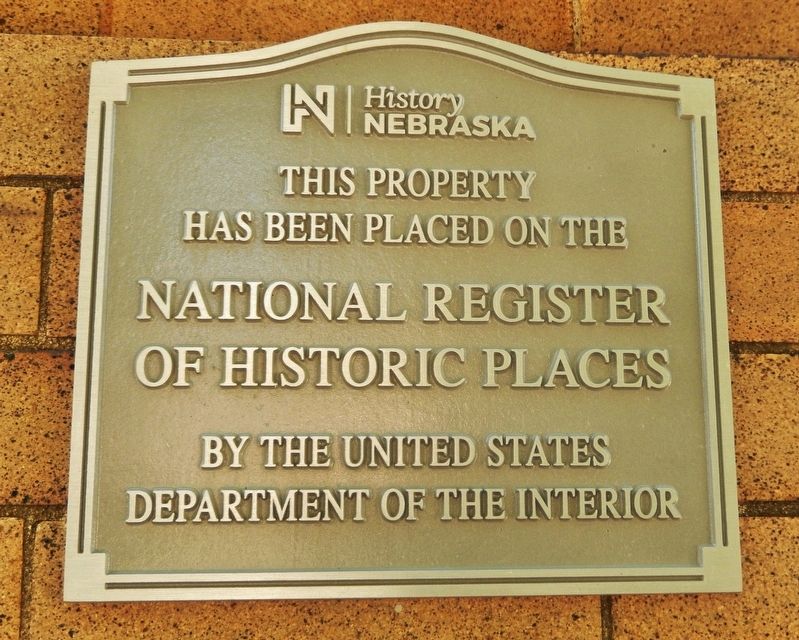
1. Alma Carnegie Library Marker
National Register of Historic Places
by the United States Department of the Interior
Erected by History Nebraska.
Topics and series. This historical marker is listed in these topic lists: Architecture • Charity & Public Work • Education • Notable Buildings. In addition, it is included in the Carnegie Libraries, and the National Register of Historic Places (NRHP) series lists. A significant historical year for this entry is 1911.
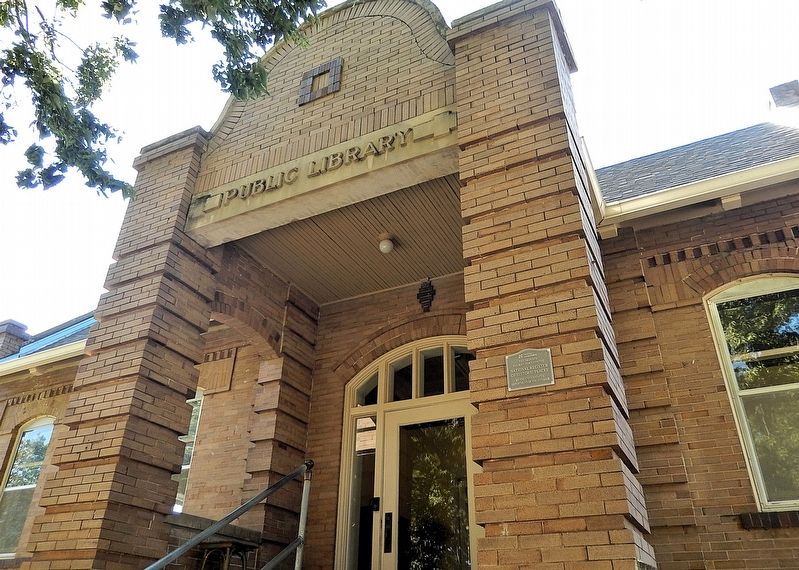
Location. 40° 5.951′ N, 99° 21.742′ W. Marker is in Alma, Nebraska, in Harlan County. It is at the intersection of South John Street and 2nd Street, on the left when traveling north on South John Street. The marker is mounted on the right side of the front entrance, near the northeast corner of the building. Touch for map. Marker is at or near this postal address: 111 South John Street, Alma NE 68920, United States of America. Touch for directions.

Regionally, this marker is in Eastern Nebraska and in the Republican River Valley. It is also in the American Midwest, in the Corn Belt, and on the prairies. Globally, it is in North America,
this page online
Other nearby markers. At least 2 other markers are within walking distance of this marker: Fish-Eating Birds (approx. ¼ mile away); The Changing Shoreline (approx. ¼ mile away).
Regarding Alma Carnegie Library. Contributing property, Carnegie Libraries in Nebraska, 1899 to 1922, National Register of Historic Places № 100007149.
From the National Register Nomination prepared by Dr. Kathleen Fimple, 6/15/1990:
Carnegie grants were awarded to 68 communities, townships or counties in Nebraska, including Alma. While Carnegie endowed many worthwhile causes in his lifetime, libraries were among the first and foremost of his benefactions. He himself divided his gifts of libraries into two periods, which he called "retail" and "wholesale." The "retail" period covered the years 1886 to 1896. During this time Carnegie gave a total of $1,860,869 to six communities, five located in Pennsylvania and one in Iowa. Fourteen buildings were erected as a result of these gifts. The "wholesale" period of libraryphilanthropy lasted from 1898 to 1919. During this period Carnegie gave $39,172,981 to 1406 communities for the sole purpose of constructing library buildings.Photographed by Cosmos Mariner, September 12, 20252. Alma Carnegie Library MarkerThe marker is mounted on the right column in front of the east/front entrance.
In Nebraska, public libraries were part of the effort to bring culture and educational opportunities to the people of the state from its early days. The local efforts to establish reading rooms or libraries were often initiated by community organizations, such as women's clubs, fraternal organizations, and commercial clubs. The offer of grants for public library buildings made by Andrew Carnegie was the catalyst for a boom in library construction in Nebraska. During the first phase of the "wholesale" period, awards were approved for 19 Nebraska communities for Carnegie libraries. The majority of Nebraska's Carnegie libraries were built during the last phase of the "wholesale" period — between 1911 and 1919. Forty-six communities were approved for awards, with 44 actually constructing libraries. All of the 68 Carnegie libraries built in Nebraska served their intended purpose for several decades. In 1981, 46 were still in use as libraries, 14 had been adapted for other uses, and8 had been demolished.Photographed by Cosmos Mariner, September 12, 20253. Alma Carnegie Library CornerstoneThe 1911 cornerstone is at the northeast corner of the building.
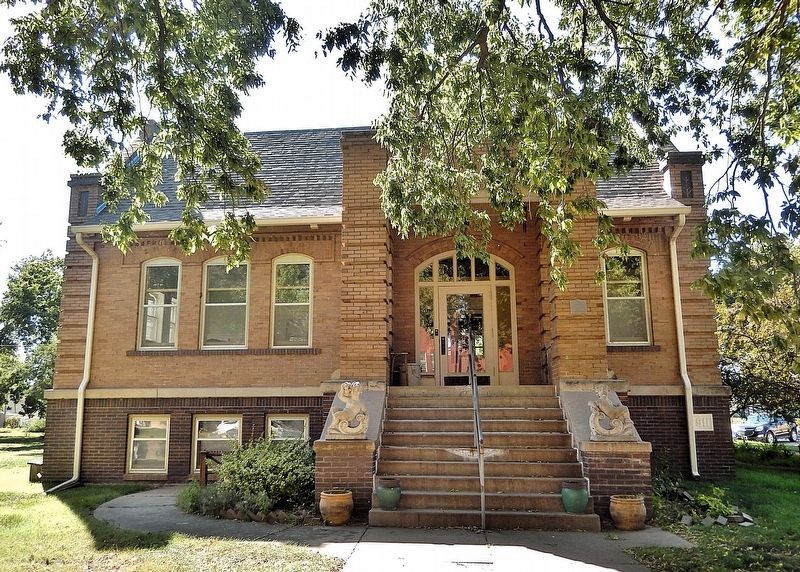
In 1911 Bertram [assistant to Carnegie] published his leaflet "Notes on Library Buildings,” in which he outlined several ideal plans for libraries, as well as giving guidelines for interior spaces. Six plans were suggested, all aimed at small communities. All were rectangular-shaped, although the dimensions varied, as did the orientation to the street. All buildings were to have a raised basement and one story. The main level would be 12 to 15 feet high, with rear and side windows 6 to 7 feet from the floor (to permit shelving). The main entry was most often in the center of the primary facade but could also be to one side of center or in the corner of the building. There was always a side or rear entrance, usually to the basement. The basement was to be 9 to 10 feet high and about four feet below the natural grade. No suggestions were made about the exterior, but it was clear that the goal was a plain, dignified structure. In fact, Bertram warned against building "Greek temples" instead of libraries. Equally favored styles in Nebraska were Neo-Classical, Renaissance Revival, and Prairie, with Craftsman, Jacobethan,and Georgian also represented. With their rectangular plan, the majority of buildings featured hipped roofs, although gable and flat could also be found. The building materials were brick or stone. Only a very few small libraries were of frame construction.Photographed by Cosmos Mariner, September 12, 20254. Alma Carnegie Library (east/front elevation)The main/front entrance is near the northeast corner of the building and faces east toward South John Steet. The main floor is at the 1½-story level, above a full ground-level basement.

Also see . . .
1. Converted Library Home for Sale in Alma Nebraska Built with Carnegie Funding.
Excerpt: This isn’t just a house — it’s a piece of history that you can call home. Built in 1911 as a Carnegie Library, this building is now a fully converted private residence that still looks and feels like a public library from the outside. The original brick exterior is still intact, and from the curb, you’d never guess it’s a private home. It has that classic, symmetrical Carnegie-style layout with tall windows, grand stone steps, and a welcoming sense of quiet strength. This home is officially listed on the National Register of Historic Places. That means it’s recognized for its architectural and cultural value on a national level. Carnegie Libraries were built in the early 1900s all across the United States thanks to funding from philanthropist Andrew Carnegie. This(Submitted on November 11, 2025, by Cosmos Mariner of Cape Canaveral, Florida.)one in Alma is a textbook example of that style — elegant, solid, and community-minded.Photographed by Cosmos Mariner, September 12, 20255. Alma Carnegie Library (southeast elevation)

2. Carnegie library (Wikipedia).
Excerpt: A Carnegie library is a library built with money donated by Scottish-American businessman and philanthropist Andrew Carnegie. A total of 2,509 Carnegie libraries were built between 1883 and 1929. 1,689 were built in the United States. At first, Carnegie libraries were almost exclusively in places with which he had a personal connection — namely his birthplace in Scotland and the Pittsburgh, Pennsylvania area, his adopted hometown. Later, Carnegie substantially increased funding to libraries outside these areas. As Carnegie's library funding progressed, very few of the towns that requested a grant, committing to his terms for operation and maintenance, were refused.(Submitted on November 11, 2025, by Cosmos Mariner of Cape Canaveral, Florida.)
3. Nebraska Public Library Founding Dates (Nebraska Library Commission).
Excerpt: Alma Carnegie Library(Submitted on November 11, 2025, by Cosmos Mariner of Cape Canaveral, Florida.)
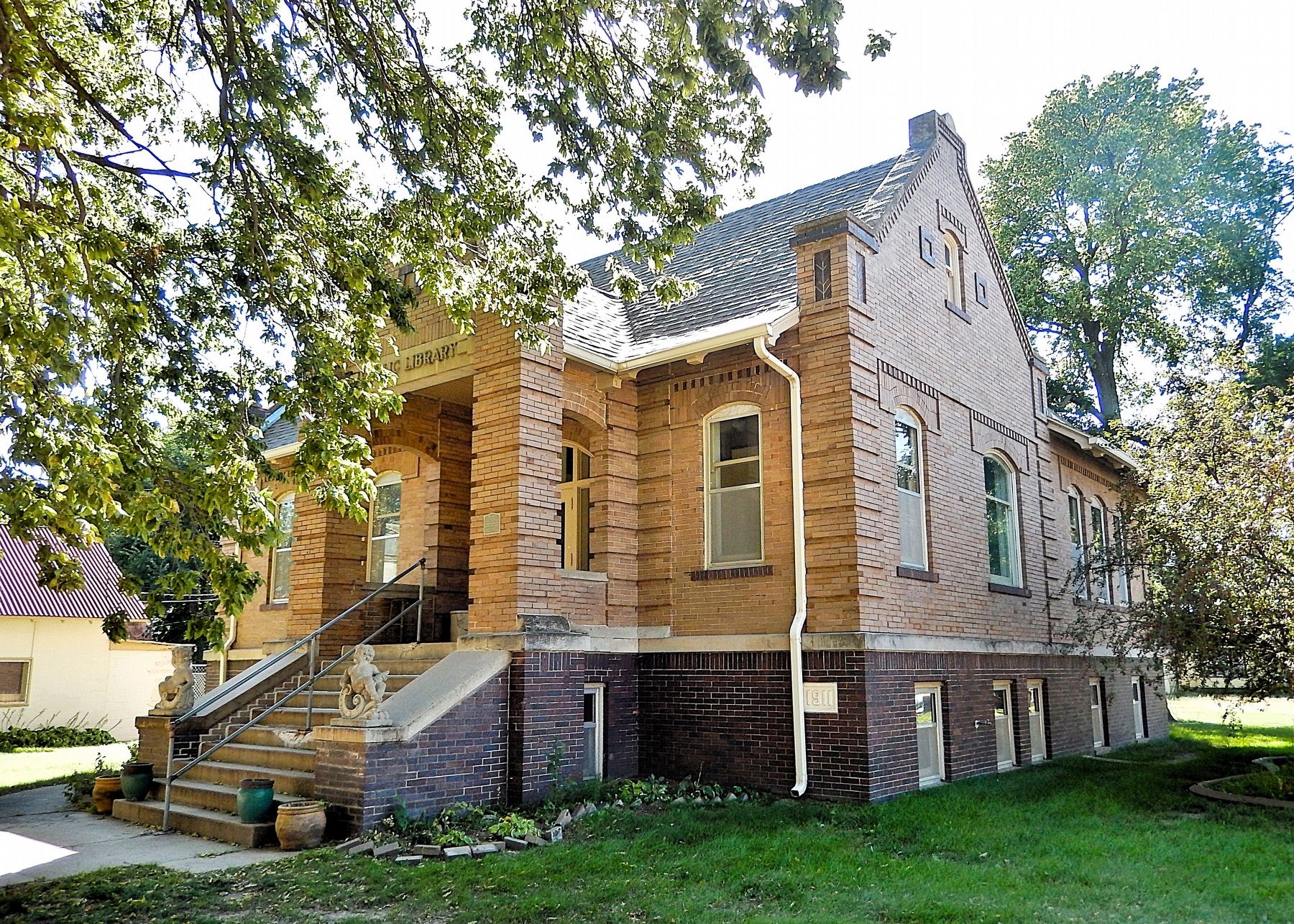
Founding date: 1910; Sponsored or assisted by Women'sClubPhotographed by Cosmos Mariner, September 12, 20256. Alma Carnegie Library (northeast elevation)
Constructed: 1911
Carnegie Building is privately owned
Designed by the Chicago architectural firm of Patton & Miller
Credits. This page was last revised on November 11, 2025. It was originally submitted on November 11, 2025, by Cosmos Mariner of Cape Canaveral, Florida. This page has been viewed 81 times since then and 48 times this year. Photos: 1, 2, 3, 4, 5, 6. submitted on November 11, 2025, by Cosmos Mariner of Cape Canaveral, Florida.
