Amsterdam-Noord , North Holland, Netherlands — Northwestern Europe
Buiksloterkerk
| — | Rijksmonument | — |
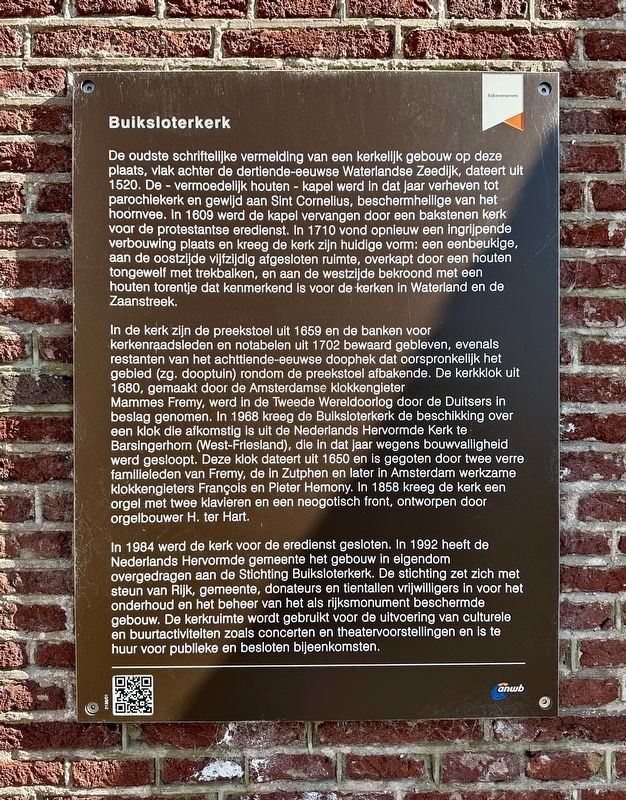
Photographed by Andrew Ruppenstein, March 20, 2025
1. Buiksloterkerk Marker

In de kerk zijn de preekstoel uit 1659 en de banken voor kerkenraadsleden en notabelen uit 1702 bewaard gebleven, evenals restanten van het achttiende-eeuwse doophek dat oorspronkelijk het gebied (zg. dooptuin) rondom de preekstoel afbakende. De kerkklok uit 1680, gemaakt door de Amsterdamse klokkengieter Mammes Fremy, werd in de Tweede Wereldoorlog door de Duitsers in beslag genomen. In 1968 kreeg de Buiksloterkerk
this page online
In 1984 werd de kerk voor de eredienst gesloten. In 1992 heeft de Nederlands Hervormde gemeente het gebouw in eigendom overgedragen aan de Stichting Buiksloterkerk. De stichting zet zich met steun van Rijk, gemeente, donateurs en tientallen vrijwilligers in voor het onderhoud en het beheer van het als rijksmonument beschermde gebouw. De kerkruimte wordt gebruikt voor de uitvoering van culturele en buurtactiviteiten zoals concerten en theatervoorstellingen en is te huur voor publieke en besloten bijeenkomsten.
The oldest written mention of a church building on this site, just behind the thirteenth-century Waterland Sea Dike, dates from 1520. The chapel,

Photographed by Andrew Ruppenstein, March 20, 2025
2. Buiksloterkerk Marker - wide view
The marker is visible here just to the right of the church entrance.
The church preserves the pulpit from 1659 and the pews for church council members and dignitaries from 1702, as well as remnants of the eighteenth-century baptismal gate that originally demarcated the area (known as the baptismal garden) around the pulpit. The church bell from 1680, made by Amsterdam bell founder Mammes Fremy, was confiscated by the Germans during World War II. In 1968, the Buiksloterkerk acquired a bell from the Dutch Reformed Church in Barsingerhorn (West Friesland), which was demolished that year due to dilapidation. This bell dates from 1650 and was cast by two distant relatives of Fremy, the bell-makers François and Pieter

Photographed by Andrew Ruppenstein, March 20, 2025
3. Buiksloterkerk - view from west
In 1984, the church was closed for worship. In 1992, the Dutch Reformed Church transferred ownership of the building to the Buiksloterkerk Foundation. With the support of the national government, the municipality, donors, and dozens of volunteers, the foundation is committed to the maintenance and management of the building, which is a national heritage site. The church space is used for cultural and community activities such as concerts and theater performances and can be rented for public and private gatherings.
Erected by the ANWB. (Marker Number 2136/01.)
Topics. This historical marker is listed in this topic list: Religion & Religious Structures. A significant historical year for this entry is 1520.
Location. 52° 24.106′ N, 4° 54.965′ E. Marker is in Amsterdam, Noord-Holland (North Holland). It is in Amsterdam-Noord. It is on Buiksloterkerkpad. Touch for map. Marker is at or near this postal address: Buiksloterkerkpad 10, Amsterdam, Noord-Holland 1034 VZ,

Photographed by Andrew Ruppenstein, March 20, 2025
4. Buiksloterkerk - view from the southwest

Regionally, it is in Europe, the European Union, Atlantic Europe, the Benelux Low Countries, the Schengen Area, Western Europe, and the Western World. Historically, it finds itself in what was once the Holy Roman Empire.
Other nearby markers. At least 8 other markers are within 2 kilometers of this marker, measured as the crow flies: Buiksloterkerk (church) (here, next to this marker); Krijtmolen d’Admiraal (chalk mill) (approx. half a kilometer away); Krijtmolen d’Admiraal / Chalkmill d’Admiraal (approx. half a kilometer away); Lancaster R5512 (approx. 1.4 kilometers away); 17 Juli 1943 Fokkerbombardementen / 17 July 1943 Fokker Bombings (approx. 1.5 kilometers away); 1936-1939 No Pasaran (approx. 1.6 kilometers away); Museum de Noord (museum of the north) and Vogeldorp (village) (approx. 1.7 kilometers away); Gerben Wagenaar (approx. 1.7 kilometers away). Touch for a list and map of all markers in Amsterdam.
Also see . . . Gebouw en geschiedenis (Stichting Buiksloterkerk, in Dutch). The QR code on the marker lead’s to homepage for the church’s supporting foundation. From the menu on that page, one may choose this page for the church’s history. Excerpt (in translation):
Just behind the houses on the Buiksloterdijk, the sea dike that once offered protection against the open water of the IJ, lies the oldest church in Amsterdam-Noord. Surrounded by greenery, water, tall trees, and a small churchyard, the church remains an idyllic spot in Buiksloot, which, despite drastic changes in the surrounding area, has retained its characteristic appearance as a dike village.(Submitted on November 11, 2025.)
The church is a single-nave brick building, five-sided on the east side, under a high gable roof. It is crowned on the west side with a small wooden tower, typical of the churches in Waterland and the Zaan region. The building's current appearance dates from 1710, when the original medieval church, which had likely been extensively renovated in 1609, was renovated. The design of the splayed buttresses on the building's exterior walls is reminiscent of the seventeenth century, but architectural history research will determine the date of the various parts of the church.…
Credits. This page was last revised on November 11, 2025. It was originally submitted on November 11, 2025, by Andrew Ruppenstein of Lamorinda, California. This page has been viewed 35 times since then and 14 times this year. Photos: 1, 2, 3, 4. submitted on November 11, 2025, by Andrew Ruppenstein of Lamorinda, California.
