Hill City in Pennington County, South Dakota — The American Midwest (Upper Plains)
Water Tank
Photographed by Cosmos Mariner, August 17, 2023
1. Water Tank Marker
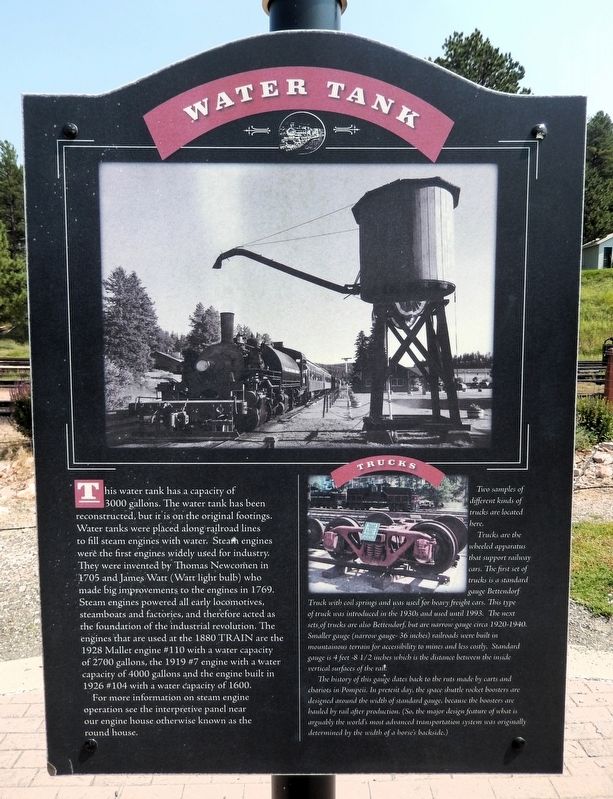
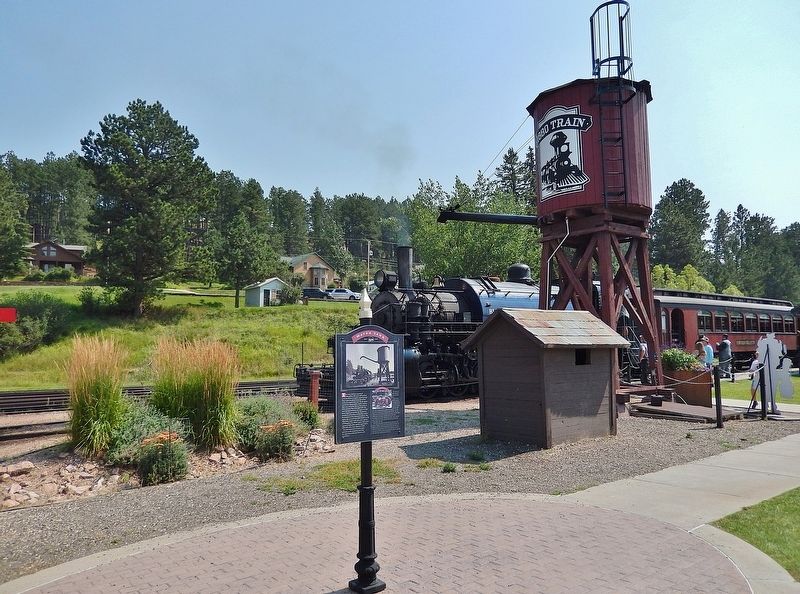
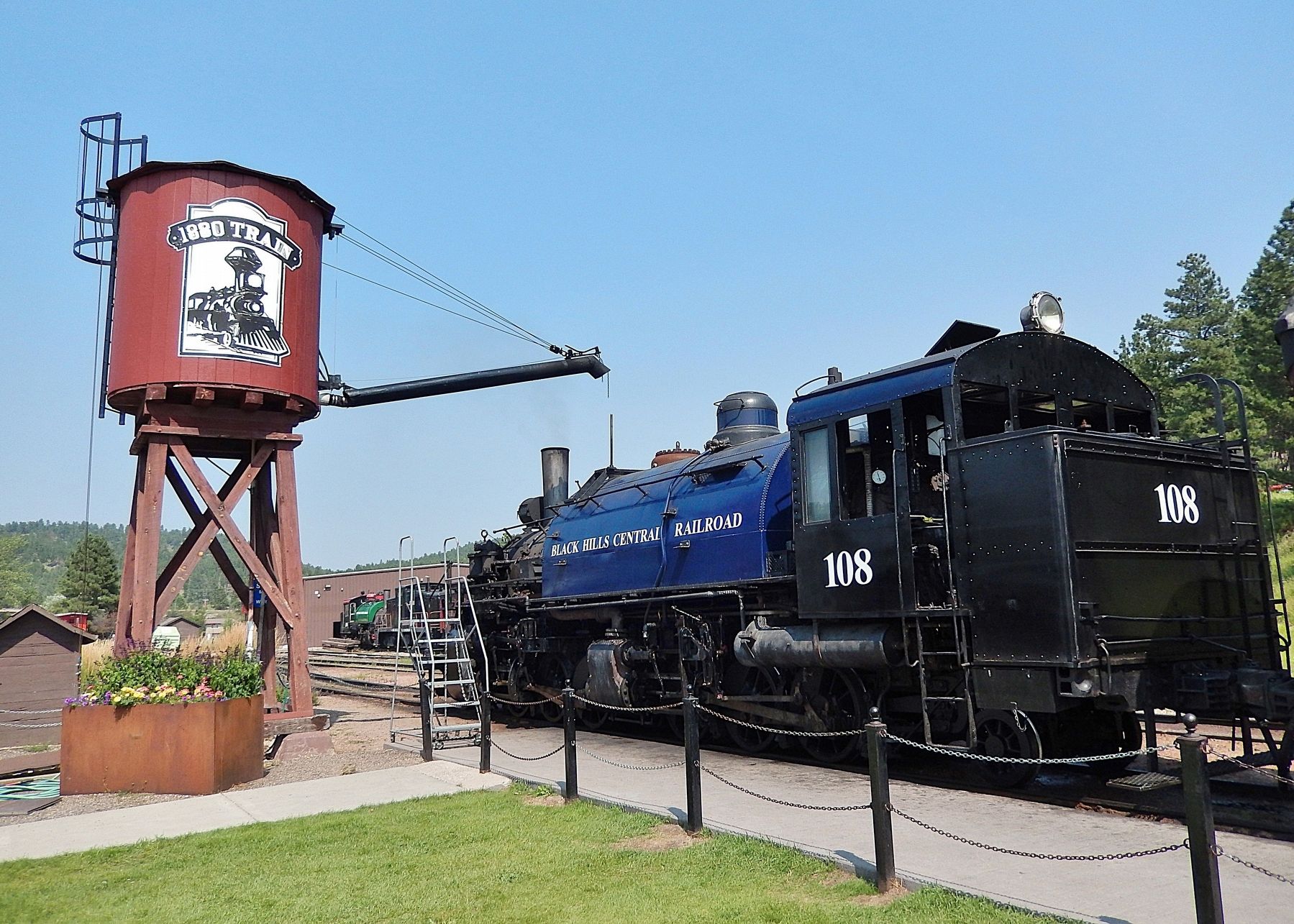
This water tank has a capacity of 3000 gallons. The water tank has been reconstructed, but it is on the original footings. Water tanks were placed along railroad lines to fill steam engines with water. Steam engines were the first engines widely used for industry. They were invented by Thomas Newcomen in 1705 and James Watt (Watt light bulb) who made big improvements to the engines in 1769. Steam engines powered all early locomotives, steamboats and factories, and therefore acted as the foundation of the industrial revolution. The engines that are used at the 1880 Train are the 1928 Mallet engine #110 with a water capacity of 2700 gallons, the 1919 #7 engine with a water capacity of 4000 gallons and the engine built in 1926 #104 with a water capacity of 1600.
For more information on steam engine operation see the interpretive panel near our engine house otherwise known as the round house.
Trucks
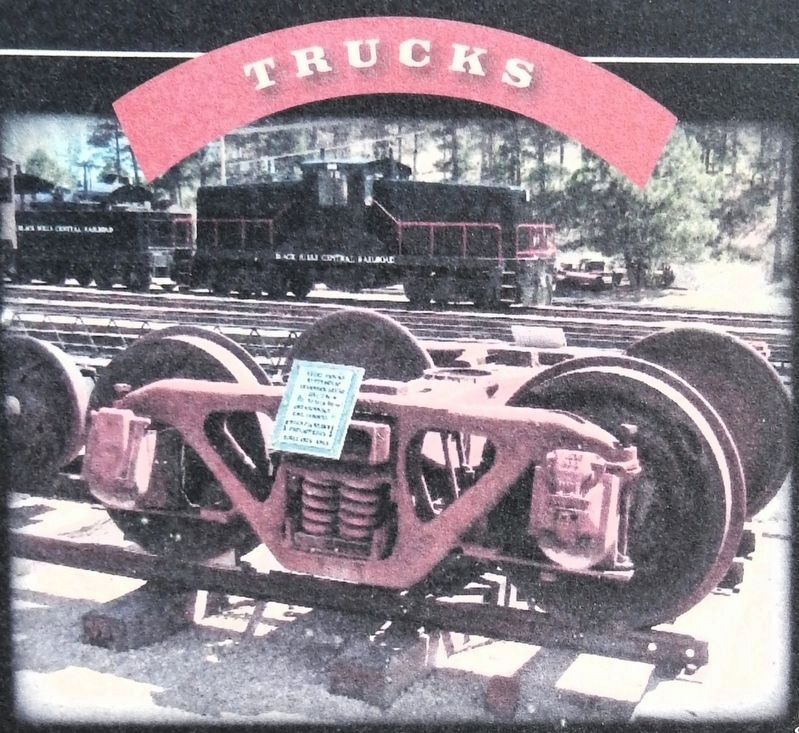
Two samples of different kinds of trucks are located here.
Trucks are the wheeled apparatus that support railway cars. The first set of trucks is a standard gauge Bettendorf Truck with coil springs and was used for heavy freight
this page online
The history of this gauge dates back to the ruts made by carts and chariots in Pompeii. In present day, the space shuttle rocket boosters are designed around the width of standard gauge, because the boosters are hauled by rail after production. (So, the major design feature of what is arguably the world's most advanced transportation system was originally determined by the width of a horse's backside.)
Erected by 1880 Train - Hill City Depot.
Topics. This historical marker is listed in this topic list: Railroads & Streetcars.
Location. 43° 55.967′ N, 103° 34.388′ W. Marker is in Hill City, South Dakota, in Pennington County. It can be reached from the intersection of Railroad Avenue and Elm Street,
2. Marker detail: Trucks

Regionally, this marker is in West River, in the Badlands, and in Greater Rapid City. It is also in the American Black Hills, in the Lewis & Clark Corridor, on the prairies, and on the Northern Plains. Globally, it is in North America, the Western Hemisphere, the Western World, and the Anglosphere. Historically, it finds itself in what was once Rupert’s Land and also the Louisiana Purchase.
Other nearby markers. At least 8 other markers are within walking distance of this marker: The Black Hills Central Railroad (within shouting distance of this marker); The Steam Locomotive (within shouting distance of this marker); Hill City Depot (within shouting distance of this marker); Semaphore & Telegraph (about 300 feet away, measured in a direct line); Black Hills Central Railroad's Famous Engine #7 (about 400 feet away); BNSF Railroad Signal (about
Photographed by Cosmos Mariner, August 17, 2023
3. Water Tank Marker
Photographed by Cosmos Mariner, August 17, 2023
4. Water Tank & Engine #108
Credits. This page was last revised on September 2, 2026. It was originally submitted on November 12, 2025, by Cosmos Mariner of Cape Canaveral, Florida. This page has been viewed 76 times since then and 40 times this year. Photos: 1, 2, 3, 4. submitted on November 12, 2025, by Cosmos Mariner of Cape Canaveral, Florida.
