Granite in Greer County, Oklahoma — The American South (West South Central)
The 36th Infantry Division's 132nd Machine Gun Battalion
1918 - World War I - 2018
| — | The War That Changed the World | — |
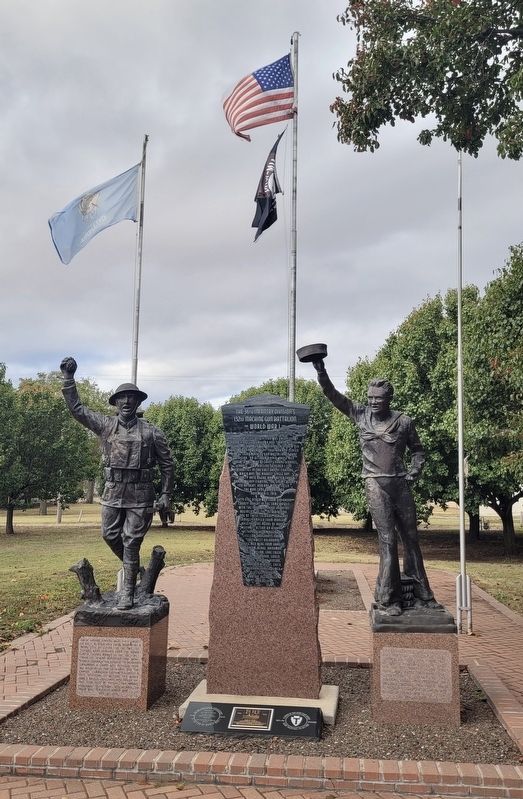
Photographed by James Hulse, October 28, 2025
1. The 36th Infantry Division's 132nd Machine Gun Battalion Marker
The 36th Infantry Division was organized by combining the Oklahoma and Texas National Guards. Sixty men who volunteered from Old Greer County were kept together and placed in the 132nd Machine Gun Battalion in that division. On October 8, 1918, these men fought on Hill 140 at Saint-Étienne-à-Arnes France. The division suffered 1,300 casualties in the first day of fighting, which was the highest single day casualty rate of the war. After three days of heavy fighting, the enemy began to retreat, and one month later the war came to an end on November 11, 1918.
Fifty-five other men from Old Greer County fought in the same battle with the 141st and 142nd Infantry Regiments of the 36th Division. One of these soldiers, Sergeant Samuel Sampler from Mangum, received the Medal of Honor for his action on Hill 140 as he fought alongside his fellow doughboys from southwest Oklahoma. These men were from Granite, Mangum, Blake, Brinkman, Reed, Willow, Lake Creek, Duke, Eldorado, Gould, Hollis, Victory, Vinson, Ozark, Blair, Altus, Erick, Liberty, Headrick, Elmer, Olustee, Dryden Martha, Deer Creek, and Delhi.
Left Panel
These bronze statues were first created by E.M. Viquesney from Indiana at a total cost of $2500 for the two. The statues were removed from the Kiowa-Greer County Bridge in the 60's because of severe mutilation and were stored. Through the efforts of Reinhart Graumann, a grant was received from Aid Association for Lutherans, and the Granite community contracted James A. Pitt, sculptor, to restore this World War I bronze doughboy and sailor at the total cost of $6,000. This bronze doughboy is hereby rededicated to those who served in World War I. Nov. 10, 1979.
Right Panel
Governor Holloway was to preside at the dedication services of these statues on May 30th, 1929, but because
this page online
Erected 2018 by American Legion Vaughan-Ellis Post No. 177.
Topics. This memorial is listed in this topic list: War, World I. A significant historical date for this entry is October 8, 1918.
Location. 34° 57.774′ N, 99° 22.872′ W. Memorial is in Granite, Oklahoma, in Greer County. It is on North Main Street north of W Parker Street, on the left when traveling north. The memorial is located at the Veterans' Memorial Park. Touch for map. Memorial is at or near this postal address: 507 N Main St, Granite OK 73547, United States of America. Touch for directions.

Regionally, this memorial is in the Kiowa Tribe, in the Comanche Nation, and in Southwest Oklahoma—Great Plains Country. It is also in the American South, specifically on the prairies, and on the Southern Plains. Globally, it is in North America, the Western Hemisphere, the Western World, and the Anglosphere. Historically,

Photographed by James Hulse, October 28, 2025
2. Center Panel
Other nearby markers. At least 8 other markers are within 9 miles of this marker, measured as the crow flies: Granite Community Memorial (a few steps from this marker); Welcome to Comecos Cemetery (approx. 0.4 miles away); Lake Creek (approx. 5 miles away); Civilian Conservation Corps and Quartz Mountain State Park (approx. 6.7 miles away); Lugert, Oklahoma (approx. 6.8 miles away); Peace on the Plains (approx. 7.9 miles away); Brinkman Community History (approx. 8.2 miles away); First Shelterbelt in the United States (approx. 8.2 miles away). Touch for a list and map of all markers in Granite.
Also see . . . Battle of Saint Étienne. Peter Larsen
On October 4th, 1918, men of the 142nd Infantry were preparing to leave Champigneul, a village near the Marne River in northeast France. The 142nd was part of the 36th Infantry Division, headquartered in Pocancy, the next village to the south. The 36th Infantry had been living in villages near the south bank of the Marne River for six days, waiting to go to the front. Just eight days before, on September 26th, allied forces attacked the entire German line in France and Belgium. It was, and remains, the largest land battle in U.S. military history.(Submitted on November 14, 2025, by James Hulse of Medina, Texas.)
Only the 36th Infantry Division was not with the American army. U.S. General John J. Pershing had loaned the 36th to the French Army for the battle, where it expected to stay in reserve behind the front line. The 36th had just cut short their training to join the Groupe d’armées de Centre, who were fighting alongside the U.S. First Army. Most noteworthy, the 36th Infantry had no combat experience, and had never been to the front. When it entered combat, according to theplan, the 36th Infantry would push through the French countryside after others had broken through German fortifications.Photographed by James Hulse, October 28, 20253. The "Spirit of the American Doughboy" statue and the left panel


Photographed by James Hulse, October 28, 2025
4. The "Spirit of the American Navy" statue and the right panel

Photographed by James Hulse, October 28, 2025
5. The view of the statues from the backside of the memorial
Credits. This page was last revised on November 20, 2025. It was originally submitted on November 14, 2025, by James Hulse of Medina, Texas. This page has been viewed 82 times since then and 41 times this year. Photos: 1, 2, 3, 4, 5. submitted on November 14, 2025, by James Hulse of Medina, Texas.
