Harbourfront-CityPlace in Toronto, Ontario — Central Canada (North America)
Turntable
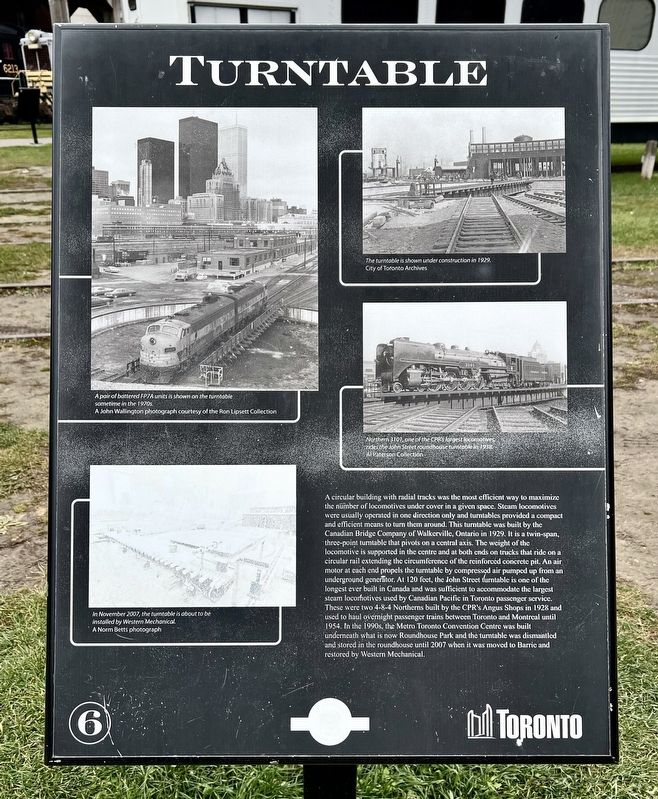
Photographed by Tim Boyd, November 14, 2025
1. Turntable Marker
this page online
Erected by Toronto Railway Heritage Centre. (Marker Number 6.)
Topics. This historical marker is listed in this topic list: Railroads & Streetcars. A significant historical year for this entry is 1929.
Location. 43° 38.481′ N, 79° 23.152′ W. Marker is in Toronto, Ontario. It is in Harbourfront-CityPlace. It can be reached from Bremner Boulevard. The marker is in Roundhouse Park, approx. 70 metres from the entrance to the park on Bremner Boulevard, across from Ripley’s Aquarium. Touch for map. Marker is at or near this postal address: 255 Bremner Boulevard, Toronto ON M5V 3M9, Canada. Touch for directions.

Regionally, this marker is in Greater Toronto and on the Golden Horseshoe. It is also in Central Canada. Globally, it is in North America, on the Great Lakes, in the Western Hemisphere, in the Western World, and in the Anglosphere. Historically, it finds itself in what was once a British colony, the Viceroyalty of New France, the Haudenosaunee (Iroquois)

Photographed by Tim Boyd, November 14, 2025
2. Turntable Marker
Other nearby markers. At least 8 other markers are within walking distance of this marker: Roundhouse (a few steps from this marker); Union Station (within shouting distance of this marker); The Coach Yards (within shouting distance of this marker); Canadian National Railways No. 6213 (within shouting distance of this marker); Pyke Crane (within shouting distance of this marker); Canadian Pacific Railway, Fowler Boxcar No. 188625 (within shouting distance of this marker); Canadian Pacific Railway “Cape Race” (within shouting distance of this marker); The Railway Lands (within shouting distance of this marker). Touch for a list and map of all markers in Toronto.
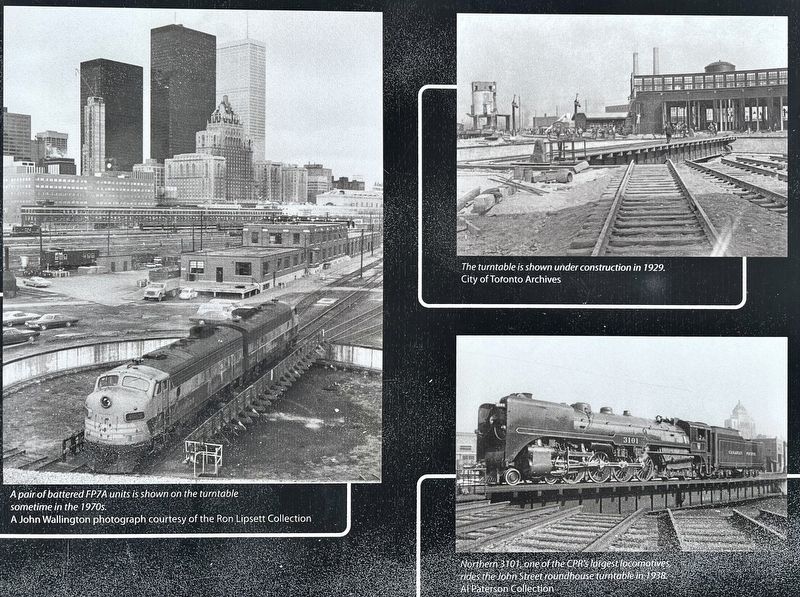
Photographed by Tim Boyd, November 14, 2025
3. Turntable marker photos and captions detail (top)
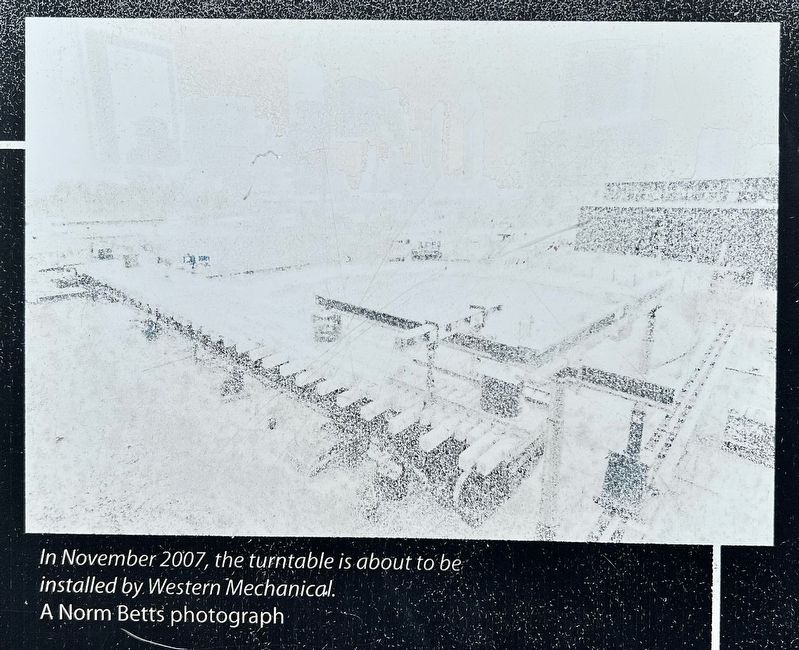
4. Turntable marker photo and caption detail (bottom)
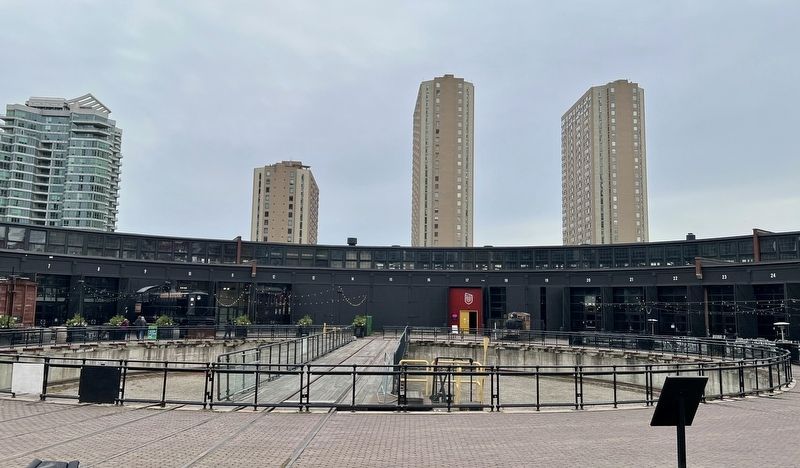
Photographed by Tim Boyd, November 14, 2025
5. Former John Street Roundhouse turntable in 2025
Credits. This page was last revised on February 24, 2026. It was originally submitted on November 16, 2025, by Tim Boyd of Hamilton, Ontario. This page has been viewed 48 times since then and 21 times this year. Photos: 1, 2, 3, 4, 5. submitted on November 16, 2025, by Tim Boyd of Hamilton, Ontario. • Andrew Ruppenstein was the editor who published this page.
