Albany in Shackelford County, Texas — The American South (West South Central)
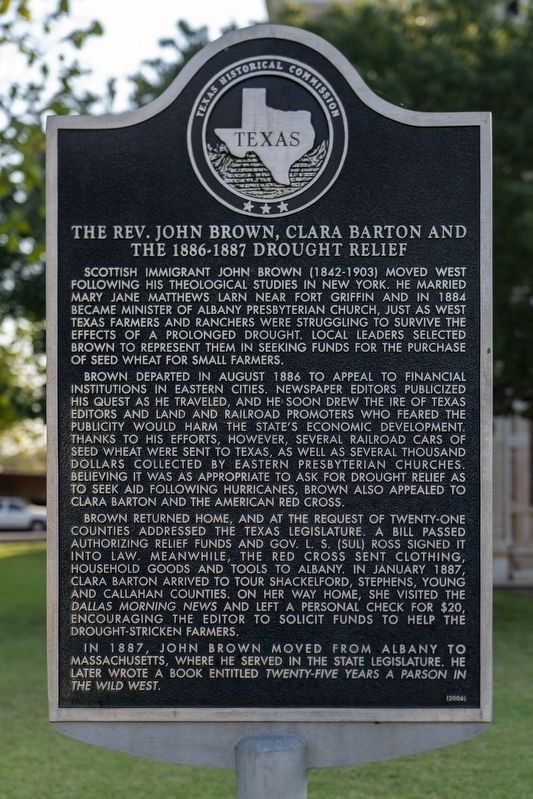
The Rev. John Brown, Clara Barton and the 1886-1887 Drought Relief
Photographed by Mansfieldphoto.com, October 16, 2024
1. The Rev. John Brown, Clara Barton and the 1886-1887 Drought Relief Marker
Brown departed in August 1886 to appeal to financial institutions in eastern cities. Newspaper editors publicized his quest as he traveled, and he soon drew the ire of Texas editors and land and railroad promoters who feared the publicity would harm the state’s economic development. Thanks to his efforts, however, several railroad cars of seed wheat were sent to Texas, as well as several thousand dollars collected by eastern Presbyterian churches. Believing it was as appropriate to ask for drought relief as to seek aid following hurricanes, Brown also appealed to Clara Barton and the American Red Cross.
Brown returned home, and at the request of twenty-one counties addressed the Texas legislature. A bill passed authorizing relief funds and Gov. L.S. (Sul) Ross signed it into law. Meanwhile, the Red Cross sent clothing, household goods and tools to Albany. In January 1887, Clara Barton arrived to tour Shackelford, Stephens, Young and Callahan counties. On her way home, she visited the Dallas Morning News and left a personal check for $20, encouraging the editor to solicit funds to help the drought-stricken farmers.
In 1887, John Brown moved from Albany to Massachusetts, where he served in the state legislature. He later wrote a book entitled Twenty-Five Years a Parson in the Wild West.
Erected 2006 by Texas Historical Commission. (Marker Number 13673.)
Topics and series.
this page online
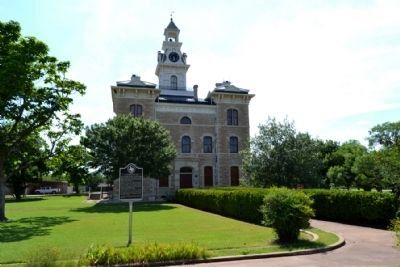
Location. 32° 43.368′ N, 99° 17.818′ W. Marker is in Albany, Texas, in Shackelford County. It can be reached from the intersection of S. Main Street (U.S. 283) and S. 2nd Street, on the right when traveling north. Marker is located on the west side of the grounds of the Shackelford County Courthouse. Touch for map. Marker is at or near this postal address: 225 S Main St, Albany TX 76430, United States of America. Touch for directions.

Regionally, this marker is in Big Country. Globally, it is in North America, a Gulf of Mexico state, the Western Hemisphere, the Western World, and the Anglosphere. Historically, it finds itself in what was once New Spain, the Comanchería, the Republic of Texas, and one of the Confederate States of America.
Other nearby markers. At least 8 other markers are within walking distance of this marker: Shackelford County (a few steps from this marker); First Producing Oil Well in West Texas
Photographed by Duane Hall, June 27, 2015
2. The Rev. John Brown, Clara Barton
and the 1886-1887 Drought Relief Marker
and the 1886-1887 Drought Relief Marker
of the grounds of the Shackelford County Courthouse
Photographed by Duane Hall, June 27, 2015
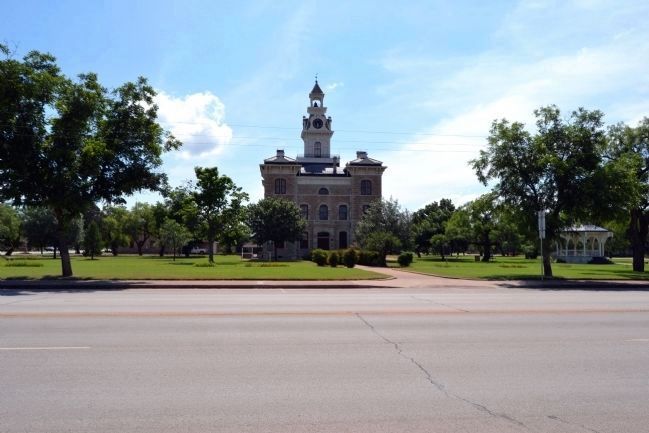
3. Shackelford County Courthouse
Marker is left (north) of the sidewalk to the main entrance of the courthouse
Credits. This page was last revised on November 23, 2025. It was originally submitted on July 17, 2015, by Duane Hall of Abilene, Texas. This page has been viewed 841 times since then and 45 times this year. Last updated on November 21, 2025, by Dave W of Co, Colorado. Photos: 1. submitted on March 14, 2025, by James Hulse of Medina, Texas. 2, 3. submitted on July 17, 2015, by Duane Hall of Abilene, Texas. • James Hulse was the editor who published this page.
