Natchez in Adams County, Mississippi — The American South (East South Central)
Rosenwald Schools - Adams County

Photographed by Bobby Dennis, November 20, 2025
1. Rosenwald Schools - Adams County Marker
When the Rosenwald Fund closed in 1948, it enabled the construction of over 4,977 schools in 15 southern states. 1/3 of all Black children attended a Rosenwald School. 637 Rosenwald schools were built in Mississippi.
Adams County had five Rosenwald schools: Fitts, Kingston, Milford, Pine Mount, and Roseland schools. The modest rural schools were constructed between 1921 and 1927. They provided locally accessible educational opportunities,
this page online
Erected 2025 by Natchez Association for the Preservation of Afro-American Culture, Jewish American Society for Historic Preservation, Regions Financial.
Topics and series. This historical marker is listed in these topic lists: African Americans • Education. In addition, it is included in the Jewish American Society for Historic Preservation., and the Rosenwald Schools series lists.
Location. 31° 33.249′ N, 91° 24.094′ W. Marker is in Natchez, Mississippi, in Adams County. It is on Homochitto Street, on the right when traveling south. Adjacent to the headquarters of the Natchez-Adams School District. Touch for map. Marker is at or near this postal address: 10 Homochitto Street, Natchez MS 39120, United States of America. Touch for directions.

Regionally, this marker is in Southwest Mississippi and in Natchez Trace Corridor. It
Photographed by Bobby Dennis, November 20, 2025
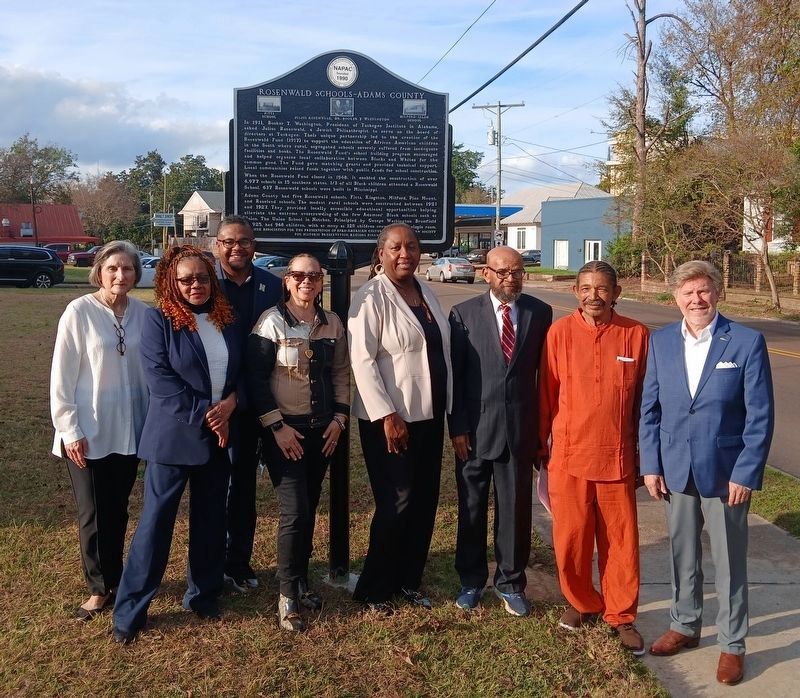
2. Rosenwald Schools - Adams County Marker
Other nearby markers. At least 8 other markers are within walking distance of this marker: Intersection of Washington and South Martin Luther King streets (about 700 feet away, measured in a direct line); F.J. Arrighi House (about 700 feet away); The Manse (about 700 feet away); Green Leaves (about 800 feet away); Intersection of Washington and South Rankin streets (approx. 0.2 miles away); Intersection of Washington and South Union streets (approx. ¼ mile away); Lambert-Taylor House (approx. ¼ mile away); White Cottage (approx. ¼ mile away). Touch for a list and map of all markers in Natchez.
More about this marker. Left to Right:
Dr. Cecile Bunch (Natchez School Board), Dr Brenda Robinson (Natchez School
Board), Toney Fields (Public engagement Co-ordinator, Natchez Public
Schools) , LLJuna Weir ( Natchez School Board,), Zandra McDonald (
Natchez Schools Superintendent), Mr Phillip West ( Natchez School Board
and First Black Mayor of Natchez after Reconstruction, Bobby Dennis,
Dan Gibson (Mayor of Natchez).
3 Images at the top of the marker, Left to Right:
Fitts School, Julius Rosenwald - Dr. Booker T. Washington, Milford-Salem School
Also see . . .
1. Inside the Rosenwald Schools.
Between 1917 and 1932, nearly 5,000 rural schoolhouses, modest one-, two-, and three-teacher buildings known as Rosenwald Schools, came to exclusively serve more than 700,000 black children over four decades. It was through the shared ideals and a partnership between Booker T. Washington, an educator, intellectual and prominent African American thought leader, and Julius Rosenwald, a German-Jewish immigrant who accumulated his wealth as head of the behemoth retailer, Sears, Roebuck & Company, that Rosenwald Schools would come to comprise more than one in five Black schools operating throughout the South by 1928.(Submitted on November 21, 2025, by Jerry Klinger of Boynton Beach, Florida.)
2. Rosenwald, Washington honored with historical marker.
Bobby Dennis, the director of the Natchez Museum of African American History and Culture, said the marker unveiled in Natchez honors “the significant educational legacy of the Rosenwald Schools of Adams County.”(Submitted on November 21, 2025, by Jerry Klinger of Boynton Beach, Florida.)
The marker is posted in front of the administrative office of the school district at 10 Homochitto Street.
“This marker is in front of the school district office to recognize the fact that Rosenwald Schools were located in each of the five county districts,” said Dennis before the unveiling ceremony. He noted Fitts School, Kingston School, Milford School, Pine Mount School, and Roseland School, were all funded by Rosenwald.
3. Remembering the Rosenwald Schools.
As a progressive philanthropist, Rosenwald believed one of the country’s most pressing social problems was the “Negro question,” and he supported the ideas and self-help doctrine of Tuskegee Institute president Booker T. Washington. In 1912, Rosenwald was a member of Tuskegee’s Board of Trustees when Washington came to him to suggest donating funds specifically for building Black schools.(Submitted on November 21, 2025, by Jerry Klinger of Boynton Beach, Florida.)
4. Rosenwald Schools – Adams County (Mississippi).
In 1911, Rosenwald wrote:(Submitted on November 23, 2025, by Jerry Klinger of Boynton Beach, Florida.)
“The horrors that are due to race prejudice come home to the Jew more forcefully than to others of the white race, on account of the centuries of persecution which they have suffered and still suffer.”
Rosenwald never wanted his money to be his legacy. He said, “Investing in the future of others is the truest form of legacy…By lifting others up, we also elevate ourselves.”
Rosenwald, through the Rosenwald Fund he established, built 637 schools and school-related buildings in Mississippi. They were Tuskegee College-designed, generally modest two-room wood structures. For the Black children in Mississippi, the schools were magnificent edifices of learning, considering most had nothing before. Education for Black Children in Jim Crow Mississippi was not a priority. It was a priority for Black parents willing to do what they had to for their children.
Rosenwald wanted to build a better America for all Americans together.
Credits. This page was last revised on November 23, 2025. It was originally submitted on November 21, 2025, by Jerry Klinger of Boynton Beach, Florida. This page has been viewed 133 times since then and 63 times this year. Photos: 1, 2. submitted on November 21, 2025, by Jerry Klinger of Boynton Beach, Florida. • Andrew Ruppenstein was the editor who published this page.
