Florence in Lauderdale County, Alabama — The American South (East South Central)
Rosenbaum House Museum
Photographed by Cosmos Mariner, September 30, 2025
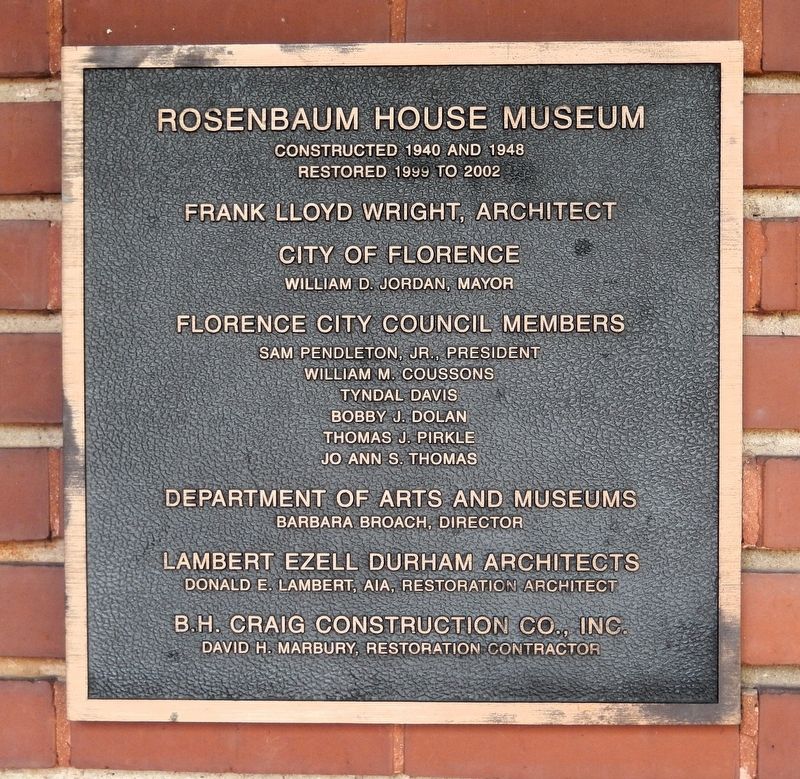
1. Rosenbaum House Museum Marker
Restored 1999 to 2002
Frank Lloyd Wright, Architect
City of Florence
William D. Jordan, Mayor
Florence City Council Members
Sam Pendleton, Jr., President • William M. Coussons • Tyndal Davis •
Bobby J. Dolan • Thomas J. Pirkle • Jo Ann S. Thomas
Department of Arts and Museums
Barbara Broach, Director
Lambert Ezell Durham Architects
Donald E. Lambert, AIA, Restoration Architect
B.H. Craig Construction Co., Inc.
David H. Marbury, Restoration Contractor
Topics and series. This historical marker is listed in these topic lists: Architecture • Notable Buildings. In addition, it is included in the Frank Lloyd Wright, and the National Register of Historic Places (NRHP) series lists. A significant historical year for this entry is 1940.
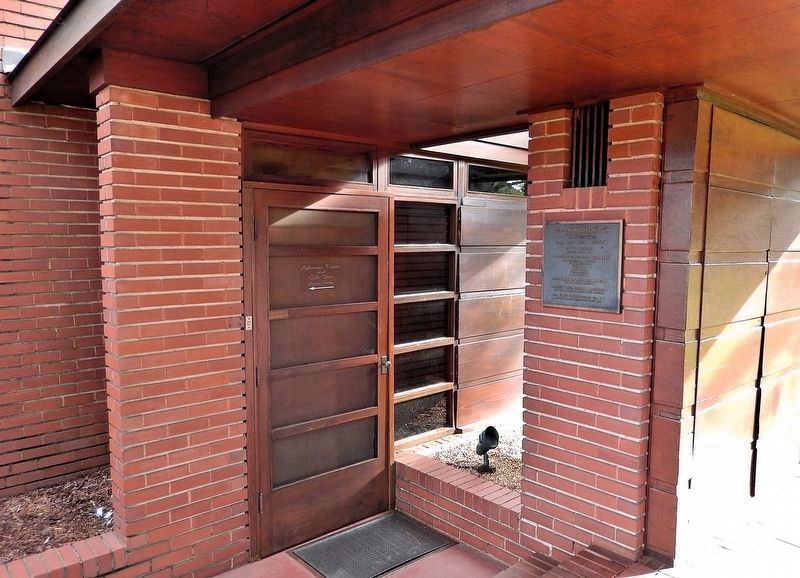
Location. 34° 47.584′ N, 87° 40.836′ W. Marker is in Florence, Alabama, in Lauderdale County. It can be reached from the intersection of Riverview Drive and Grove Street, on the right when traveling east. The marker is mounted near the front entrance of the Rosenbaum House. Touch for map. Marker is at or near this postal address: 601 Riverview Drive, Florence
this page online

Regionally, this marker is in North Alabama and in the Shoals. It is also in the American South, specifically in the Deep South, in Appalachia, and specifically in Southern Appalachia. Globally, it is in North America, a Gulf of Mexico state, the Western Hemisphere, the Western World, and the Anglosphere. Historically, it finds itself in what was once the territory of the Mississippian Culture, one of the Confederate States of America, and the Antebellum South.
Other nearby markers. At least 8 other markers are within walking distance of this marker: Burrell Normal School (approx. ¼ mile away); W. C. Handy Birthplace (approx. 0.3 miles away); Saint Paul African Methodist Episcopal Church (approx. 0.3 miles away); William Christopher Handy (approx. 0.3 miles away); Florence Little League Baseball (1951) (approx. 0.3 miles away); Church Spring Church and School (approx. 0.4 miles away); Church Spring and School (approx. 0.4 miles away); Locust Street Historic District (approx. 0.4 miles away). Touch for a list and map of all markers in Florence.
Regarding Rosenbaum House Museum. National
Photographed by Cosmos Mariner, September 30, 2025
2. Rosenbaum House Museum Marker
The marker is mounted near the front entrance of the house, on the right side as you enter.
From the National Register Nomination prepared by Stanley and Mildred Rosenbaum, owners, and Ellen Mertins, 10/24/1978:
The Rosenbaum House is an outstanding example of Frank Lloyd Wright’s Usonian designs of the late 1930’s, the only Usonian house to have been enlarged with a major addition by Wright, and the only Wright structure in Alabama.
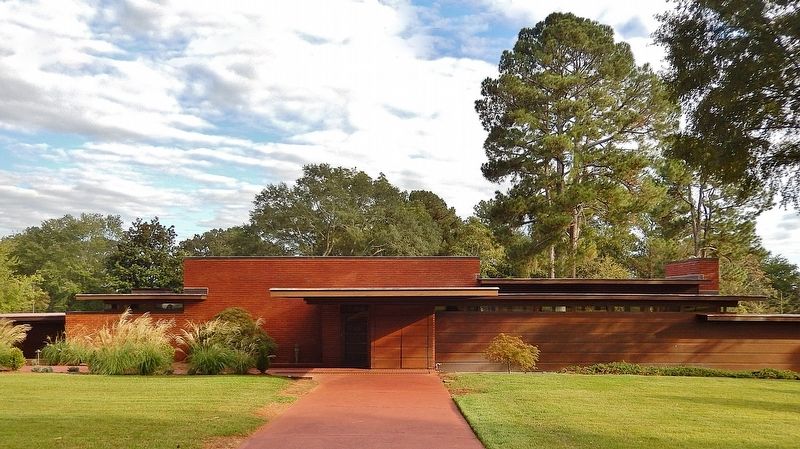
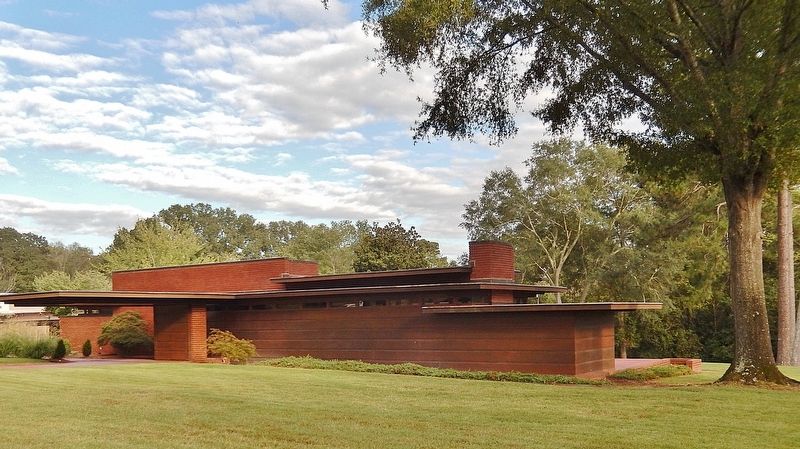
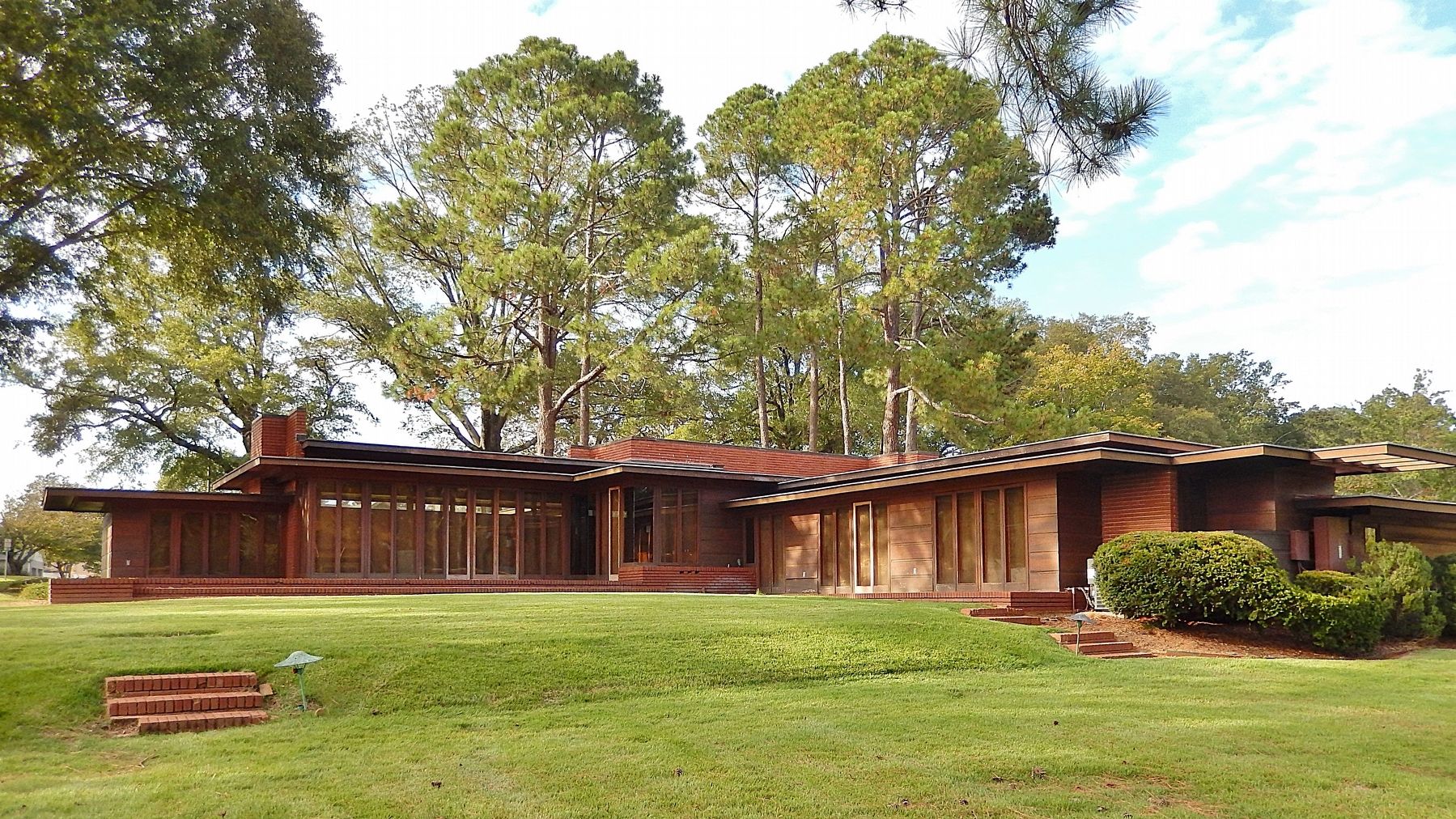
The house is a mature statement of the Usonian phase of Wright’s career when he was examining the problem of low-cost housing. It exhibits all the elements, in a refined form, that were characteristic of Usonian designs such as the concrete slab with underfloor heating, sandwich wall panels of cypress, structural brick chimneys to support the multiple flat roofs, a brick service core, and a modular planning grid. The overriding horizontal motif is emphasized by the massive projecting eaves, the raked joints of the brickwork, the board and batten walls, and the shifting floor and ceiling levels which create layers of space and light. The recessed lighting fixtures and clerestories are framed by a distinctive fretwork pattern designed by Wright specificallyfor this house. The sitting illustrated Wright’s ideas of facing blank walls to the street while opening up the rear walls to the privacy of the garden through continuous spans of window doors. The interrelationship of interior and exterior space is further heightened by the continuation of the floor slab into the yard as surrounding terraces.Photographed by Cosmos Mariner, September 30, 20253. Rosenbaum House (east elevation)
The Rosenbaum House is a one-story structure of "L" shape, set on a corner lot so that the interior of the "L" faces away from the streets. The street walls are unfenestrated except for a narrow strip of clerestories while the walls along the back are glazed providing both great privacy and openness. An addition to the original house, also "L" shaped and designed by Wright, is placed so that the house now forms an approximate “T”.
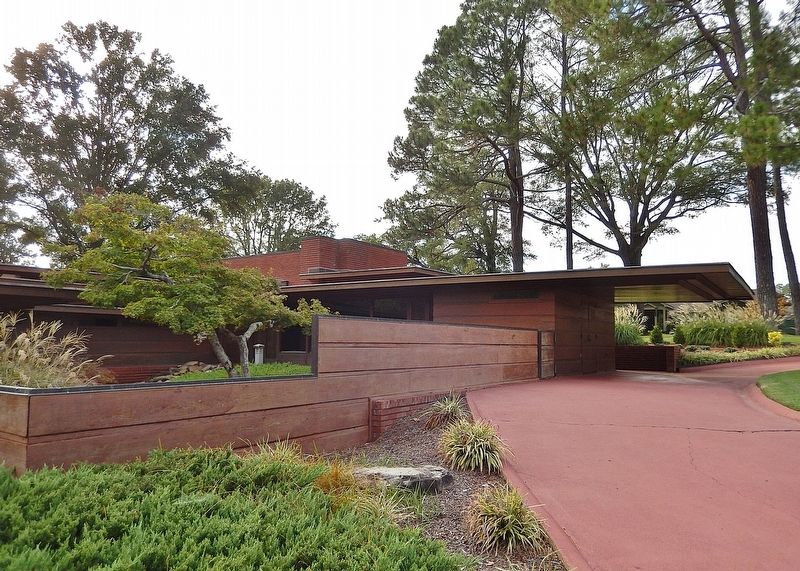
The house is built directly on the ground on a concrete slab under which are the heating pipes. The walls are of a special sandwich construction devised by Wright for his Usonian houses and consist of a plywood core covered on both sides with building paper to which are screwed, inside and out, horizontal panels of cypress to create a board and batten effect. Massivebrick chimney walls at the end of each wing provide structural support for the flat roofs with their extreme cantilevered eaves.Photographed by Cosmos Mariner, September 30, 20254. Rosenbaum House (north/front elevation)
The house contains four brick fireplaces; the concrete floors have been carpeted; and the hardware is of brass. A cantilevered roof of twenty-foot span provides a carport on the main street facade while the sunken front door is hidden at the end of the carport. The extensive grounds behind the house have been planted and landscaped to create a park-like setting.
Also see . . . Rosenbaum House (Wikipedia).
Excerpt: The Rosenbaum House is a single-family house designed by architect Frank Lloyd Wright and built for Stanley and Mildred Rosenbaum in Florence, Alabama. A noted example of his Usonian house concept, it is the only Wright building in Alabama, and is one of only 26 pre-World War II Usonian houses. Wright scholar John Sergeant called it "the purest example of the Usonian." It is currently a house museum.(Submitted on November 22, 2025, by Cosmos Mariner of Cape Canaveral, Florida.)
In 1938 Stanley Rosenbaum (a professor at Florence State Teachers' College, now the University of North Alabama) and his new wife Mildred were given a building lot in Florence, Alabamaand funds to build a house on it by Rosenbaum's parents. Both newlyweds had read Frank Lloyd Wright's autobiography and a cover story on Wright in Time magazine. They commissioned Wright to design and build the house.Photographed by Cosmos Mariner, September 30, 20255. Rosenbaum House (northwest elevation)
This is an example of Wright's "Usonian"-style homes, which he intended as low-cost housing for middle-class American families. But the first phase of the house ultimately cost $14,000 (equivalent to $310,000 in 2024), nearly double the wealthy couple's original $7,999 budget. The flat roof leaked almost immediately, the heating system failed, and the Rosenbaum family seldom used the custom furniture built on-site for the home.
The house was placed on the National Register of Historic Places in 1978. It remained in the Rosenbaum family until 1999 (when Mildred Rosenbaum moved into a nursing home). By this time the house was in poor repair, with extensive water penetration and termite damage. The Rosenbaum family donated the house to the City of Florence and at the same time sold the furniture and contents of the house to the city for $75,000. The city spent a further $600,000 on repairs, using original plans in the FrankLloyd Wright Foundation's archive at Taliesin West.Photographed by Cosmos Mariner, September 30, 20256. Rosenbaum House (southwest elevation)
Credits. This page was last revised on November 22, 2025. It was originally submitted on November 21, 2025, by Cosmos Mariner of Cape Canaveral, Florida. This page has been viewed 86 times since then and 41 times this year. Photos: 1, 2, 3, 4, 5, 6. submitted on November 22, 2025, by Cosmos Mariner of Cape Canaveral, Florida.
