Yonge-Bay Corridor in Toronto, Ontario — Central Canada (North America)
Winston Churchill
Toronto and Canada
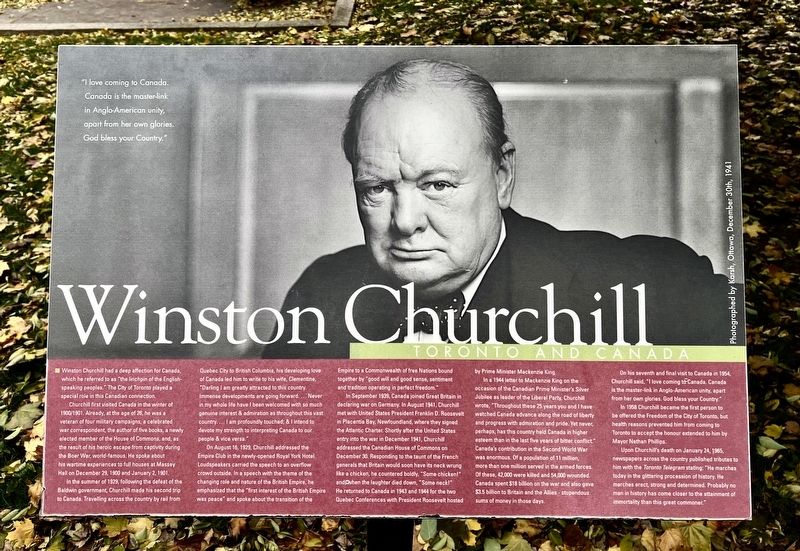
Photographed by Tim Boyd, November 14, 2025
1. Winston Churchill Marker
Churchill first visited Canada in the winter of 1900/1901. Already, at the age of 26, he was a veteran of four military campaigns, a celebrated war correspondent, the author of five books, a newly elected member of the House of Commons, and, as the result of his heroic escape from captivity during the Boer War, world-famous. He spoke about his wartime experiences to full houses at Massey Hall on December 29, 1900 and January 2, 1901.
In the summer of 1929, following the defeat of the Baldwin government, Churchill made his second trip to Canada. Travelling across the country by rail from Quebec City to British Columbia, his developing love of Canada led him to write to his wife, Clementine, "Darling I am greatly attracted to this country. Immense developments are going forward. ... Never in my whole life have I been welcomed with so much genuine interest & admiration as throughout this vast country. ... I am profoundly touched;
this page online
On August 16, 1929, Churchill addressed the Empire Club in the newly-opened Royal York Hotel. Loudspeakers carried the speech to an overflow crowd outside. In a speech with the theme of the changing role and nature of the British Empire, he emphasized that the "first interest of the British Empire was peace" and spoke about the transition of the Empire to a Commonwealth of free Nations bound together by "good will and good sense, sentiment and tradition operating in perfect freedom.
In September 1939, Canada joined Great Britain in declaring war on Germany. In August 1941, Churchill met with United States President Franklin D. Roosevelt in Placentia Bay, Newfoundland, where they signed the Atlantic Charter. Shortly after the United States entry into the war in December 1941, Churchill addressed the Canadian House of Commons on December 30. Responding to the taunt of the French generals that Britain would soon have its neck wrung like a chicken, he countered boldly, "Some chicken!" and, when the laughter died down, "Some neck!" He returned to Canada
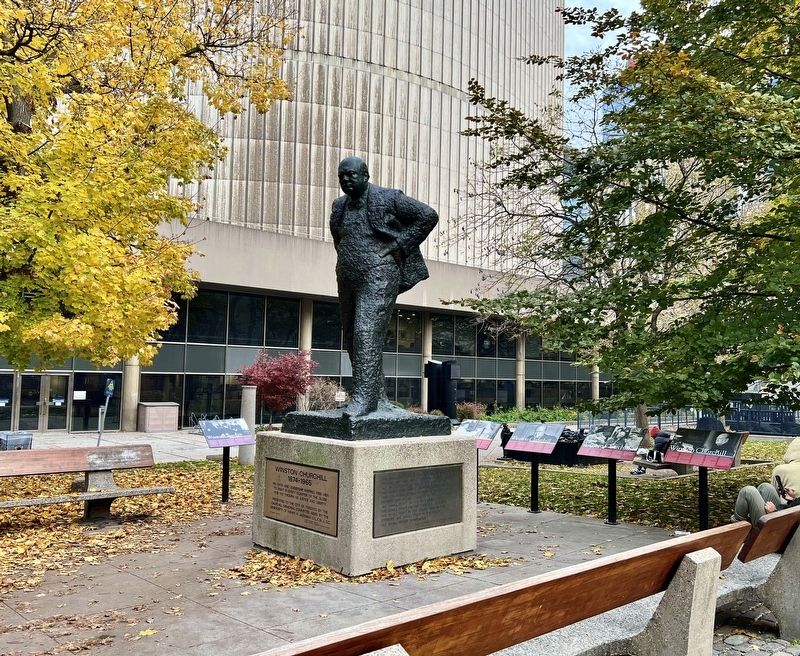
Photographed by Tim Boyd, November 14, 2025
2. Winston Churchill Marker
The second to the right of the statue
In a 1944 letter to Mackenzie King on the occasion of the Canadian Prime Minister's Silver Jubilee as leader of the Liberal Party, Churchill wrote, "Throughout these 25 years you and I have watched Canada advance along the road of liberty and progress with admiration and pride. Yet never, perhaps, has this country held Canada in higher esteem than in the last five years of bitter conflict." Canada's contribution in the Second World War was enormous. Of a population of 11 million, more than one million served in the armed forces. Of these, 42,000 were killed and 54,000 wounded. Canada spent $18 billion on the war and also gave $3.5 billion to Britain and the Allies - stupendous sums of money in those days.
On his seventh and final visit to Canada in 1954, Churchill said, "I love coming to Canada. Canada is the master-link in Anglo-American unity, apart from her own glories. God bless your Country." In 1958 Churchill became the first person to be offered the Freedom of the City of Toronto, but health reasons prevented

Photographed by Tim Boyd, November 14, 2025
3. Winston Churchill marker, wider context
Upon Churchill's death on January 24, 1965, newspapers across the country published tributes to him with the Toronto Telegram stating: "He marches today in the glittering procession of history. He marches erect, strong and determined. Probably no man in history has come closer to the attainment of immortality than this great commoner."
Topics. This historical marker is listed in these topic lists: Government & Politics • War, World II. A significant historical date for this entry is January 2, 1901.
Location. 43° 39.217′ N, 79° 23.102′ W. Marker is in Toronto, Ontario. It is in Yonge-Bay Corridor. It is at the intersection of Chestnut Street and Armoury Street, on the left when traveling south on Chestnut Street. Touch for map. Marker is at or near this postal address: 21 Osgoode Lane, Toronto ON M5G 1R1, Canada. Touch for directions.

Regionally, this marker is in Greater Toronto and on the Golden Horseshoe. It is also in Central Canada. Globally, it is in North America, on the Great Lakes, in the Western Hemisphere, in the Western World,
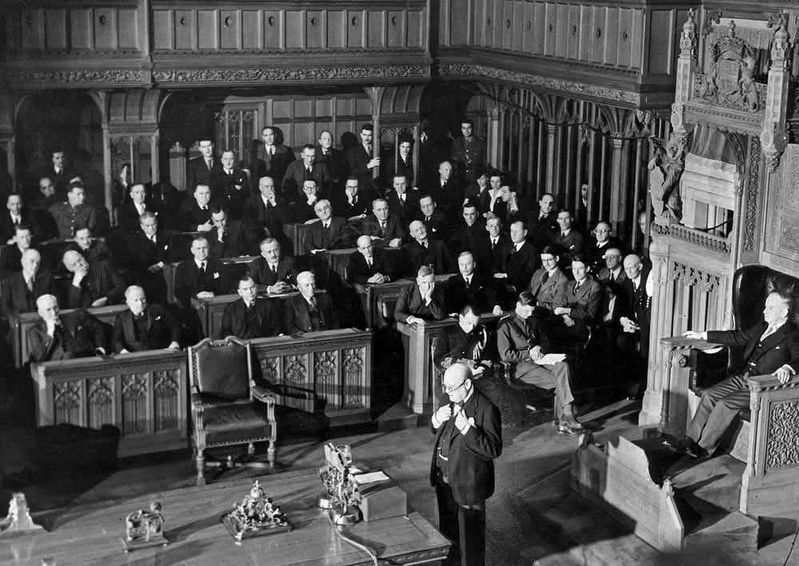
1941
4. Winston Churchill addressing the Canadian Parliament in Ottawa, 1941
Government of Canada (public domain)
Other nearby markers. At least 8 other markers are within walking distance of this marker: A different marker also named Winston Churchill (here, next to this marker); a different marker also named Winston Churchill (here, next to this marker); a different marker also named Winston Churchill (here, next to this marker); a different marker also named Winston Churchill (here, next to this marker); Toronto’s First Chinatown (a few steps from this marker); A Community Church / Une église communautaire (within shouting distance of this marker); Black Life in St. John's Ward / La vie des Noirs dans le St. John's Ward (within shouting distance of this marker); Jean Lumb, C.M., 1919-2002 (about 90 meters away, measured in a direct line). Touch for a list and map of all markers in Toronto.
Credits. This page was last revised on November 23, 2025. It was originally submitted on November 22, 2025, by Tim Boyd of Hamilton, Ontario. This page has been viewed 114 times since then and 84 times this year. Photos: 1, 2, 3, 4. submitted on November 22, 2025, by Tim Boyd of Hamilton, Ontario. • Andrew Ruppenstein was the editor who published this page.
