Amsterdam-Zuid , North Holland, Netherlands — Northwestern Europe
Monument De Gevallen Hoornblazer
⎯⎯⎯
The Fallen Hornblower Memorial
Photographed by Andrew Ruppenstein, March 16, 2025
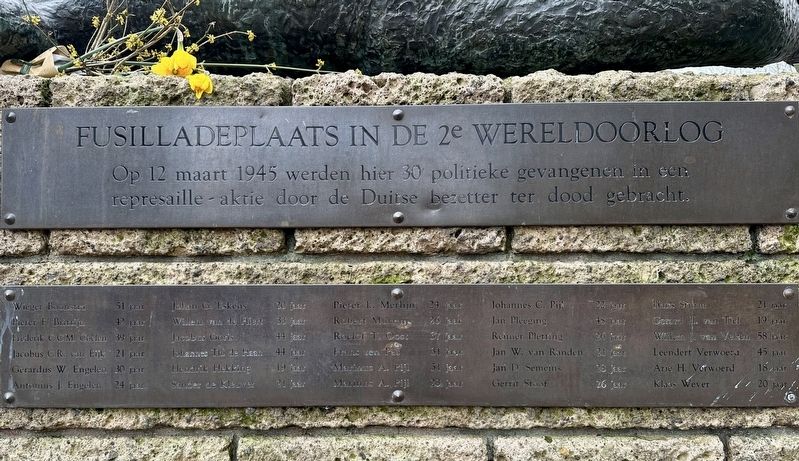
1. The Fallen Hornblower Memorial text

Op 12 maart 1945 werden hier 30 politieke gevangenen in een represaille - aktie door de Duitse bezetter ter dood gebracht.
Execution site during World War II
On March 12, 1945, 30 political prisoners were executed here in a reprisal by the German occupiers.
(name, age)
Wieger Boonstra 51 jaar · Pieter F. Brittijn 43 jaar · Frederik C.C.M. Coelen 39 jaar · Jacobus C.R. van Eijk 21 jaar · Gerardus W. Engelen 30 jaar · Antonius J. Engelen 24 jaar · Johan G. Eskens 20 jaar · Willem van de Fliert 33 jaar · Jacobus Goris 44 jaar · Johannes Th. de Haan 44 jaar · Hendrik Hekking 19 jaar · Sander de Kleaver 21 jaar · Pieter L. Merlijn 24 jaar · Robert Murray 26 jaar · Roelot T. Oost 37 jaar · Frans ten Pas 31 jaar · Marinus A. Pijl 51 jaar · Marinus A. Pijl 23 jaar · Johannes C. Pijl 22 jaar · Jan Pleeging 48 jaar · Reinier Pletting 26 jaar · Jan W. van Randen 21 jaar · Jan D. Semeins 28 jaar · Gerrit Stoof 26 jaar · Hans Sturm 21 jaar · Gerard H. van Tiel 19 jaar · Willem J. van Velzen 58 jaar · Leendert
this page online
Erected 1954.
Topics. This historical marker and memorial is listed in this topic list: War, World II. A significant historical date for this entry is March 12, 1945.
Location. 52° 21.527′ N, 4° 53.406′ E. Marker is in Amsterdam, Noord-Holland (North Holland). It is in Amsterdam-Zuid. It is on Weteringlaan, on the right when traveling south. Touch for map. Marker is in this post office area: Amsterdam, Noord-Holland 1017 SG, Netherlands. Touch for directions.

Regionally, it is in Europe, the European Union, Atlantic Europe, the Benelux Low Countries, the Schengen Area, Western Europe, and the Western World. Historically, it finds itself in what was once the Holy Roman Empire.
Other nearby markers. At least 8 other markers are within walking distance of this marker: Frans Hals (about 180 meters away, measured in a direct line); Artus Quellinus (about 210 meters away); Marie Heineken (approx. 0.2 kilometers away); Bartholomeus van der Helst (approx. 0.3 kilometers away); Pieter Janszoon Saenredam (approx. 0.3 kilometers away); Gerard Dou (approx. 0.4 kilometers
Photographed by Andrew Ruppenstein, March 16, 2025
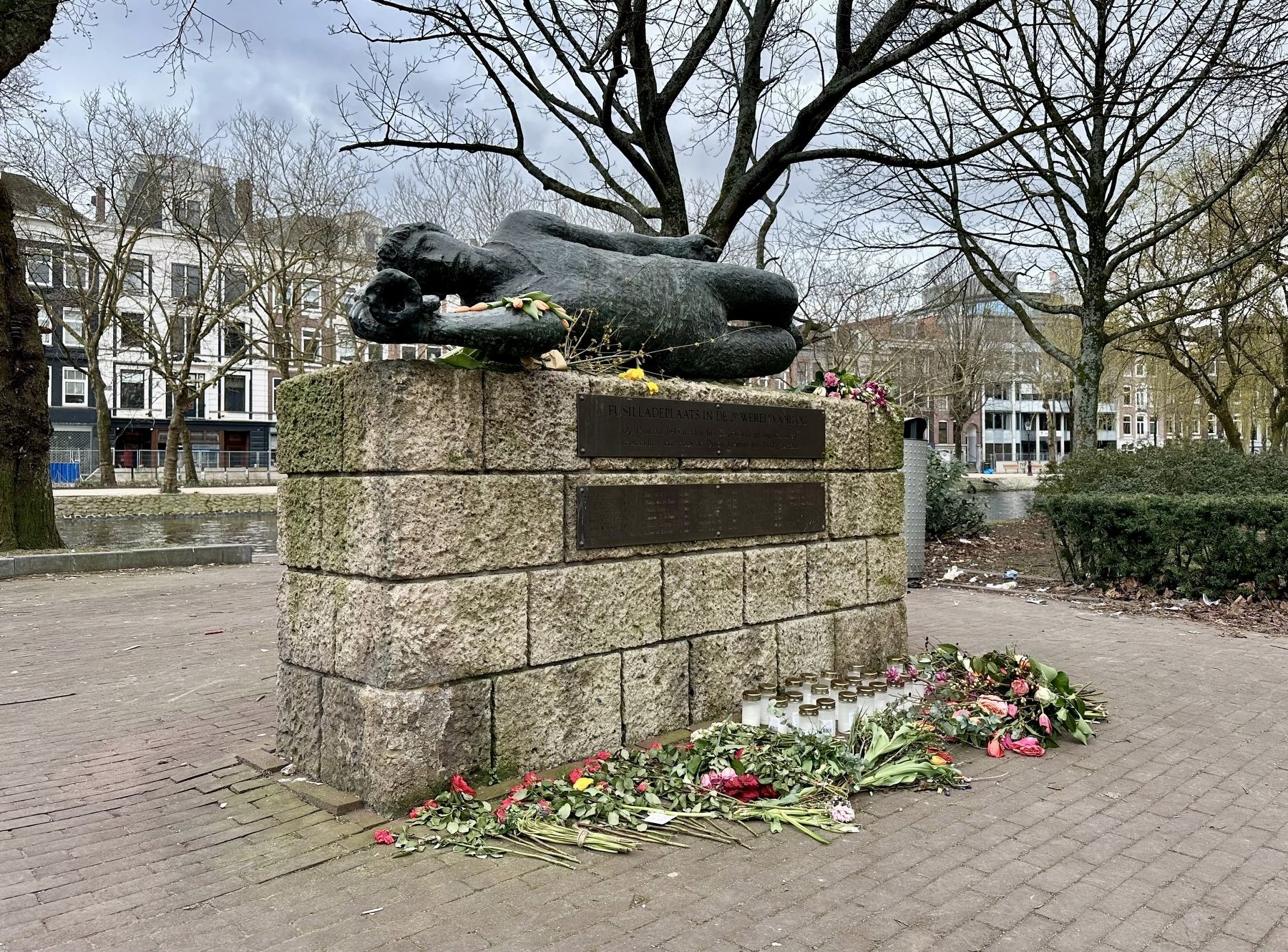
2. Monument De Gevallen Hoornblazer / The Fallen Hornblower Memorial
Also see . . . Executies Weteringplantsoen (Wikipedia, in Dutch). Excerpt (in translation):
On March 12, 1945, thirty resistance fighters were executed in the Eerste Weteringplantsoen (First Wetering Plantsoen) in Amsterdam. Minister Dr. Jan Koopmans, who had been in hiding on the opposite side of the street, was also hit by a stray bullet. The prisoners were coming from the House of Detention I on the Weteringschans, a few hundred meters away.(Submitted on November 22, 2025.)
The executions were a reprisal for the shooting of SS-Hauptscharführer Ernst Wehner on March 10, 1945, on the Stadhouderskade. He was fatally wounded when resistance fighters raided the building used by the illegal resistance group Groep 2000. The SD had raided the building the day before, and the resistance fighters wanted to prevent the discovery of a code key that could have been used by the Germans to read sensitive records.
The prisoners were shot dead in three groups of ten by German soldiers. Passing civilians, regardless of age, were forced to watch the executions. The remains were initially left for a long time as a warning before being transported on an open truck. The Germans then buried the dead in the Kennemer Dunes. After the war, they were reburied at the Honorary Cemetery in the dunes near Overveen, and some at Duinrust Cemetery in Beverwijk.
In memory of those executed, the Fusillade monument, also known as "The Fallen Hornblower," was erected in the public garden, where a wreath-laying ceremony takes place annually on May 4th. The monument, created in 1954 by sculptor Gerrit Bolhuis, depicts a dead soldier holding a horn.
Credits. This page was last revised on November 22, 2025. It was originally submitted on November 22, 2025, by Andrew Ruppenstein of Lamorinda, California. This page has been viewed 97 times since then and 72 times this year. Photos: 1, 2. submitted on November 22, 2025, by Andrew Ruppenstein of Lamorinda, California.
