Yonge-Bay Corridor in Toronto, Ontario — Central Canada (North America)
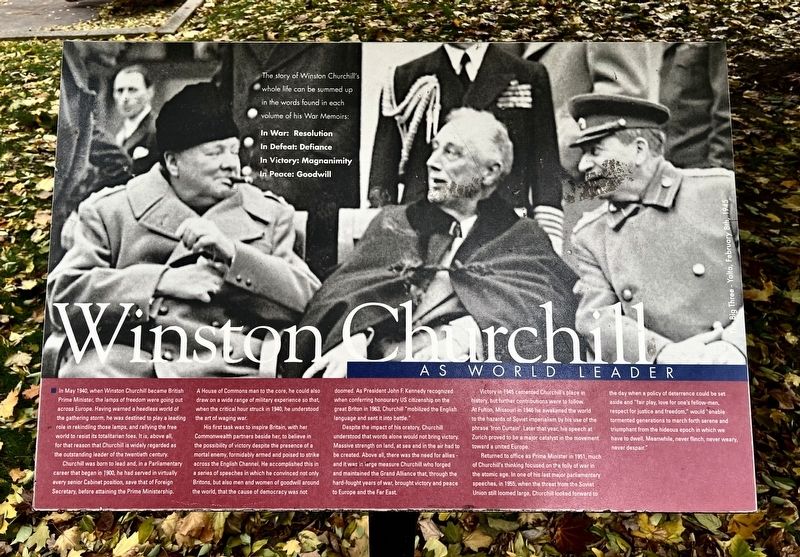
Winston Churchill
As World Leader
Photographed by Tim Boyd, November 14, 2025
1. Winston Churchill Marker
Churchill was born to lead and, in a Parliamentary career that began in 1900, he had served in virtually every senior Cabinet position, save that of Foreign Secretary, before attaining the Prime Ministership.
A House of Commons man to the core he could also draw on a wide range of military experience so that, when the critical hour struck in 1940, he understood the art of waging war.
His first task was to inspire Britain, with her Commonwealth partners beside her, to believe in the possibility of victory despite the presence of a mortal enemy, formidably armed and poised to strike across the English Channel. He accomplished this in a series of speeches in which he convinced not only Britons,
this page online
Despite the impact of his oratory, Churchill understood that words alone would not bring victory. Massive strength on land, at sea and in the air had to be created. Above all, there was the need for allies- and it was in large measure Churchill who forged and maintained the Grand Alliance that, through the hard-fought years of war, brought victory and peace to Europe and the Far East.
Victory in 1945 cemented Churchill's place in history, but further contributions were to follow. At Fulton, Missouri in 1946 he awakened the world to the hazards of Soviet imperialism by his use of the phrase Iron Curtain, later that year his speech at Zurich proved to be a major catalyst in the movement toward a united Europe.
Returned to office as Prime Minister in 1951, much of Churchill's thinking focused on the folly of war in the atomic age. In one of his last major
Photographed by Tim Boyd, November 14, 2025
2. Winston Churchill Marker
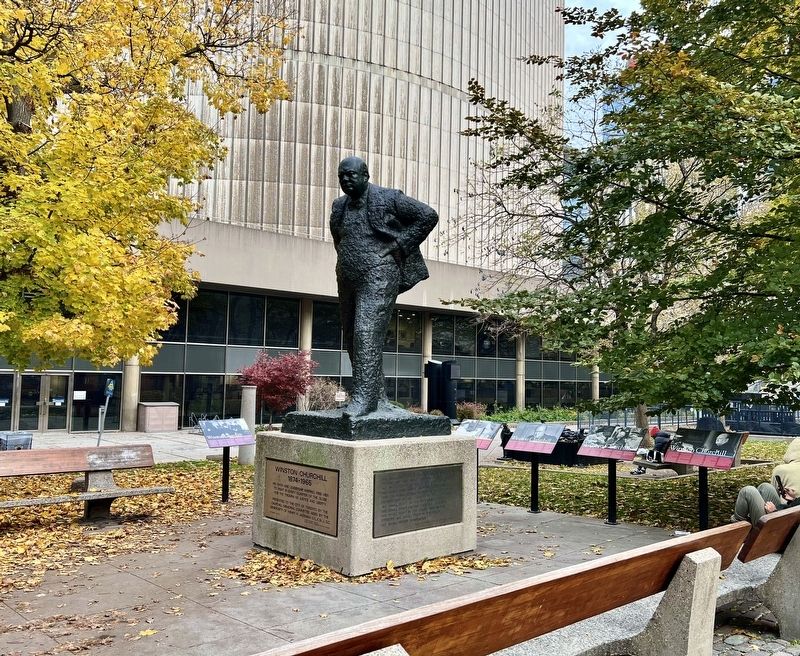
The marker is second from the right
Topics. This historical marker is listed in these topic lists: Government & Politics • War, World II. A significant historical month for this entry is May 1940.
Location. 43° 39.217′ N, 79° 23.103′ W. Marker is in Toronto, Ontario. It is in Yonge-Bay Corridor. It is at the intersection of Chestnut Street and Armoury Street, on the left when traveling south on Chestnut Street. Touch for map. Marker is at or near this postal address: 21 Osgoode Lane, Toronto ON M5G 1R1, Canada. Touch for directions.

Regionally, this marker is in Greater Toronto and on the Golden Horseshoe. It is also in Central Canada. Globally, it is in North America, on the Great Lakes, in the Western Hemisphere, in the Western World,

Photographed by Tim Boyd, November 14, 2025
3. Winston Churchill marker, wider context
Other nearby markers. At least 8 other markers are within walking distance of this marker: A different marker also named Winston Churchill (here, next to this marker); a different marker also named Winston Churchill (here, next to this marker); a different marker also named Winston Churchill (here, next to this marker); a different marker also named Winston Churchill (here, next to this marker); Toronto’s First Chinatown (a few steps from this marker); A Community Church / Une église communautaire (within shouting distance of this marker); Black Life in St. John's Ward / La vie des Noirs dans le St. John's Ward (within shouting distance of this marker); Jean Lumb, C.M., 1919-2002 (about 90 meters away, measured in a direct line). Touch for a list and map of all markers in Toronto.
Credits. This page was last revised on November 23, 2025. It was originally submitted on November 22, 2025, by Tim Boyd of Hamilton, Ontario. This page has been viewed 78 times since then and 50 times this year. Photos: 1, 2, 3. submitted on November 22, 2025, by Tim Boyd of Hamilton, Ontario. • Andrew Ruppenstein was the editor who published this page.
