Yonge-Bay Corridor in Toronto, Ontario — Central Canada (North America)
Winston Churchill
Parliamentary Democracy

Photographed by Tim Boyd, November 14, 2025
1. Winston Churchill Marker
Winston Churchill was first elected in 1900, at age 25, to the British Parliament as a Conservative MP representing the riding of Oldham in the North of England. Except for one short interval, he would remain a Member of Parliament for almost 64 years. He contested 21 parliamentary elections. These are records unequalled in the parliamentary world. It can truly be said that he was both a child and a father of the House of Commons.
Throughout his career Churchill stood for liberty. He believed in open debate and freedom of speech, and opposed any system or ideology that tried to dictate the way one should think. Churchill felt deeply that disagreements within the democratic system should not degenerate into personal animosities. In 1911, he was a co-founder of the Other Club, which was designed to bring together leaders and thinkers from all parts of the political spectrum in gatherings that would bridge the political quarrels of the day.
Churchill changed parties twice. In 1904, unable to support his own government's position on increasing tariffs, he crossed the floor to sit with the opposition Liberals. In 1924,
this page online
During his lengthy parliamentary career, Churchill held many ministerial positions. As President of the Board of Trade in the Asquith Government, he played a major role in championing legislation leading to the beginning of the welfare state. He also served under Asquith as Home Secretary and First Lord of the Admiralty. After the Dardanelles disaster in 1915, Churchill left the Government and went to France to train with the Second Battalion, Grenadier Guards before taking command of the Sixth Battalion of the Royal Scots Fusiliers at the front lines. On his return to government, he held the positions of Minister of Munitions, Minister of War and Air and Colonial Secretary in the Lloyd George Coalition Government. He then served as Chancellor of the Exchequer in the Baldwin Government, holding that position from his return to the Conservative Party, in 1924, to 1929.
In the 1930s, it was as a "backbench" Member of Parliament that

Photographed by Tim Boyd, November 14, 2025
2. Winston Churchill Marker
The marker is furthest on the right
Throughout the war Churchill was adamant about the importance of Parliament continuing to sit and debate the conduct of the war. "Debates on these large issues," he told the House in 1941; "are of the very greatest value to the life-thrust of the nation.” By making it clear that Parliament, and not he or the rest of His Majesty's Government, was the ultimate arbiter of the country's fate, Churchill did much to advance the cause of parliamentary democracy.
After the end of the European War, the Conservatives were defeated and Churchill became Leader of the Opposition until October 1951, when his party was returned to power and
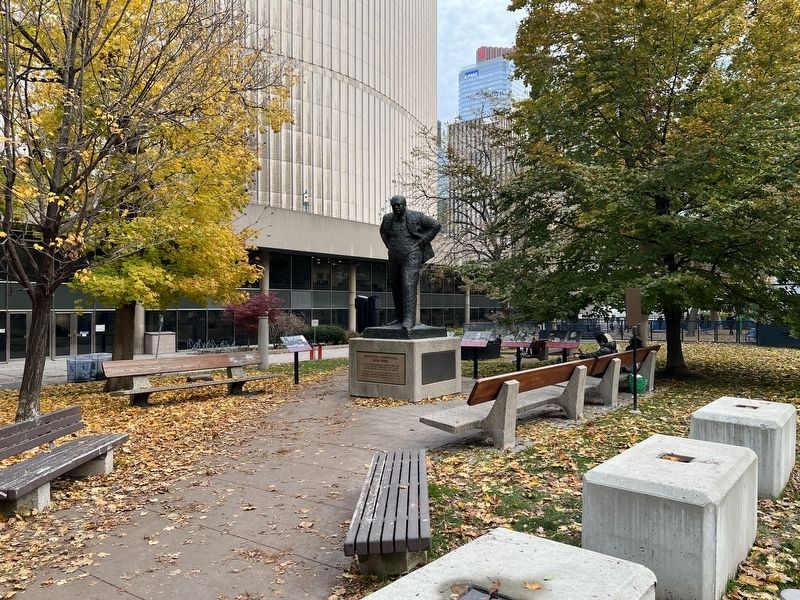
Photographed by Tim Boyd, November 14, 2025
3. Winston Churchill marker, wider context
"Debates on these large issues," he told the House of Commons in 1941, "are of the very greatest value of the life-thrust of the nation."
Topics. This historical marker is listed in these topic lists: Government & Politics • War, World I • War, World II. A significant historical date for this entry is January 24, 1965.
Location. 43° 39.217′ N, 79° 23.103′ W. Marker is in Toronto, Ontario. It is in Yonge-Bay Corridor. It is at the intersection of Chestnut Street and Armoury Street, on the left when traveling south on Chestnut Street. Touch for map. Marker is at or near this postal address: 21 Osgoode Lane, Toronto ON M5G 1P5, Canada. Touch for directions.

Regionally, this marker is in Greater Toronto and on the Golden Horseshoe. It is also in Central Canada. Globally, it is in North America, on the Great Lakes, in the Western Hemisphere, in the Western World, and in the Anglosphere. Historically, it finds itself in what was once a British colony, the Viceroyalty of New France, the Haudenosaunee (Iroquois) Confederacy, and Rupert’s Land.
Other nearby markers. At least 8 other markers are within walking distance of this marker: A different marker also named Winston Churchill (here, next to this marker); a different marker also named Winston Churchill (here, next to this marker); a different marker also named Winston Churchill (here, next to this marker); a different marker also named Winston Churchill (here, next to this marker); Toronto’s First Chinatown (within shouting distance of this marker); A Community Church / Une église communautaire (within shouting distance of this marker); Black Life in St. John's Ward / La vie des Noirs dans le St. John's Ward (within shouting distance of this marker); Jean Lumb, C.M., 1919-2002 (about 90 meters away, measured in a direct line). Touch for a list and map of all markers in Toronto.
Credits. This page was last revised on November 23, 2025. It was originally submitted on November 23, 2025, by Tim Boyd of Hamilton, Ontario. This page has been viewed 85 times since then and 64 times this year. Last updated on November 23, 2025, by Tim Boyd of Hamilton, Ontario. Photos: 1, 2, 3. submitted on November 23, 2025, by Tim Boyd of Hamilton, Ontario. • Devry Becker Jones was the editor who published this page.
