Bremen-Mitte in Mitte, Germany — Central Europe
Deutsches Haus
Photographed by Andrew Ruppenstein, May 18, 2025
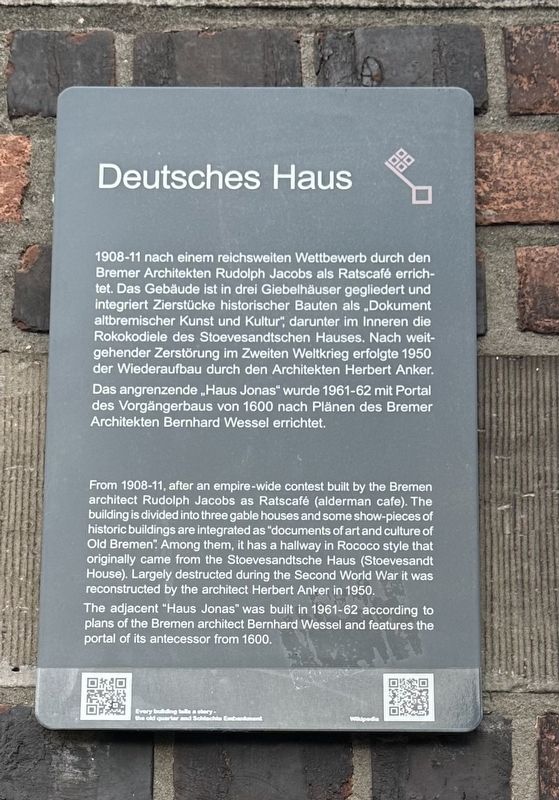
1. Deutsches Haus Marker

Das angrenzende „Haus Jonas“ wurde 1961-62 mit Portal des Vorgängerbaus von 1600 nach Plänen des Bremer Architekten Bernhard Wessel errichtet.
From 1908-11, after an empire-wide contest built by the Bremen architect Rudolph Jacobs as Ratscafé (alderman cafe). The building is divided into three gable houses and some show-pieces of historic buildings are integrated as “documents of art and culture of Old Bremen”: Among them, it has a hallway in Rococo style that originally came from the Stoevesandtsche Haus (Stoevesandt House). Largely destructed during the Second World War it was reconstructed by the architect Herbert Anker in 1950.
The adjacent "Haus Jonas" was built
this page online
Topics and series. This historical marker is listed in these topic lists: Architecture • Industry & Commerce. In addition, it is included in the Bremen Red Key series list. A significant historical year for this entry is 1950.
Location. 53° 4.566′ N, 8° 48.423′ E. Marker is in Bremen, in Mitte. It is in Bremen-Mitte. It is on Am Markt. Touch for map. Marker is at or near this postal address: Am Markt 1, Bremen 28195, Germany. Touch for directions.

Regionally, it is in Europe, the European Union, Atlantic Europe, Central Europe, the Schengen Area, Western Europe, and the Western World. Historically, it finds itself in what was once the Holy Roman Empire.
Other nearby markers. At least 8 other markers are within walking distance of this marker: Sparkasse am Markt / Savings Bank on Market Square (within shouting distance of this marker); Geschäfts- und Bürohaus / Commercial- and Office Building (within shouting distance of this marker); Der Schütting (within shouting distance of this marker); Haus Rohlandseck / Rohlandseck Building
Photographed by Andrew Ruppenstein, May 18, 2025
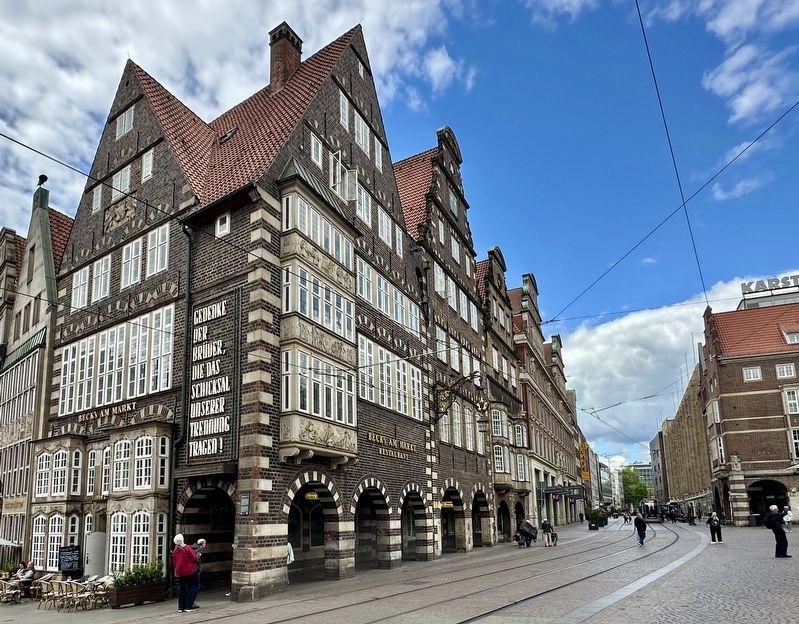
2. Deutsches Haus Marker - wide view
The marker is visible here on the corner of the building (in front of the woman in the red jacket).
Also see . . . Rathscafé (Bremen) (Wikipedia). Excerpt:
In the Middle Ages, a municipal wine-house was situated on the corner of Bremer Marktplatz/Liebfrauenkirchhof and Obernstrasse. Later on, the building was redecorated with a Renaissance gable. Until the 17th century, the building was used as a wine warehouse. Later on it passed into private ownership and was remodeled on several occasions. In 1900, it was used as a lingerie store. Thereafter, it was purchased by the city and demolished to provide space for a new building.(Submitted on November 23, 2025.)
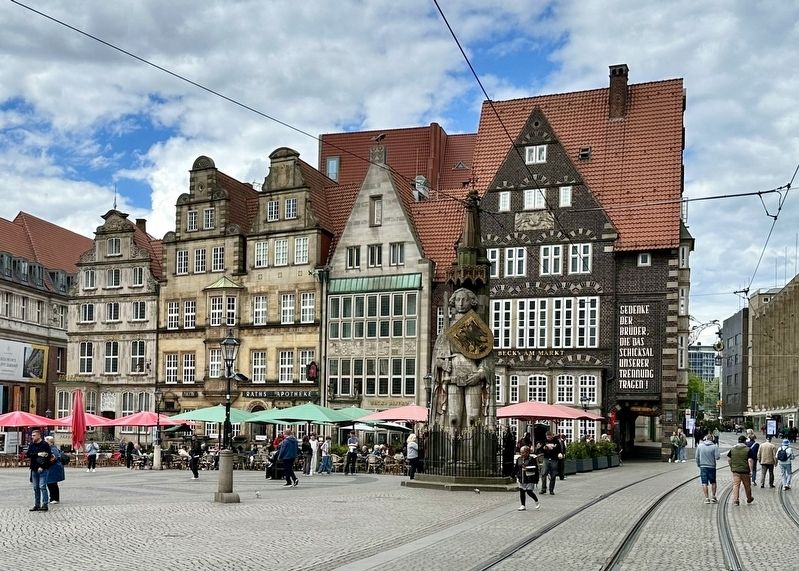
As the building was situated in the immediate neighbourhood of the Town Hall, it was decided to launch an architectural competition to attract bids for its reconstruction from throughout Germany. The competitionwas won by the young Bremen architect Rudolf Jacobs. In accordance with his designs, it was reconstructed between 1909 and 1911 as a four-storey building with a saddle roof on the Marktplatz which at that time was called Kaiser-Wilhelm-Platz. Jacobs succeeded in creating a building which attracted expert attention. The building is an important component of the area's development given its relationship to the Marktplatz itself as well as to Unser-Lieben-Frauen-Kirchhof, the cemetery located opposite.Photographed by Andrew Ruppenstein, May 18, 20253. Deutsches Haus - wide viewThe Deutsches Haus and the buildings to the left of it form the northern side of the market square.
Built in the early 20th century, the building was inspired by the Heimatschutzarchitektur and Reformarchitektur trends, common in Germany at the time. Documenting the art and culture of the old town, the group of three gabled houses is decorated both outside and inside with items from excavations, collections and acquisitions. They include the freestone gable decorations, the 18th-century oriel windows, the portals and, inside the building, the 18th-century hallways.
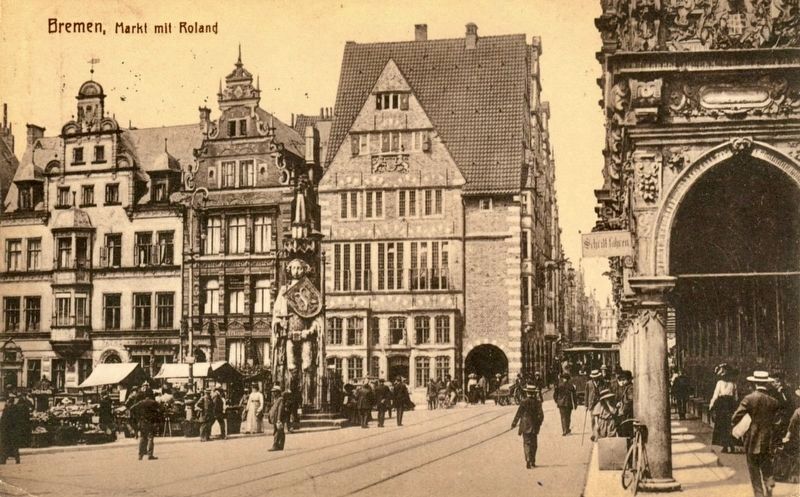
circa 1914
4. Deutsches Haus - more than a century earlier
Credits. This page was last revised on November 23, 2025. It was originally submitted on November 23, 2025, by Andrew Ruppenstein of Lamorinda, California. This page has been viewed 46 times since then and 13 times this year. Photos: 1, 2, 3, 4. submitted on November 23, 2025, by Andrew Ruppenstein of Lamorinda, California.
