
Sterling Public Library
1916
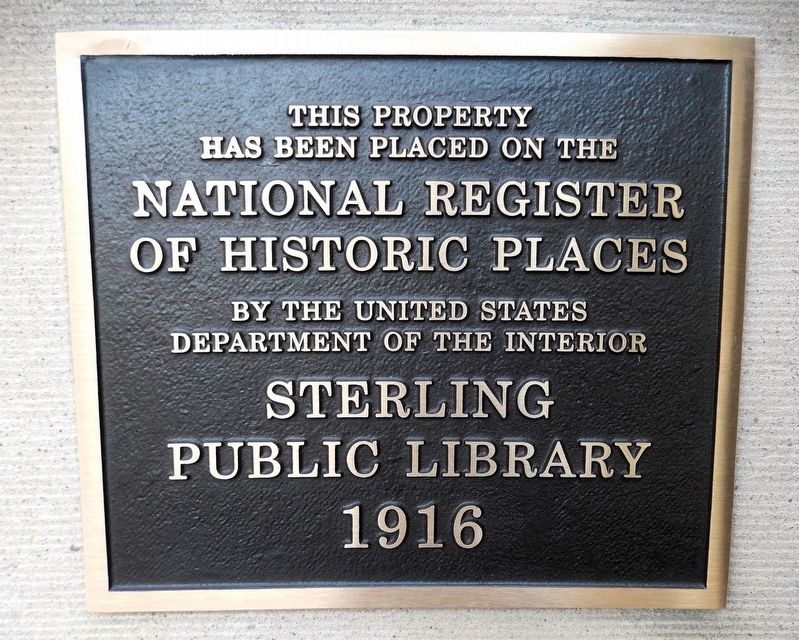
This property has been placed on the
National Register of Historic Places
by the United States Department of the Interior
Topics and series. This historical marker is listed in these topic lists: Architecture • Charity & Public Work • Education • Notable Buildings. In addition, it is included in the Carnegie Libraries, and the National Register of Historic Places (NRHP) series lists. A significant historical year for this entry is 1916.
Location. 40° 37.394′ N, 103° 12.671′ W. Marker is in Sterling, Colorado, in Logan County. It is at the intersection of South 4th Street and Ash Street, on the left when traveling north on South 4th Street. The marker is mounted directly on the subject building, on the right side of the front entrance. Touch for map. Marker is at or near this postal address: 210 South 4th Street, Sterling CO 80751, United States of America. Touch for directions.

Regionally, this marker is in the Eastern Plains. It is also in the American Mountain West, on the Great Plains, and specifically on the High Plains. Globally, it is in North America, the Western Hemisphere, the Western World,
this page online
Other nearby markers. At least 8 other markers are within walking distance of this marker: Logan County Courthouse (about 500 feet away, measured in a direct line); Orville S. Johnson (1911-1987) and H. Catherine Johnson (1914-2003) (about 500 feet away); Replica of the Statue of Liberty (about 600 feet away); The South Platte River Valley (about 700 feet away); I & M Building (about 800 feet away); Sterling Union Pacific Railroad Depot (approx. ¼ mile away); William Shaw Hadfield (approx. ¼ mile away); "Dinkey Engine" (approx. 0.4 miles away). Touch for a list and map of all markers in Sterling.
Regarding Sterling Public Library. National Register of Historic Places № 01001121.
From the National Register Nomination prepared by Jennifer J. Goble, 5/2/2001:
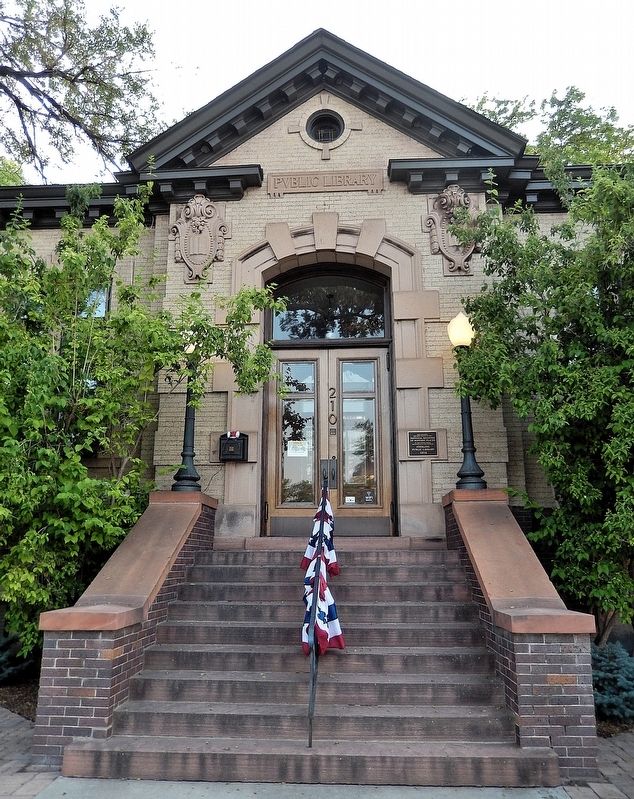
The Sterling Public Library is significant in social history because of its association with the nationwide public library movement sponsored by Andrew Carnegie. The building is significant in community planning and development for its place as the town's first public library,an important part of Sterling's civic infrastructure. The building also has architectural significance. The building typifies the basic library design standards first set forth by the Carnegie Corporation in 1911 for small community libraries funded by the corporation.Photographed by Cosmos Mariner, July 7, 20212. Sterling Public Library MarkerThe marker is mounted on the right side of the front entrance.The first mention of a public library for Sterling was recorded in the minutes of the Zeta Zeta Club's meeting of October 7, 1910, when it was reported, "we started discussing with our husbands the matter of a Carnegie Library." As a result of this meeting the Zeta Zeta Club and other area clubs and organizations met with the Sterling City Council, on October 7, 1912, to discuss plans for a library. Sterling's formal efforts to secure a Carnegie library began in early 1913 when Mayor J.H. King appointed a public library committee of three men and three women.
The Zeta Zeta Club and the local chapter of the Women's Christian Temperance Union contributed $1,000 toward the $4,000 purchase price of the triangle lot at South Fourth and Ash streets for the building site. The club determined that at least $500 ought to be raised by the men in the community. The sale of tickets
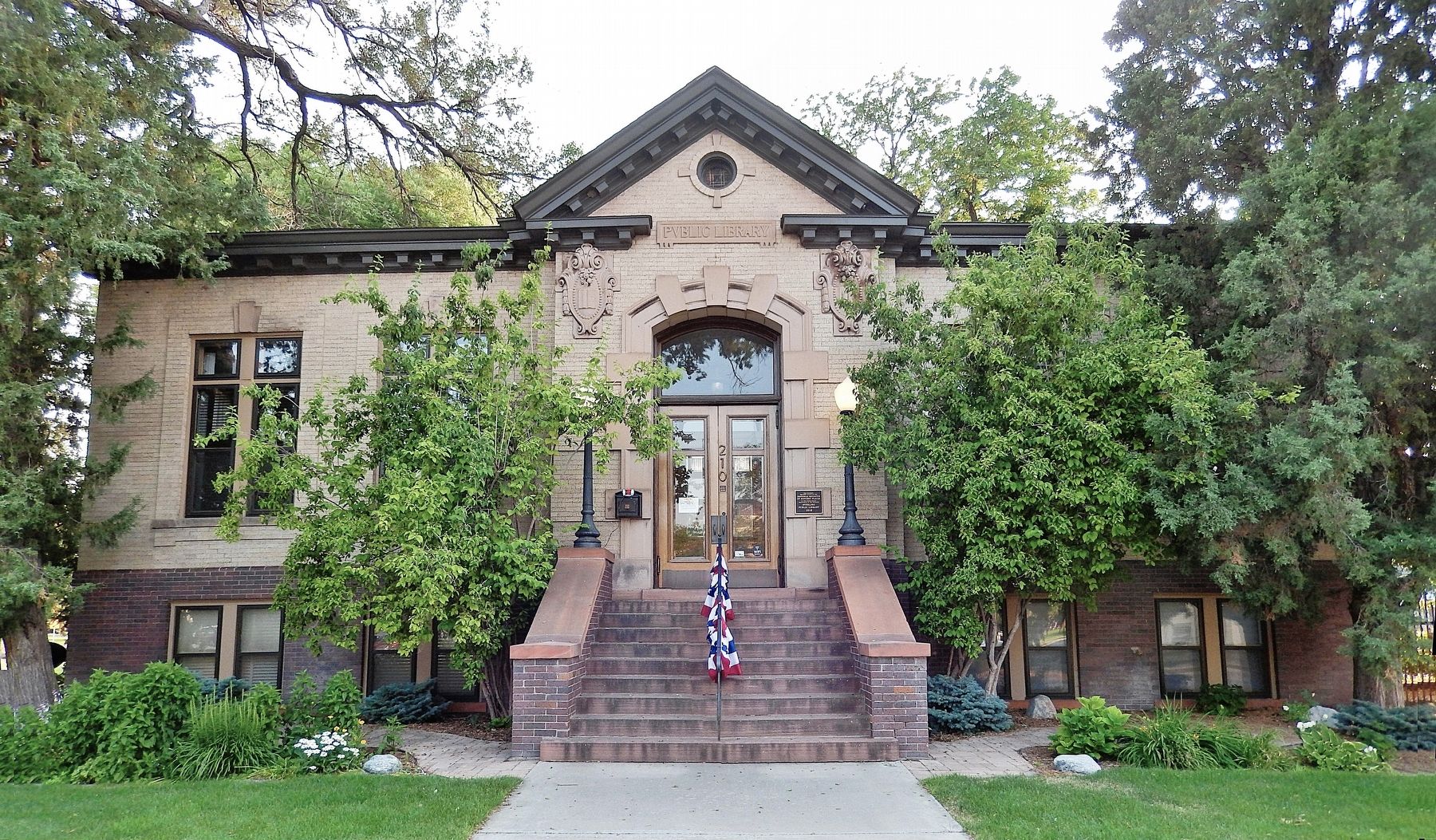
for a picture show constituted the first money-raising venture and netted the club $78. The Zeta Zeta Club organized the opening ceremonies for the library. The April 9, 1918, edition of the Sterling Evening Advocate promoted the new public library. The library formally opened three days later. At that time, the library was worth approximately $20,000. The community supplied additional funds beyond the $12,500 Carnegie gift. In addition to the $4,000 raised for the purchase of the building site, the city raised all the funds necessary to furnish the new building and stock it with nearly 2,000 books. The city also levied a half-mill tax which generated $1,500 /year to provide maintenance funds for the library. Carnegie gifts came with the stipulation that the community establish a yearly fund equal to at least 10 percent of the grant award for the annual maintenance of the library building.Photographed by Cosmos Mariner, July 7, 20213. Sterling Public LibraryThe design of the Sterling library building is attributed to Denver architect William Cowe. Local builder L.J. Brown won the contract for the construction of Cowe's plans with a bid of $12,240. Cowe closely followed Carnegie recommendations for a
small building for the Sterling library. He utilized the basic rectangular plan with a raised basement. His plan included the suggested entry vestibule, the two large main level reading rooms and the basement level lecture room. The tall facade windows admitted natural light, but in keeping with Carnegie suggestions, the other windows were placed high to allow bookshelves to wrap around the interior walls. Cowe relegated the storage and work areas, the restrooms and the heating plant to half the basement space, allowing ample room for the lecture room with its own outside entry. The only aspect of Cowe's interior plan at odds with the Carnegie standards was the inclusion of a reading room fireplace.The exterior reflects the organization of the interior spaces. Cowe utilized a somewhat eclectic assemblage of classically inspired elements to create a dignified masonry building in keeping with Carnegie standards. The symmetrical composition with the central entry to the raised main level immediately identifies the building as a Carnegie library. Though later modifications to the interior resulted in the loss of some design integrity, the building retains sufficient integrity in its design, materials, and workmanship to be a good example of the Carnegie standard for small library design.
Also see . . .
1. Sterling Public Library (Wikipedia).
Excerpt: The Sterling Public Library was listed on the National Register of Historic Places in 2001. It was built as a Carnegie library, funded by a $12,500 Carnegie grant, and was built during 1916 to 1918. It is about 61 by 31 feet in plan. It served as Sterling's public library for 58 years, until 1976. It was designed by Denver architect William Cowe, a Scottish immigrant who died in 1930. During much of 2001 to 2010 it served as the Old Library Inn, a bed and breakfast; it has been a private residence since then. A 100-year anniversary event at the library in June 2018 raised funds for the Sterling Community Fund.(Submitted on November 24, 2025, by Cosmos Mariner of Cape Canaveral, Florida.)
2. Carnegie library (Wikipedia).
Excerpt: A Carnegie library is a library built with money donated by Scottish-American businessman and philanthropist Andrew Carnegie. A total of 2,509 Carnegie libraries were built between 1883 and 1929. 1,689 were built in the United States. At first, Carnegie libraries were almost exclusively in places with which he had a personal connection — namely his birthplace in Scotland and the Pittsburgh, Pennsylvania area, his adopted hometown. Later, Carnegie substantially increased funding to libraries outside these areas. As Carnegie's library funding progressed, very few of the towns that requested a grant, committing to his terms for operation and maintenance, were refused.(Submitted on November 24, 2025, by Cosmos Mariner of Cape Canaveral, Florida.)
Credits. This page was last revised on November 24, 2025. It was originally submitted on November 24, 2025, by Cosmos Mariner of Cape Canaveral, Florida. This page has been viewed 125 times since then and 101 times this year. Photos: 1, 2, 3. submitted on November 24, 2025, by Cosmos Mariner of Cape Canaveral, Florida.
