Elliston in Montgomery County, Virginia — The American South (Mid-Atlantic)
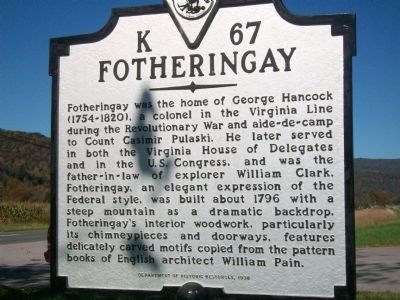
Fotheringay
Photographed by Kathy Walker, October 19, 2009
1. Fotheringay Marker
Erected 1998 by Department of Historic Resources. (Marker Number K-67.)
Topics and series. This historical marker is listed in these topic lists: Architecture • War, US Revolutionary. In addition, it is included in the Virginia Department of Historic Resources (DHR) series list. A significant historical year for this entry is 1796.
Location. 37° 11.45′ N, 80° 14.167′ W. Marker is in Elliston, Virginia, in Montgomery County. It is at the intersection of Roanoke Road (U.S. 11/460) and Graham Street, on the left when traveling east
this page online

Regionally, this marker is in Southwest Virginia, in the Blue Ridge Highlands, and in the New River Gorge. It is also in the American South, specifically in the Upper South, in Appalachia, and specifically in Southern Appalachia. Globally, it is in North America, the Western Hemisphere, the Western World, and the Anglosphere. Historically, it finds itself in what was once the territory of the Mississippian Culture, one of the original Thirteen Colonies, one of the Confederate States of America, and the Antebellum South.
Other nearby markers. At least 8 other markers are within 9 miles of this marker, measured as the crow flies: Fort Vause (approx. 2 miles away); American Revolution on the Frontier (approx. 2.9 miles away); Bow String Arch Truss (approx. 3.4 miles away); Montgomery White Sulphur Springs (approx. 3.4 miles away); The “Bowstring” Truss Bridge (approx. 3.4 miles away); Montgomery County / Roanoke County (approx. 3.8 miles
Photographed by Kathy Walker, October 19, 2009
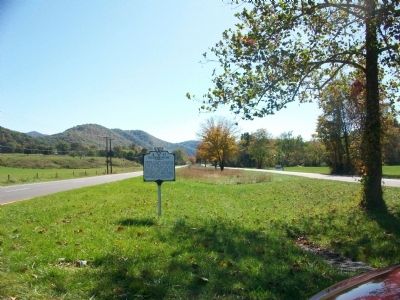
2. Fotheringay Marker
Looking south on Route 11
Also see . . . George Hancock from the Biographical Directory of the United States Congress. (Submitted on November 6, 2009, by Bill Pfingsten of Bel Air, Maryland.)
Credits. This page was last revised on November 24, 2025. It was originally submitted on October 31, 2009, by Kathy Walker of Stafford, Virginia. This page has been viewed 2,812 times since then and 112 times this year. Last updated on November 24, 2025, by Stephen Escalera of Roanoke, Virginia. Photos: 1, 2. submitted on October 31, 2009, by Kathy Walker of Stafford, Virginia. • Devry Becker Jones was the editor who published this page.
