Bellwood in Chesterfield County, Virginia — The American South (Mid-Atlantic)
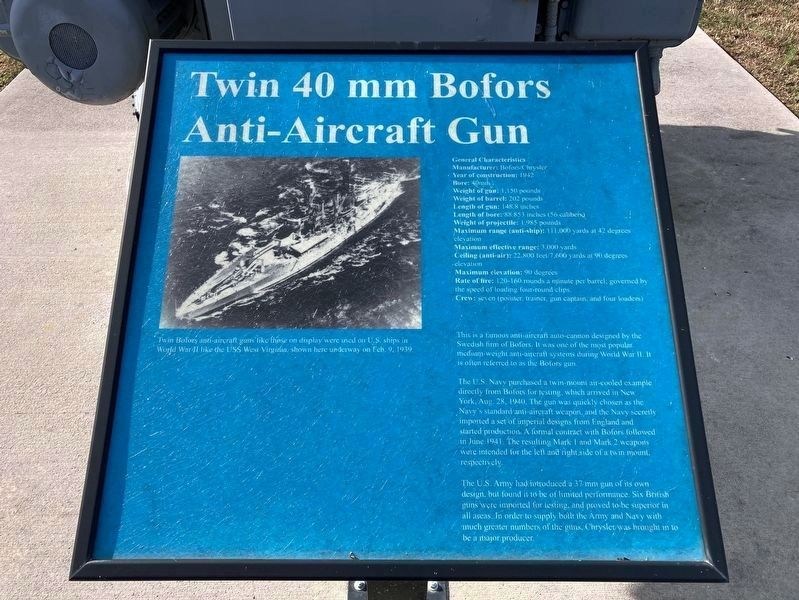
Twin 40 mm Bofors Anti-Aircraft Gun
circa November 2025
1. Twin 40 mm Bofors Anti-Aircraft Gun Marker
General Characteristics
Manufacturer: Bofors/Chrysler
Year of construction: 1942
Bore: 40mm
Weight of gun: 1,150 pounds
Weight of barrel: 202 pounds
Length of gun: 148.8 inches
Length of bore: 88.853 inches (56 calibers)
Weight of projectile: 1,985 pounds
Maximum range (anti-ship): 111,000 yards at 42 degrees elevation
Maximum effective range: 3,000 yards
Ceiling (anti-air): 22,800 feet/7,600 yards at 90 degrees elevation
Maximum elevation: 90 degrees
Rate of fire: 120-160 rounds a minute per barrel; governed by the speed of loading four-round clips.
Crew: seven (pointer, trainer, gun captain, and four loaders)
This is a famous anti-aircraft auto-cannon designed by the Swedish firm of Bofors. It was one of the most popular medium-weight anti-aircraft systems during World War II. It is often referred to as the Bofors gun.
The U.S. Navy purchased a twin-mount air-cooled example directly from Bofors for testing, which arrived in New York, Aug. 28, 1940. The gun was quickly chosen as the Navy's standard anti-aircraft weapon, and the Navy secretly imported a set of imperial designs from England and started
this page online
The U.S. Army had introduced a 37mm gun of its own design, but found it to be of limited performance. Six British guns were imported for testing, and proved to be superior in all areas. In order to supply both the Army and Navy with much greater numbers of the guns, Chrysler was brought in to be a major producer.
[Caption:]
Twin Bofors anti-aircraft guns like those on display were used on U.S. ships in World War II like the USS West Virginia, shown here underway on Feb. 9, 1939
Topics. This historical marker is listed in these topic lists: Industry & Commerce • War, World II. A significant historical month for this entry is June 1941.
Location. 37° 25.257′ N, 77° 26.945′ W. Marker is in Bellwood, Virginia, in Chesterfield County. It is on F Road 0.1 miles north of East Road, on the right when traveling south. Marker is on post at Defense Supply Center Richmond and is not accessible to civilians without sponsored access or authorized escort. Touch for map.
circa November 2025
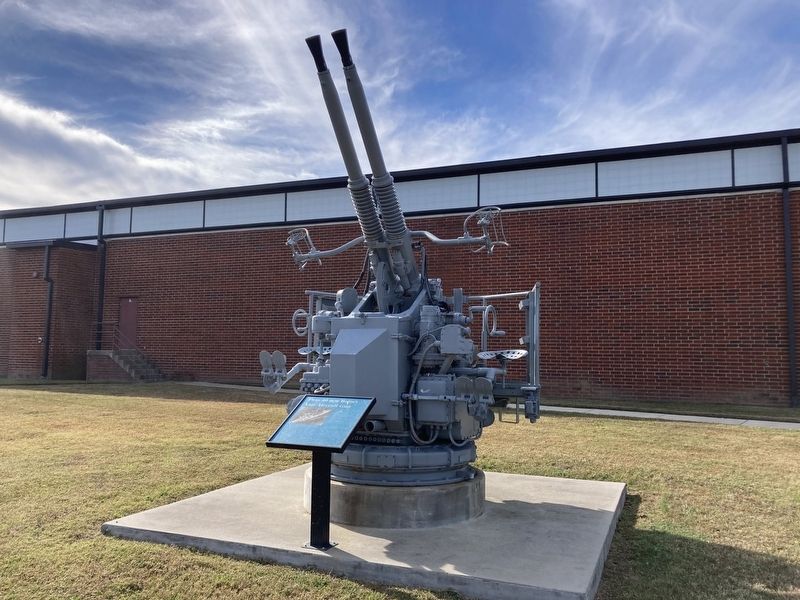
2. Twin 40 mm Bofors Anti-Aircraft Gun Marker & Display Weapons

Regionally, this marker is in the Piedmont, in Central Virginia, and in the Richmond Metropolitan Area. It is also in the American South, specifically in the Upper South, and on the Eastern Seaboard. Globally, it is in the North Atlantic Region, North America, the Western Hemisphere, the Western World, and the Anglosphere. Historically, it finds itself in what was once the territory of the Mississippian Culture, one of the original Thirteen Colonies, one of the Confederate States of America, and the Antebellum South.
Other nearby markers. At least 8 other markers are within walking distance of this marker: Standard U.S. Navy Stockless Anchor (within shouting distance of this marker); F-4 Phantom II (approx. 0.4 miles away); A-10 Thunderbolt II (approx. half a mile away); OH-58D Kiowa (approx. half a mile away); F-16 Fighting Falcon (approx. half a mile away); Our American Indian Ancestors (approx. half a mile away); African American Pioneers (approx. 0.6 miles away); World War II Memorial (approx. 0.6

circa November 1944
3. USS West Virginia 40mm Guns
This view shows the battleship equipped with 40mm guns in 1944. The mount locations have been circled in yellow. USS West Virginia used quad mount 40mm Bofors - four guns (really two pairs of two guns) all on the same mounting ring - rather than the twin mount displayed at DSC Richmond. Compare West Virginia's configuration at this juncture, in the first year of carrying the Bofors guns, to the 1939 photograph on the marker as an illustration of how massive the post-Pearl Harbor modifications to the ship were. This view also shows how numerous the 40mm Bofors came to be especially late in WWII. Post-war, it was supplanted by a twin 3-inch gun firing a heavier projectile to deal with the heavier, faster first-generation jet aircraft.
More about this marker. There are two major errors on the marker under the General Characteristics section. Firstly, the weight of the complete projectile round fired by the 40mm Bofors is only 4.75 pounds, not the 1,985 pounds given on the marker. It is physically impossible for a gun with a 40mm bore diameter to fire something that heavy. The projectile length alone would be impractical. Secondly, the maximum range for a Bofors gun at 42 degrees of elevation is 11,000 yards, not 111,000. For reference, the longest range direct-hit in naval history, by any gun, is somewhere between 26,500 and 28,000 yards, accomplished by the 16-inch (406mm) guns of battleship USS Massachusetts (BB-59) off the coast of Casablanca on 8 November 1942 against the French destroyer (contre torpilleur) Milan, which was manuevering at high speed when struck on her deck just to starboard of the superstructure with a plunging American shell. For a projectile ten times smaller, like a 40mm Bofors projectile, to reach 111,000 yards is simply impossible. There is insufficient propellant to generate the force needed to hurl such a light projectile that distance.
As a further technical note, the proper title for the marker should have been Twin 40 mm Bofors Anti-Aircraft Mount. There are two guns on the mount so labeling it as a "twin.... gun" is paradoxical. The weapon system shown is a twin mount featuring two 40mm Bofors guns.
Finally, the ship shown in the photograph does not carry 40mm Bofors in any capacity as shown; the US, as the marker indicates, had not even tested the Bofors gun in 1939 when that photo was taken. The battleship West Virginia would not receive 40mm Bofors until 1944, after repairs from the damage incurred in the Pearl Harbor attack. However, the 40mm was in widespread fleet use by late 1942 - largely serving as a direct replacement for the jam-prone 1.1" anti-aircraft gun quadruple mounts as soon as manufacturing capacity and shipyard availability allowed. It is interesting that a ship that did not mount the 40mm until late war was chosen to illustrate this marker, and further, to use a photo of it before it carried the 40mm, when there are thousands of photographs of ships carrying 40mm Bofors guns earlier and actually visible to the viewer.
Regarding Twin 40 mm Bofors Anti-Aircraft Gun. The 40mm Bofors was the intermediate layer of a three-layer anti-aircraft artillery strategy employed by the navy. The largest guns of the strategy were usually 5-inch (127mm), used to engage aircraft at long-range - primarily to disrupt formations, though with Variable-Timed (VT) fuses, better known as Proximity Fuses, introduced later in WWII, near-bursts of projectiles near distant aircraft could knock heavy planes out of the sky before ever coming into range of the intermediate layer. The intermediate layer was the 40mm, preceded by (and sometimes supplemented with) quadruple 1.1" (28mm) guns and succeeded by (and sometimes supplemented with) 3-inch (75mm) guns. All three of these intermediate-caliber systems were rapid firing and had projectiles heavy enough, theoretically, to cripple an aircraft or knock it down as it approached the ship. Should an aircraft get too close for the mount to be able to track (i.e., target moving faster than the mount could swivel and elevate), the last line of defense were small 20mm, .50-caliber, and .30-caliber machine guns incapable of doing anything beyond killing a pilot or disrupting an approach - in other words, incapable of destroying the plane. So, contrary to what the marker states, the 40mm Bofors was not THE standard anti-aircraft gun of the US Navy - it was one of several standard weapons that worked together to form a layered system of anti-aircraft defense.
Credits. This page was last revised on December 2, 2025. It was originally submitted on November 26, 2025. This page has been viewed 196 times since then and 124 times this year. Photos: 1, 2. submitted on November 26, 2025. 3. submitted on November 26, 2025, by Evan Dwyer of Richmond, Virginia. • Devry Becker Jones was the editor who published this page.
