Craig Township near Vevay in Switzerland County, Indiana — The American Midwest (Great Lakes)
Musee de Venoge
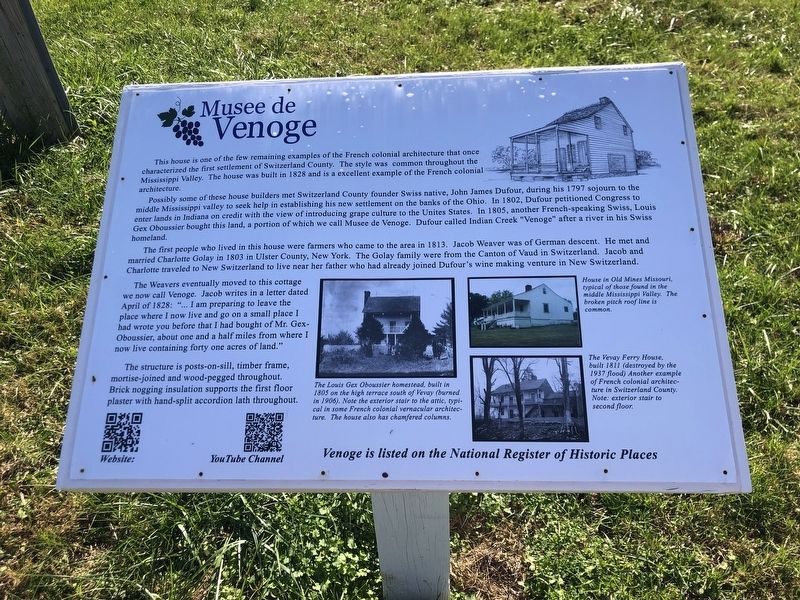
Photographed by Duane and Tracy Marsteller, November 3, 2025
1. Musee de Venoge Marker
Possibly some of these house builders met Switzerland County founder Swiss native, John James Dufour, during his 1797 sojourn to the middle Mississippi valley to seek help in establishing his new settlement on the banks of the Ohio. In 1802, Dufour petitioned Congress to enter lands in Indiana on credit with the view of introducing grape culture to the Unites [sic] States. In 1805, another French-speaking Swiss, Louis Gex Oboussier bought this land, a portion of which we call Musee de Venoge. Dufour called Indian Creek “Venoge” after a river in his Swiss homeland.
The first people who lived in this house were farmers who came to the area in 1813. Jacob Weaver was of German descent. He met and married Charlotte Golay in 1803 in Ulster County, New York. The Golay family were from the Canton of Vaud in Switzerland. Jacob
this page online
The Weavers eventually moved to this cottage. we now call Venoge. Jacob writes in a letter dated April of 1828: “… I am preparing to leave the place where I now live and go on a small place 1 had wrote you before that I had bought of Mr. Gex- Oboussier, about one and a half miles from where I now live containing forty one acres of land.”
The structure is posts-on-sill, timber frame, mortise-joined and wood-pegged throughout. Brick nogging insulation supports the first floor plaster with hand-split accordion lath throughout.
Photo captions (clockwise from left)
• The Louis Gex Oboussier homestead, built in 1805 on the high terrace south of Vevay (burned in 1906). Note the exterior stair to the attic, typical in some French colonial vernacular architecture. The house also has chamfered columns.
• House in Old Mines, Missouri, typical of those found in the middle Mississippi Valley. The broken pitch roof line is common.
• The Vevay Ferry House, built 1811 (destroyed by the 1937 flood). Another example of French colonial architecture in Switzerland County. Note: exterior stair to second floor.
Venoge

Photographed by Duane and Tracy Marsteller, November 3, 2025
2. Musee de Venoge Marker
Featured marker is on the left.
Topics and series. This historical marker is listed in these topic lists: Architecture • Settlements & Settlers. In addition, it is included in the National Register of Historic Places (NRHP) series list. A significant historical month for this entry is April 1828.
Location. 38° 44.722′ N, 85° 5.832′ W. Marker is near Vevay, Indiana, in Switzerland County. It is in Craig Township. It is on Indiana 129 0.2 miles east of Detour Road, on the right when traveling east. Touch for map. Marker is at or near this postal address: 4085 IN-129, Vevay IN 47043, United States of America. Touch for directions.

Regionally, this marker is in Southern Indiana. It is also in the American Midwest, in the Ohio River Valley, and in the Corn Belt. Globally, it is in North America, the Western Hemisphere, the Western World, and the Anglosphere. Historically, it finds itself in what was once the territory of the Mississippian Culture and also the Northwest Territory.
Other nearby markers. At least 8 other markers are within 2 miles of this marker, measured as the crow flies: Venoge Farmstead (here, next to this marker); Jean-Daniel Morerod House – 1817 (approx. 1.2 miles away); Detraz House (approx. 1.3 miles away); Early Church - 1834 (approx. 1.4 miles away); Historic Fire Bells (approx. 1.4 miles away); Hall House (approx. 1.4 miles away); Hall House - 1842 (approx. 1.4 miles away); Roxy House - 1814 (approx. 1½ miles away). Touch for a list and map of all markers in Vevay.
Also see . . . Venoge Farmstead. National Register of Historic Places nomination (PDF) and photographs (separate PDF) of the property, which was listed in 1997. (Nomination prepared by Thomas R Weaver, Musee de Venoge, Inc.; Photographs taken by Donna Weaver and Thomas Weaver; via National Park Service) (Submitted on December 10, 2025, by Duane and Tracy Marsteller of Murfreesboro, Tennessee.)
Credits. This page was last revised on December 10, 2025. It was originally submitted on November 27, 2025, by Duane and Tracy Marsteller of Murfreesboro, Tennessee. This page has been viewed 68 times since then and 33 times this year. Photos: 1, 2. submitted on November 27, 2025, by Duane and Tracy Marsteller of Murfreesboro, Tennessee.
