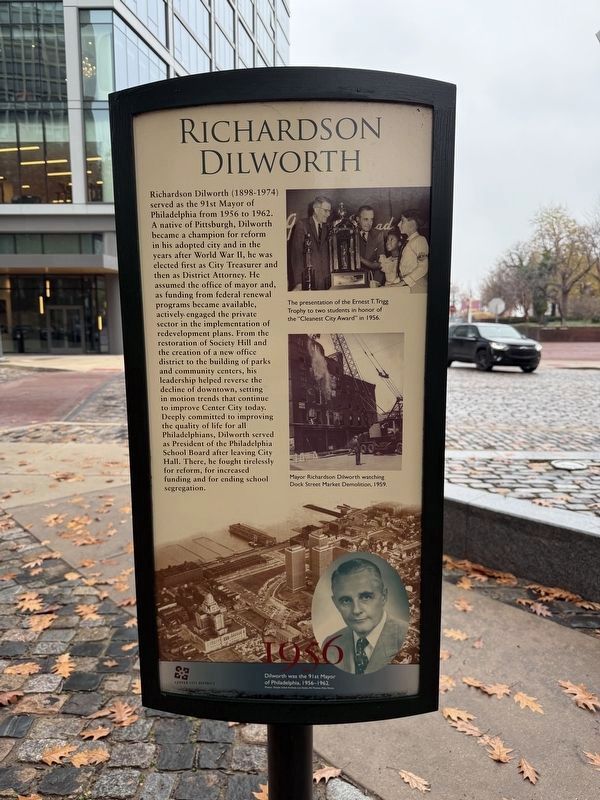
Richardson Dilworth 1956. Richardson Dilworth (1898-1974) served as the 91st Mayor of Philadelphia from 1956 to 1962. A native of Pittsburgh, Dilworth became a champion for reform in his adopted city and in the years after World War II, he was elected first as City Treasurer and then as District Attorney. He assumed the office of mayor and, as funding from federal renewal programs became available, actively engaged the private sector in the implementation of redevelopment plans. From the restoration of Society Hill and the creation of a new office district to the building of parks and community centers, his leadership helped reverse the decline of downtown, setting in motion trends that continue to improve Center City today. Deeply committed to improving the quality of life for all Philadelphians, Dilworth served as President of the Philadelphia School Board after leaving City Hall. There, he fought tirelessly for reform, for increased funding and for ending school segregation., [Captions:] The presentation of the Ernest T. Trigg Trophy to two students in honor of the "Cleanest City Award" in 1956., Mayor Richardson Dilworth watching Dock Street Market Demolition, 1959., Dilworth was the 91st Mayor of Philadelphia, 1956-1962. ,
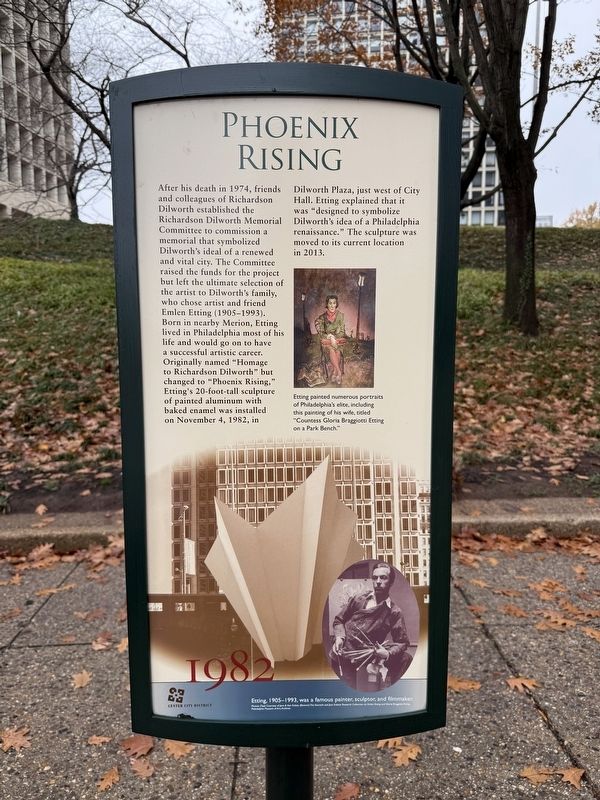
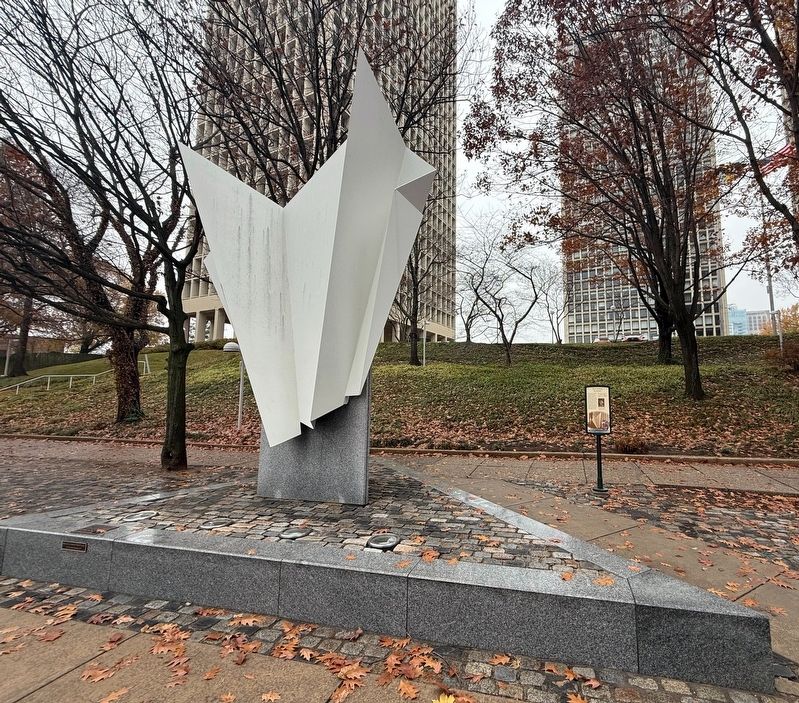
Phoenix Rising 1982. After his death in 1974, friends and colleagues of Richardson Dilworth established the Richardson Dilworth Memorial Committee to commission a memorial that symbolized Dilworth's ideal of a renewed and vital city. The Committee raised the funds for the project but left the ultimate selection of the artist to Dilworth's family, who chose artist and friend Emlen Etting (1905-1993). Born in nearby Merion, Etting lived in Philadelphia most of his life and would go on to have a successful artistic career. Originally named "Homage or Richardson Dilworth" but changed to "Phoenix rising," Etting's 20-foot-tall sculpture of painted aluminum with baked enamel was installed on November 4, 1982, in Dilworth Plaza, just west of City Hall. Etting explained that it was "designed to symbolize Dilworth's idea of a Philadelphia renaissance." The sculpture was moved to its current location in 2013., [Captions:] Etting painted numerous portraits of Philadelphia's elite, including this painting of his wife, titled "Countess Gloria Braggiotti Etting on a Park Bench.", Etting, 1905-1993, was a famous painter, sculptor, and filmmaker.
Richardson Dilworth
1956
Richardson Dilworth (1898-1974) served as the 91st Mayor of Philadelphia from 1956 to 1962. A native of Pittsburgh, Dilworth became a champion for reform in his adopted city and in the years after World War II, he was elected first as City Treasurer and then as District Attorney. He assumed the office of mayor and, as funding from federal renewal programs became available, actively engaged the private sector in the implementation of redevelopment plans. From the restoration of Society Hill and the creation of a new office district to the building of parks and community centers, his leadership helped reverse the decline of downtown, setting in motion trends that continue to improve Center City today. Deeply committed to improving the quality of life for all Philadelphians, Dilworth served as President of the Philadelphia School Board after leaving City Hall. There, he fought tirelessly for reform, for increased funding and for ending school segregation.
[Captions:]
The presentation of the Ernest T. Trigg Trophy to two students in honor of the "Cleanest City Award" in 1956.
Mayor Richardson Dilworth watching Dock Street Market Demolition, 1959.
Dilworth was the 91st Mayor of Philadelphia, 1956-1962.
Phoenix Rising
1982
After
Click or scan to see this page online
his death in 1974, friends and colleagues of Richardson Dilworth established the Richardson Dilworth Memorial Committee to commission a memorial that symbolized Dilworth's ideal of a renewed and vital city. The Committee raised the funds for the project but left the ultimate selection of the artist to Dilworth's family, who chose artist and friend Emlen Etting (1905-1993). Born in nearby Merion, Etting lived in Philadelphia most of his life and would go on to have a successful artistic career. Originally named "Homage or Richardson Dilworth" but changed to "Phoenix rising," Etting's 20-foot-tall sculpture of painted aluminum with baked enamel was installed on November 4, 1982, in Dilworth Plaza, just west of City Hall. Etting explained that it was "designed to symbolize Dilworth's idea of a Philadelphia renaissance." The sculpture was moved to its current location in 2013.
[Captions:]
Etting painted numerous portraits of Philadelphia's elite, including this painting of his wife, titled "Countess Gloria Braggiotti Etting on a Park Bench."
Etting, 1905-1993, was a famous painter, sculptor, and filmmaker.
Erected by Center
Photographed by Devry Becker Jones (CC0), November 26, 2025
2. Phoenix Rising side of the marker
City District.
Topics. This historical marker is listed in these topic lists: Arts, Letters, Music • Government & Politics. A significant historical date for this entry is November 4, 1982.
Location. 39° 56.722′ N, 75° 8.639′ W. Marker is in Philadelphia, Pennsylvania, in Philadelphia County. It is in Society Hill. It is at the intersection of Dock Street and 38th Parallel Place, on the right when traveling south on Dock Street. Touch for map. Marker is at or near this postal address: 285 St James Pl, Philadelphia PA 19106, United States of America. Touch for directions.
Regionally, this marker is in Southeast Pennsylvania. It is also in the American Northeast and in the Mid-Atlantic. Globally, it is in North America, the Western Hemisphere, the Western World, and the Anglosphere. Historically, it finds itself in what was once the Haudenosaunee (Iroquois) Confederacy, New Netherland, and one of the original Thirteen Colonies.
Credits. This page was last revised on November 28, 2025. It was originally submitted on November 28, 2025, by Devry Becker Jones of Washington, District of Columbia. This page has been viewed 51 times since then and 20 times this year. Photos:1, 2, 3. submitted on November 28, 2025, by Devry Becker Jones of Washington, District of Columbia.