Palacio in Madrid, Spain — Southwestern Europe (Iberian Peninsula)
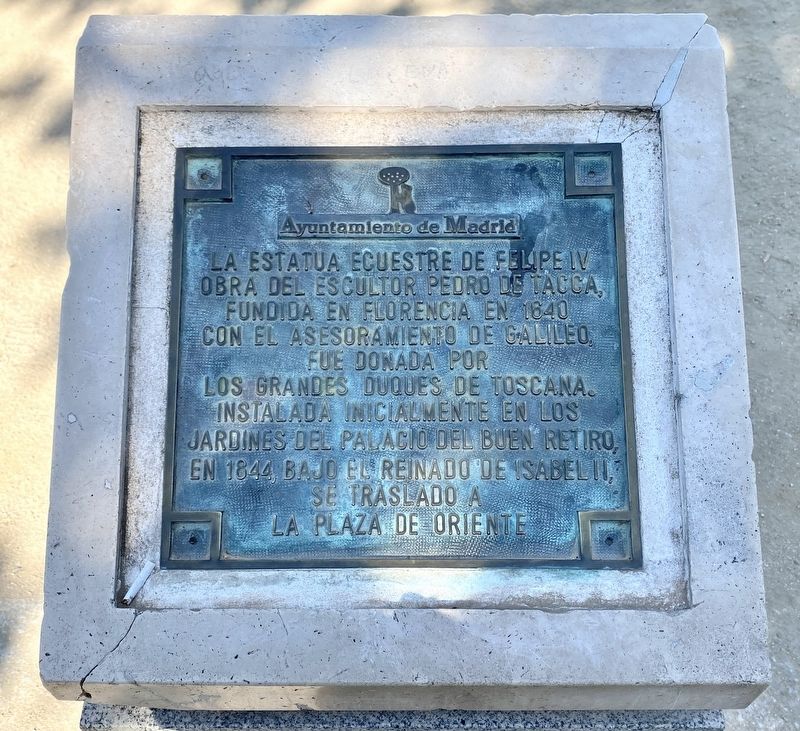
La Estatua Ecuestre de Felipe IV
⎯⎯⎯
Equestrian Statue of Philip IV
Photographed by Andrew Ruppenstein, April 18, 2022
1. La Estatua Ecuestre de Felipe IV / Equestrian Statue of Philip IV Marker

Instalada inicialmente en los jardines del Palacio del Buen Retiro, en 1844, bajo el reinado de Isabel II se traslado a la Plaza de Oriente
Erected by Ayuntamiento de Madrid.
Topics. This historical marker is listed in this topic list: Arts, Letters, Music. A significant historical year for this entry is 1640.
Location. 40° 25.1′ N, 3° 42.712′ W. Marker is in Madrid. It is in Palacio. It is on Plaza de Oriente, in the median. Touch for map. Marker is in this post office area: Madrid 28013, Spain. Touch for directions.

Regionally, it is in the North Atlantic Region, in Europe, in the European Union, in Atlantic Europe,
this page online
Other nearby markers. At least 8 other markers are within walking distance of this marker: Julian Gayarre (within shouting distance of this marker); José Cubiles (within shouting distance of this marker); Vicente Huidobro (within shouting distance of this marker); Juan Bautista Sachetti (within shouting distance of this marker); Juan Gómez de Mora (about 90 meters away, measured in a direct line); Monumento al Cabo Noval / Monument to Corporal Noval (about 90 meters away); El 2 de Mayo de 1808 (about 120 meters away); Puerta de Valnadú / Valnadú Gate (about 120 meters away). Touch for a list and map of all markers in Madrid.
Also see . . . Monument to Philip IV of Spain (Wikipedia). Excerpt:
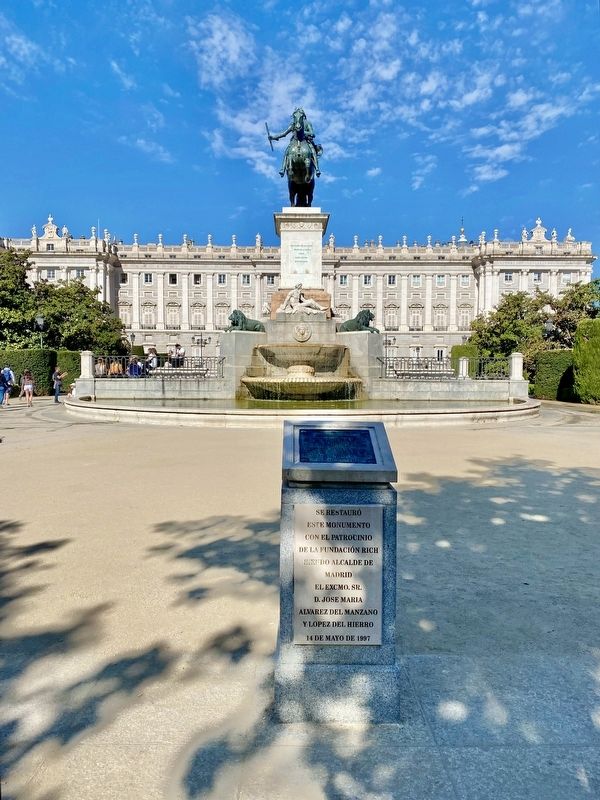
The Monument to Philip IV or Fountain of Philip IV is a memorial to Philip IV of Spain in the centre of Plaza de Oriente in Madrid, Spain. It was raised at the insistence of Isabella II of Spain in the first half of the 19th century, opening on 17 November(Submitted on December 1, 2025.)1843, a year before Narciso Pascual y Colomer came up with the square's final layout. However, its equestrian statue of the king dates to the 17th century and was produced by the Italian sculptor Pietro Tacca. It was begun in 1634 and shipped to Madrid in 1640, the year of his death. The sculpture, atop a complicated fountain composition, forms the centerpiece of the façade of the Royal Palace. The statue was based in drawings by Diego Velázquez and a bust by Juan Martínez Montañés (who also collaborated on the work). The daring stability of the statue was calculated by Galileo Galilei: the horse rears, and the entire weight of the sculpture balances on the two rear legs—and, discreetly, its tail— a feat that had never been attempted in a figure on a heroic scale, of which Leonardo had dreamed.Photographed by Andrew Ruppenstein, April 18, 20222. Equestrian Statue of Philip IV Marker - wide viewThe marker is visible here on top of a low cement monument, with the equestrian statue directly behind it, and the Palacio Real forming the background. The lower panel on the monument notes that the monument was restored in 1997 with the aid of the Fundación Rich.
Photographed by Andrew Ruppenstein, April 18, 2022
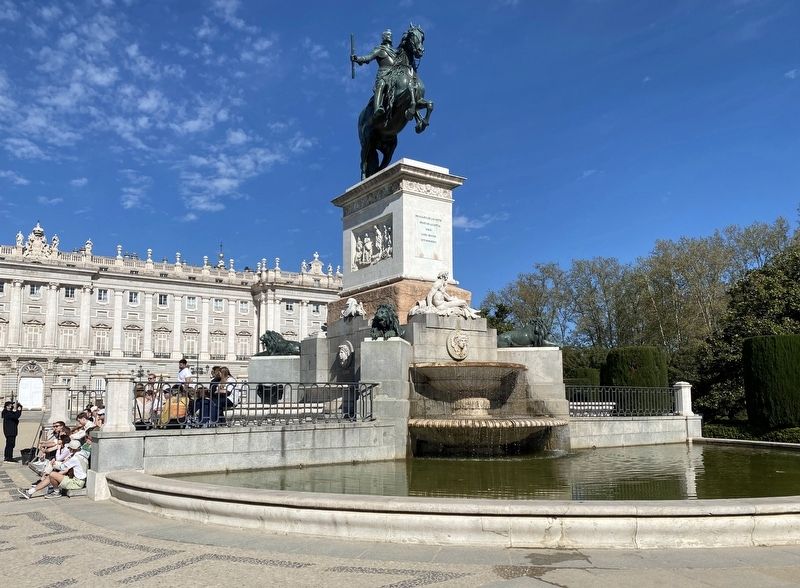
3. Equestrian Statue of Philip IV - three-quarters view
Photographed by Andrew Ruppenstein, April 18, 2022
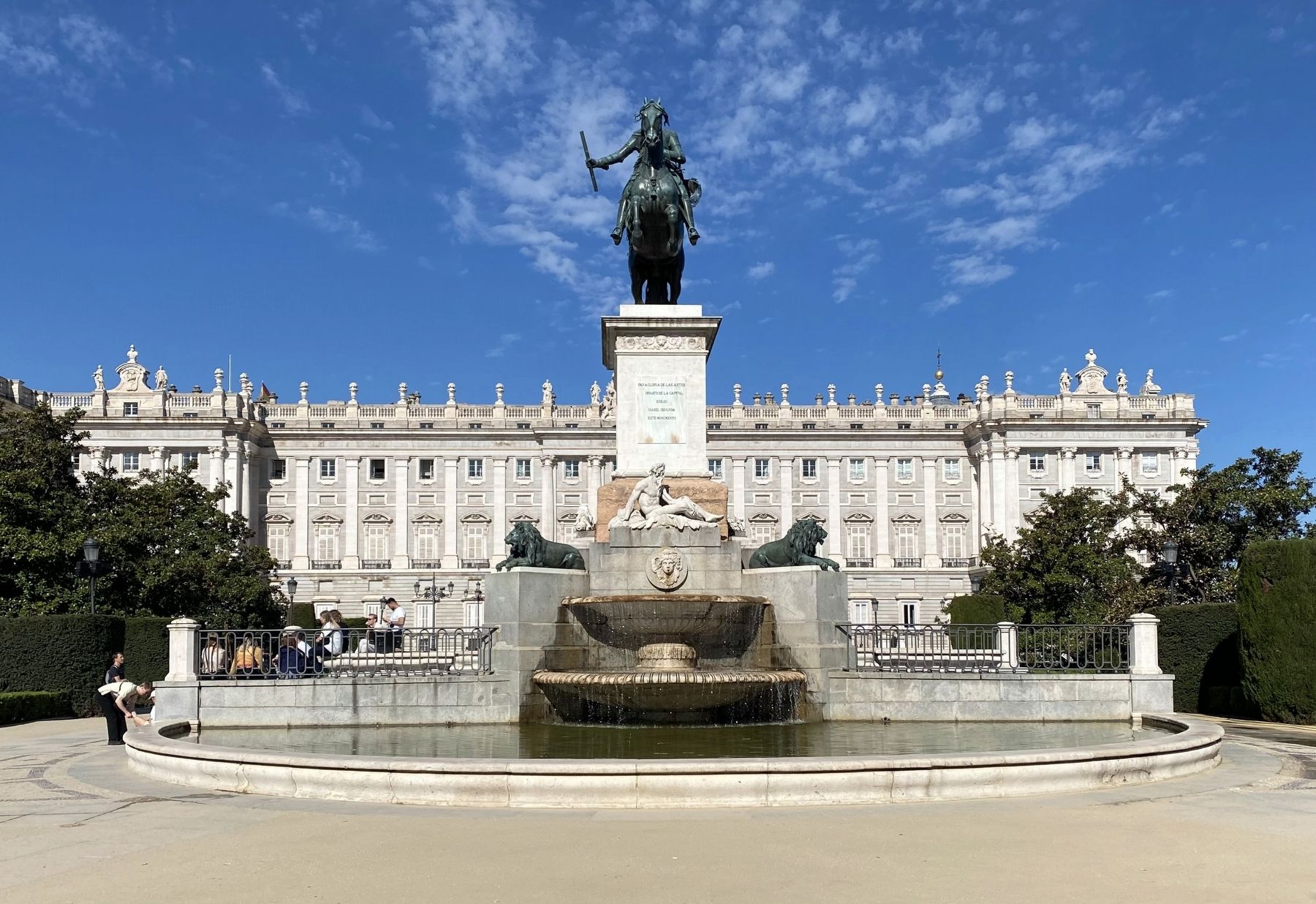
4. La Estatua Ecuestre de Felipe IV / Equestrian Statue of Philip IV
Credits. This page was last revised on December 1, 2025. It was originally submitted on December 1, 2025, by Andrew Ruppenstein of Lamorinda, California. This page has been viewed 143 times since then and 112 times this year. Photos: 1, 2, 3, 4. submitted on December 1, 2025, by Andrew Ruppenstein of Lamorinda, California.
