North Capitol Hill in Denver in Denver County, Colorado — The American Mountains (Southwest)
Once the Site of Cathedral School

Photographed by Cosmos Mariner, July 25, 2021
1. Once the Site of Cathedral School Marker
This site was once the home of the Cathedral Grade School. The building was designed by renowned Denver architect Frank Edbrooke in the Classic Romanesque style. It was built in 1891, suffered a devastating fire in 1955, and was completely remodeled including a high school addition. It stood proudly until its closing in 1965, and its demolition by the archdiocese in 2006. Hundreds of children attended the school and walked the stage as high school graduates. The current structure is a nod to the beautiful architecture and colorful history that continues to make Uptown Denver the most authentic neighborhood in the city.
Erected by One City Block.
Topics. This historical marker is listed in these topic lists: Architecture • Education. A significant historical year for this entry is 1891.
Location. 39° 44.7′ N, 104° 58.924′ W. Marker is in Denver, Colorado, in Denver County. It is in North Capitol Hill. It is at the intersection of East 18th Avenue and Logan Street, on the right when traveling west on East 18th Avenue. The marker is on the south facade of the building at the northeast corner of the intersection. Touch for map. Marker is at or near this postal address: 1800 Logan Street, Denver CO 80203, United States of America. Touch for directions.

Regionally, this marker is in the Front Range. It is also in the American Mountain West. Globally, it is in North America, the Rocky Mountains, the Western Hemisphere, the Western World, and the Anglosphere. Historically, it finds itself in what was once the Louisiana Purchase.
Other nearby markers. At least 8 other markers are within walking distance of this marker: The Arno Apartments (within shouting distance of this marker); The Birth of Denver Mass Transit (approx. 0.3 miles away); Gridlock (approx. 0.3 miles away); Menu for the Brown Palace
this page online
Also see . . . Frank E. Edbrooke (History Colorado).
(by Thomas J. Noel) Excerpt: Frank E. Edbrooke (1841–1921), Colorado’s best-known and most-celebrated architect, designed more than seventy buildings, including many now-landmarked structures that helped define Denver’s built environment. He gave the city its first fine commercial buildings while also designing institutional and domestic architecture. Edbrooke introduced new styles and techniques to the city, from the steel-frame, Richardsonian Romanesque–style Brown Palace Hotel (1892) to his own Queen Anne–inspired residence at 931 East 17th Avenue (1889).(Submitted on December 4, 2025, by Cosmos Mariner of Cape Canaveral, Florida.)
Edbrooke became Colorado’s premier architect of the late nineteenth century and early twentieth. He was a founding member of the Colorado chapter of the American Institute of Architects, and hisarchitectural firm, F. E. Edbrooke & Co., was the largest in the state. Edbrooke used local red sandstone, granite, and brick to create massive yet graceful Richardsonian Romanesque structures. 2. Marker detail: Cathedral School
Of Edbrooke’s surviving works, some of the best known are Brown Palace Hotel (1892), Central Presbyterian Church (1892), Denver Dry Goods (1889), Loretto Heights Academy (1891), the Denver Masonic Temple (1889), and the Oxford Hotel (1890), all in Denver; as well as the Toltec Hotel (1911) in Trinidad and the Ouray County Courthouse (1888). Edbrooke retired in 1915 and died on May 21, 1921, in Glendale, California. He is buried in Denver’s Fairmount Cemetery in a neoclassical mausoleum he designed.

Photographed by Cosmos Mariner, July 25, 2021
3. Once the Site of Cathedral School Marker
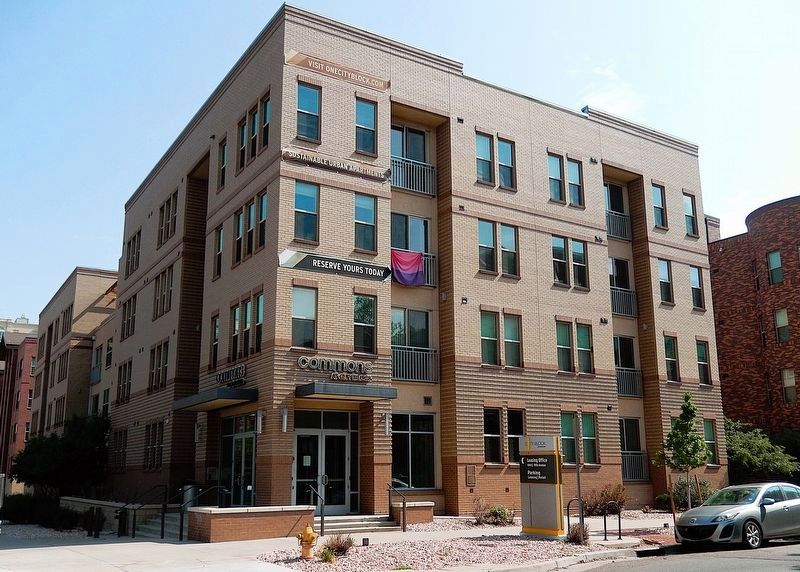
The marker is mounted at eye level on the south façade of the apartment building at this location today. It is near the right side of the southwest corner entrance.
Photographed by Cosmos Mariner, July 25, 2021
4. Commons at City Block
The apartment building at the former site of Cathedral School.
Credits. This page was last revised on December 4, 2025. It was originally submitted on December 3, 2025, by Cosmos Mariner of Cape Canaveral, Florida. This page has been viewed 96 times since then and 41 times this year. Photos: 1, 2, 3, 4. submitted on December 4, 2025, by Cosmos Mariner of Cape Canaveral, Florida.
