Saint-Denis in Seine-Saint-Denis, Île-de-France, France — Western Europe
Draps et Teintures
⎯⎯⎯
Cloths and Dyes
Photographed by Andrew Ruppenstein, April 18, 2024
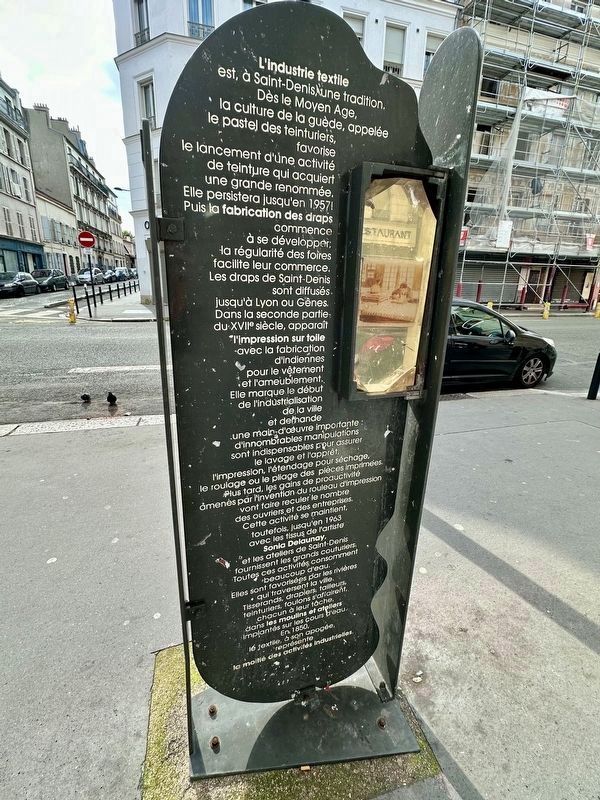
1. Draps et Teintures / Cloths and Dyes Marker - French side I

L'industrie textile est, à Saint-Denis une tradition. Dès le Moyen Age, la culture de la guède, appelée le pastel des teinturiers, favorise le lancement d'une activité de teinture qui acquiert une grande renommée. Elle persistera jusqu'en 1957!
Puis la fabrication des draps commence à se développer: la régularité des foires facilite leur commerce. Les draps de Saint-Denis sont diffusés, jusqu'à Lyon ou Gênes. Dans la seconde partie du XVIIe siècle, apparaît l'impression sur toile avec la fabrication d'indiennes pour le vêtement et l'ameublement. Elle marque le début de l'industrialisation de la ville et demande une main-d'oeuvre importante: d'innombrables manipulations sont indispensables pour assurer le lavage et l'apprêt, l'impression, l'étendage pour séchage, le roulage ou le pliage des pièces imprimées. Plus tard, les gains de productivité amenés par l'invention du rouleau d'impression vont faire reculer le nombre des ouvriers et des entreprises. Cette activité se maintient, toutefois, jusqu'en 1963. avec les tissus de l'artiste Sonia Delaunay, et les
this page online
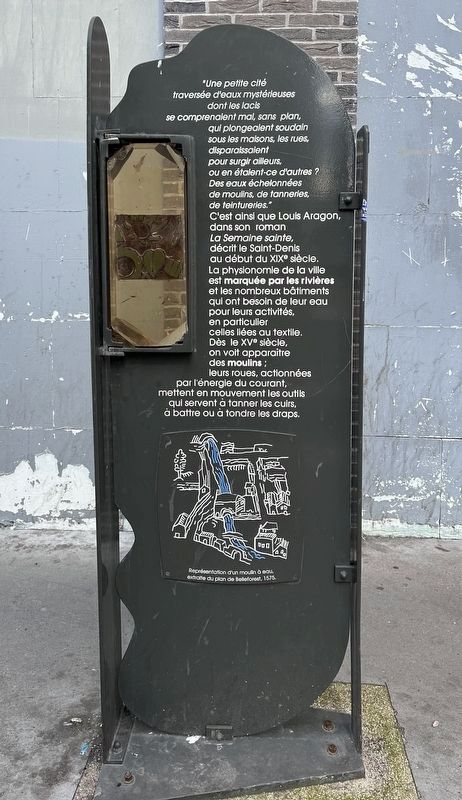
"Une petite cité traversée d'eaux mystérieuses dont les lacis se comprenaient mal, sans plan, qui plongeaient soudain sous les maisons, les rues, disparaissaient pour surgir ailleurs, ou en étaient-ce d'autres? Des eaux échelonnées de moulins, de tanneries, de teintureries."
C'est ainsi que Louis Aragon, dans son roman La Semaine sainte, décrit le Saint-Denis au début du XIXe siècle. La physionomie de la ville est marquée par les rivières et les nombreux bâtiments qui ont besoin de leur eau pour leurs activités, en particulier celles liées au textile. Dès le XVe siècle, on voit apparaître des moulins; leurs roues, actionnées par l'énergie du courant, mettent en mouvement les outils qui servent à tanner les cuirs, à battre
Photographed by Andrew Ruppenstein, April 18, 2024
2. Draps et Teintures / Cloths and Dyes Marker - French Side II
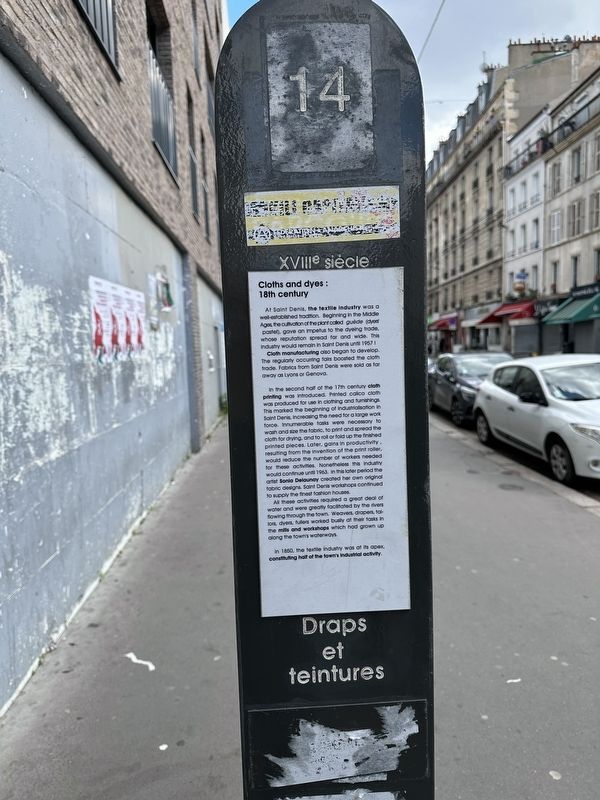
At Saint Denis, the textile industry was a well-established tradition. Beginning in the Middle Ages, the cultivation of the plant called guéde (dyers pastel), gave an impetus to the dyeing trade, whose reputation spread far and wide. This Industry would remain in Saint Denis until 1957!
Cloth manufacturing also began to develop. The regularly occurring fairs boosted the cloth trade. Fabrics from Saint Denis were sold as far away as Lyons or Genova.
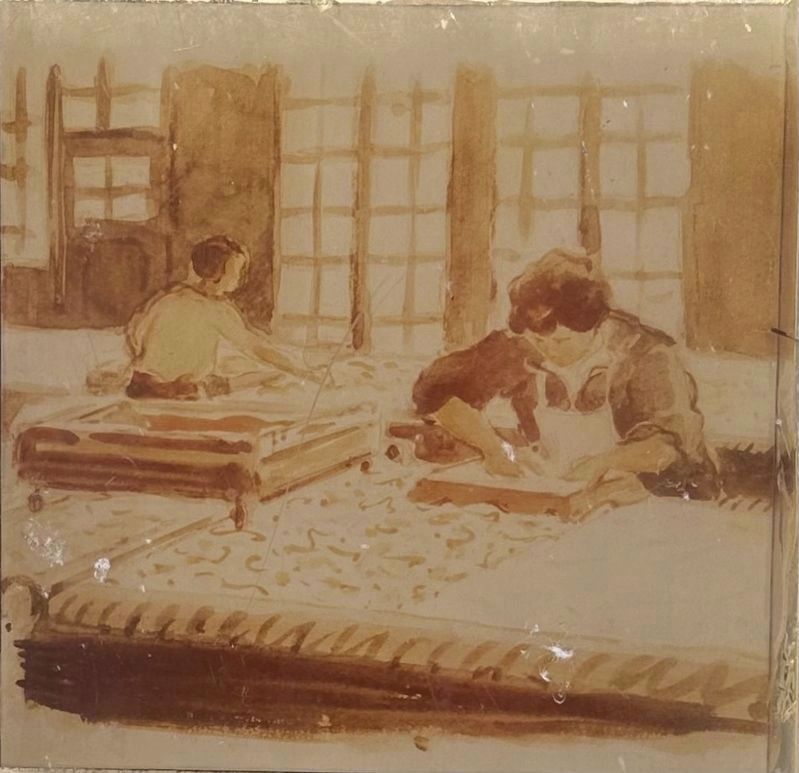
In the second half of the 17th century cloth printing was introduced. Printed calico cloth was produced for use in clothing and furnishings. This marked the beginning of industrialisation in Saint Denis, increasing the need for a large work force. Innumerable tasks were necessary to wash and size the fabric, to print and spread the cloth for drying, and to roll or fold up the finished printed pieces. Later, gains in productivity. resulting from the invention of the print roller, would reduce the number of workers needed for these activities. Nonetheless this industry would continue until 1963. In this later period the artist Sonia Delaunay created her own original fabric designs. Saint Denis workshops continued to supply the finest fashion houses.
All these activities required a great deal of water and were greatly facilitated by the rivers flowing through the town. Weavers, drapers, tailors, dyers, fullers worked busily at their tasks in the mills and workshops which had grown up along the town's waterways.
In 1850, the textile industry was at its apex, constituting half of the town's Industrial activity.
"A little city criss-crossed by mysterious waters creating incomprehensible, unstructured mazes, waters suddenly disappearing, plunging under houses and streets, only to reappear elsewhere. Or were those the same rivers? Waters punctuated by mills, tanneries and dyers'workshops."
This
Photographed by Andrew Ruppenstein, April 18, 2024
3. Draps et Teintures / Cloths and Dyes Marker - English Side
(Marker Number 14.)
Topics. This historical marker is listed in this topic list: Industry & Commerce. A significant historical year for this entry is 1963.
Location. 48° 55.889′ N, 2° 21.373′ E. Marker is in Saint-Denis, Île-de-France, in Seine-Saint-Denis. It is at the intersection of Rue Gabriel Péri and Rue des Carmélites, on the right when traveling north on Rue Gabriel Péri. Touch for map. Marker is at or near this postal address: 16 Rue Gabriel Péri, Saint-Denis, Île-de-France 93200, France. Touch for directions.

Regionally, it is in the North Atlantic Region, Europe, the European Union, Atlantic Europe, the Schengen Area, Western Europe, a coastal Mediterranean
4. Marker illustration
Other nearby markers. At least 8 other markers are within walking distance of this marker: Porte de Paris (about 120 meters away, measured in a direct line); L’orphenilat Génin / The Génin Orphanage (about 180 meters away); L’église Sainte-Croix (about 210 meters away); La Maison Aux Masques (approx. 0.3 kilometers away); École elementaire Jean Vilar Deported Jewish Students Memorial (approx. 0.3 kilometers away); La Mairie / City Hall (approx. half a kilometer away); Jardin Pierre-de-Montreuil (approx. half a kilometer away); L’église des Trois-Patrons (approx. 0.6 kilometers away). Touch for a list and map of all markers in Saint-Denis.
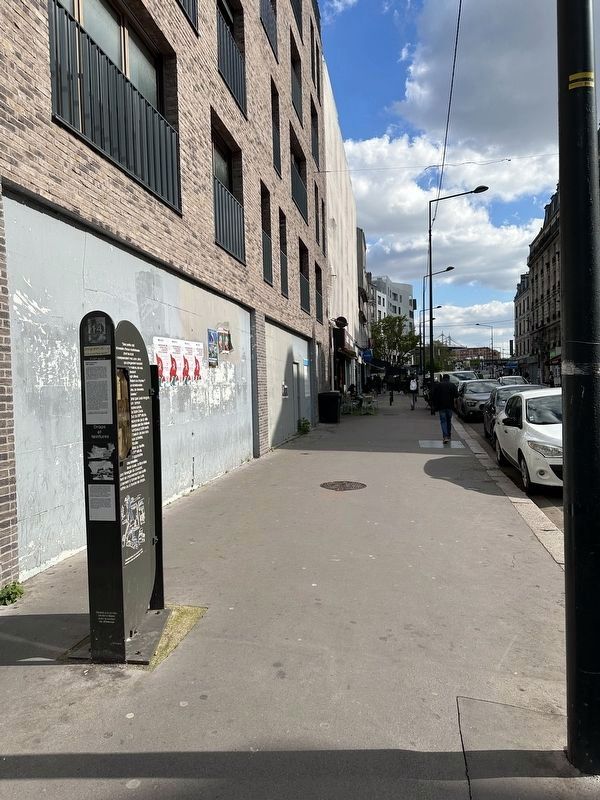
Photographed by Andrew Ruppenstein, April 18, 2024
5. Draps et Teintures / Cloths and Dyes Marker - wide view
The marker is 3-sided, with an English side (visible here), and two French sides.
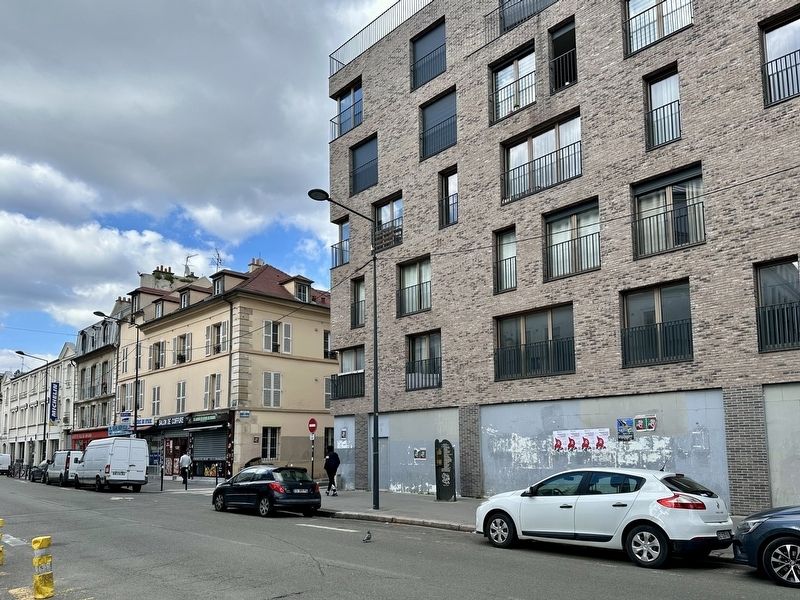
Photographed by Andrew Ruppenstein, April 18, 2024
6. Draps et Teintures / Cloths and Dyes Marker - wide view
Credits. This page was last revised on December 6, 2025. It was originally submitted on December 5, 2025, by Andrew Ruppenstein of Lamorinda, California. This page has been viewed 32 times since then and 13 times this year. Photos: 1. submitted on December 5, 2025, by Andrew Ruppenstein of Lamorinda, California. 2. submitted on December 6, 2025, by Andrew Ruppenstein of Lamorinda, California. 3. submitted on December 5, 2025, by Andrew Ruppenstein of Lamorinda, California. 4, 5, 6. submitted on December 6, 2025, by Andrew Ruppenstein of Lamorinda, California.
